The Index Investor
July 2020
Tactical Asset Allocation Implications of Our Forecasts
Forecast Logic
Forecast Pre-Mortem Analysis
Combining and Extremizing Forecasts to Improve Predictive Accuracy
Feature Article: Can The US Successfully Meet the Threat Posed by Worsening Inequality?
High Value Information Observed Last Month
- Technology
- Energy and Environment
- Health and Disease
- Economy
- National Security
- Society
- Politics
- Financial Markets and Investor Behavior
Critical System Thresholds/Tipping Points Analysis
Appendix: Anticipatory Thinking and Forecasting Methodologies
Current Macro Forecast
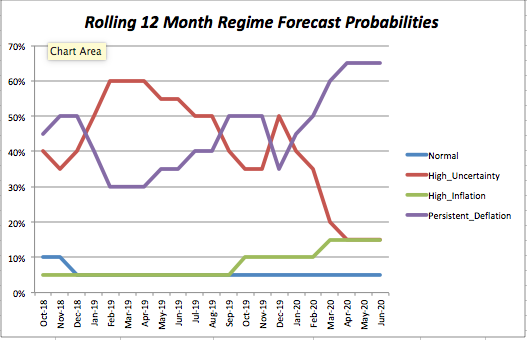
This month we saw more evidence that equity investors have underestimated the underlying damage COVID19 has done to the demand side of the US economy (which will quickly become even more apparent if the US Congress fails to pass another stimulus bill to support middle and lower income households).
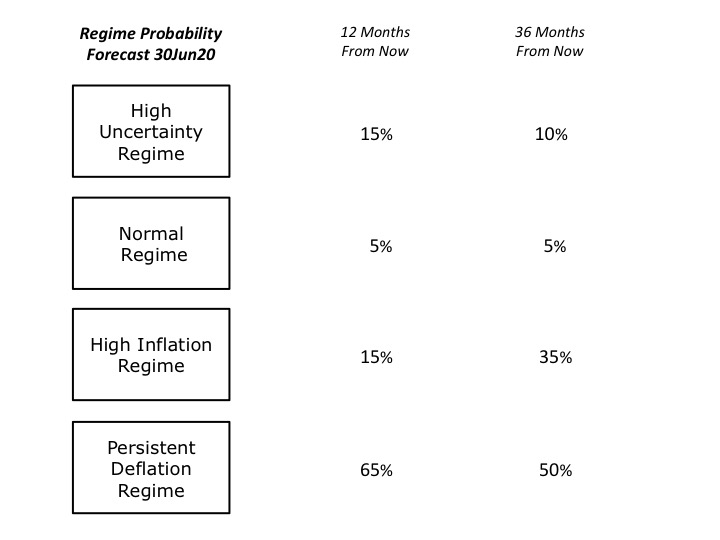
We have made no change to our 36-month regime forecasts. The probability the United States will be in the Persistent Deflation Regime remains 50%.
This forecast still rests on three assumptions. The first is that the increasing headwinds that were restraining aggregate demand growth before the devastating arrival of the COVID-19 pandemic either have not improved or are worsening. These include population aging, weak productivity growth, declining labor share of GDP, high levels of both inequality and debt, and the growing threat of job displacement as increasingly capable automation and artificial intelligence technologies are deployed.
The second assumption is that COVID19’s unprecedented demand and supply shocks have substantially worsen corporate and household debt servicing problems, and will lead to rising defaults, bankruptcies, and liquidations that will have a deflationary impact. We already see evidence of this in rising delinquencies and bankruptcy filings.
The third assumption is that the weak recovery of demand, accelerating debt problems, continued increase in tensions with China, and increasing domestic tensions in the United States between now and the November election will keep uncertainty higher than most people currently expect, which will further depress aggregate demand relative to supply and cause price declines in many sectors.
Our 36-month forecast probability for being in the High Inflation Regime remains at 35%.
Whether the High Inflation Regime comes to pass will depend on the interaction between COVID19’s shocks to demand and supply, along with even more important political factors.
We know that the demand shock has been swift and severe, and has triggered falls in the US Consumer Price Index. Current evidence leads to the conclusion that depressed demand may last longer than many expect. The longer it takes to develop and deploy an effective vaccine, more layoffs will occur, more bankruptcies will take place, and the long term impact of uncertainty will be stronger. All of these depress consumption, investment, and export demand. If supply remained constant, this would tend to decrease rather than increase prices.
However, COVID19 has also been a shock to aggregate supply; many past episodes of high inflation were caused by such shocks (e.g., oil supply cutbacks in 1973 and 1979). In June, the US Consumer Price Index reversed its recent three months of decline, and increased by 0.6%. This was primarily driven by a 5.1% increase in energy prices, which reflected the interaction of a modest increase in demand as quarantines were lifted with a much larger reduction in supply.
On balance, we continue to believe that the impact of demand destruction will outweigh the impact of supply reduction.
In our view, the most logical cause of a return to the High Inflation regime over the next 36 months would be a crisis of confidence in the US government and/or economy that causes a flight from the US dollar and a sharp rise in the price of imported goods (and very likely gold as well).
The most likely cause of such a crisis is an attempt by Donald Trump to disrupt the November election or his refusal to leave office if he id defeated. This past month has seen accumulating evidence that probability of such a crisis is increasing.
Another potential cause of such a crisis would be the outbreak of open conflict between the China and the United States (e.g., a Chinese invasion of Taiwan or rapid escalation of a kinetic encounter in the South China Sea) in which American forces were defeated and/or global supply chains were severely disrupted.
Finally, at the 36-month time horizon, our forecast probabilities for the High Uncertainty (10%) and Normal Regimes (5%) also remain unchanged. The former regime could occur if the Democrats win the White House and both houses of Congress in November, and struggle to revive the economy with good policy initiatives, but without an effective coronavirus vaccine while facing intensifying conflict with China.
Return to the Normal Regime would require the same political wins and policy initiatives, along with early deployment of a highly effective vaccine and a sharp reduction in US-China tensions (e.g., due to the removal of Xi Jinping from office).
In reviewing the current situation, we are again reminded that when uncertainty is high, people rely more heavily on social learning and copying what others are doing. Not only does this slow the diffusion of new information throughout social systems like economies and financial markets, but it also causes these systems to coalesce around a small number of increasingly fragile narratives. Under these conditions, rapid, non-linear changes are very likely to occur.
That certainly appears to be the case today in global financial markets.
Portfolio Allocation Implications of Our Forecast
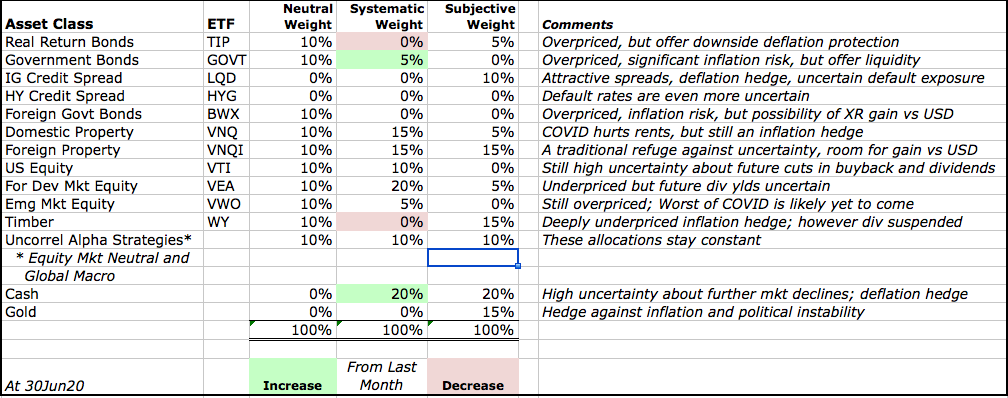
We take two approaches to deriving the tactical asset allocation implications from our analyses. The first takes a systematic approach, and is based on relative asset class valuations. Our starting point is our “neutral” model portfolio, which is equally weighted across nine broad asset classes, and also includes a 10% allocation to alpha strategies (equity market neutral and global macro) that are designed to have a low correlation to returns on broad asset classes. Based on asset class valuations, we systematically vary the asset class weights (but not the active strategy weight), increasing from 10% to 15% when an asset class is likely undervalued, and 15% when it is very likely undervalued. In the case of overvaluations, we go to 5% and then into cash, if there are no undervalued asset classes with room for an increase. In effect, this replicates the systematic rebalancing strategy we used for 15 years in our previous model portfolios.Based on subscriber requests, this month we are re-introducing a feature from the previous version of The Index Investor: Tactical Asset Allocation Implications from our analyses.
The second tactical approach is based on our subjective view not only of current asset class valuations, but also of the implications of the broader macro trends and uncertainties that we analyze each month. Importantly, this subjective view reflects our primary goal of avoiding large downside losses, rather than seeking large upside gains.
Two final notes: First, with respect to US fixed income, we include credit products (investment grade and high yield) in the same asset class as government debt, and will shift into the former when their valuations become attractive. Second, we regard gold not as a separate asset class to be held long-term, but rather as a complement to cash, into which we shift in periods of substantial overvaluation across multiple asset classes.
More information about our investment beliefs, including our core philosophy, approach to asset allocation (including our model portfolios and their long-term track record), and views on various approaches to active and passive management can all be found here.
Here is our latest asset allocation view:
Forecast Logic: Quantitative Indicators
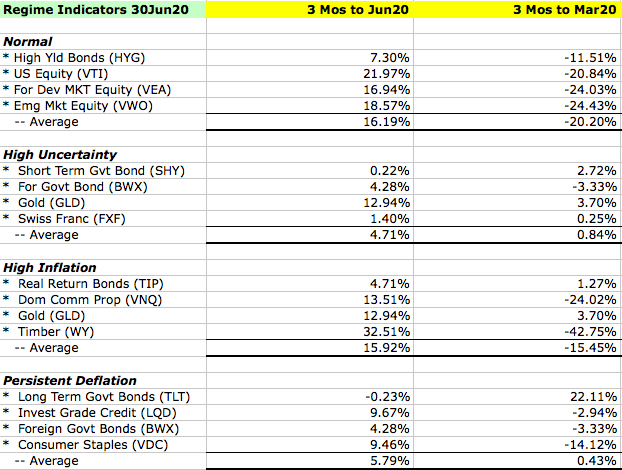
Implications of the Most Recent Three Month Asset Class Returns
Our quantitative forecast methodology focuses on the level and change in three-month returns, over the most recent and previous three-month periods, for those asset classes, which should perform best under different regimes (in this sense, our regimes can be regarded as macro factors). We assume that relatively higher returns are associated with more widely held investor belief in the probability that a given macro regime will develop in the future.
Asset Class Valuation and Momentum Indicators (@30Jun20)
| Asset Class (ETF) | Valuation | 1 Month Return | Conclusion |
| US Real Return Govt Bond (TIP) | Very Likely Overvalued* | 0.99% | Increasing Overvaluation |
| US Nom Return Govt Bond (GOVT) | Likely Overvalued* | 0.11% | Increasing Overvaluation |
| US Investment Grade Credit (LQD) | Likely Undervalued* | 2.12% | Decreasing Undervaluation |
| US High Yield Credit (HYG) | Likely Overvalued* | (0.58%) | Decreasing Overvaluation |
| US Commercial Property (VNQ) | Likely Undervalued* | 2.40% | Decreasing Undervaluation |
| US Equity (VTI) | Very Likely Overvalued* | 2.29% | Increasing Overvaluation |
| Foreign Devel Mkt Equity (VEA) | Very Likely Undervalued* | 3.50% | Decreasing Undervaluation |
| Emerging Markets Equity (VWO) | Very Likely Overvalued* | 6.58% | Increasing Overvaluation |
| Timber (WY) | Almost Certainly Overvalued* Dividend eliminated this month. | 11.24% | Increasing Overvaluation |
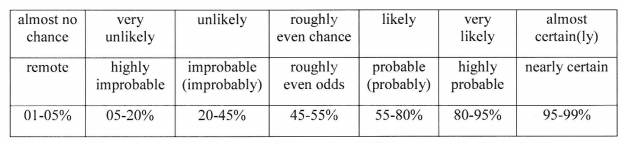
Note: The language we use to describe our estimated likelihood of asset class over or undervaluation is based on US Intelligence Community Directive 203 on Analytic Standards, which includes the following table:
Market Stress Indicators (@30Jun20)
| Market Stress Indicator | This Month vs Last Month |
| Asset Class Returns Autocorrelation (this month versus last month). Higher autocorrelation is an indicator of higher market stress. | .24 vs .45 the previous month. This indicates a decreasing level of market stress. |
| Economic Policy Uncertainty Index (how many days over the last 30 was index in top quartile of values since 1985?). A higher number equals more market stress. | On 30 days last month (unchanged from the previous month) the index was in the top quartile of daily values since 1985 (the 99th percentile of all rolling 30-day periods), the same as last month. |
| AAA Rated Bonds Spread over 10 Year Treasury Yield (month end). Higher spreads indicate rising concern about market liquidity. | 1.68% (74th percentile since 1983), vs 1.76% at the end of the previous month, indicating a high level of market stress. |
| BB Rated Bonds Spread over 10 Year Treasury Yield (month end). High spreads indicate increasing credit risk. | 4.69%, (81st percentile) up from 4.17% (67th) last month. |
| Gold Price per Ounce in US Dollars (month end). Rising gold prices are an indicator of increasing market uncertainty and stress. | $1,771 vs $1,740, up (2.6%) from the previous month. At the end of 2017, we estimated the “disaster premium” in the gold price was 47% (see our methodology in the Appendix). At the end of last month it was 84%. |
New Qualitative Evidence
• The COVID pandemic is stimulating faster corporate adoption of automation technologies. At the same time, the reopening of schools in the United States has become politicized, with teachers unions apparently seeking to keep them closed (perhaps until the November election). This will almost certainly worsen economic conditions, and lead to more demand and supply destruction that will take longer than many expect to reverse. Student learning losses will almost certainly never be recouped, which will put further downward pressure on productivity and employment growth once demand revives. This scenario would also lead to more medium term social and political conflict, and higher levels of uncertainty.
• A genetic mutation seems to have increased the transmissibility of SARS-CoV-2 coronavirus. It is not yet clear whether it will lead to higher case fatality rates. The number of infections in the United States continued to increase in the past month, as mask use became increasingly politicized along partisan lines. Recent research has found differing genetic susceptibilities to the virus, whose lingering debilitating effects in some patients has become clear. Other research showed a wide variation in antibody responses in COVID patients, but possibly longer-lasting T-cell responses. The net impact on the degree and duration of immunity remains unclear.
• A new report from McKinsey concluded that, “The COVID-19 crisis has strongly affected Europe’s labor markets, and it may take years for employment to return to its pre-crisis levels.” With far weaker employment protections in the United States, recovery of the labor market will likely take longer.
• Delinquencies, bankruptcy filings, and other indicators of financial distress increased, in what already was an over-indebted economy before COVID arrived.
• New research from multiple parties concluded that, acting through a variety of channels (e.g., weaker financial and labor markets; higher individual uncertainty and risk aversion), the negative effects of the COVID pandemic will very likely last longer than many currently expect.
• Negative COVID impacts are falling disproportionately on lower income groups. In the absence of more effective government action in polarized political systems, this will almost certainly increase inequality and worsen social and political conflicts.
• Last month, more evidence emerged to support the claim that the SARS-CoV-2 pandemic was triggered by an accidental release from a Chines lab that was either conducting coronavirus gain of function and/or bioweapons research. The implications for the new Cold War between China and the US are obvious and ominous.
• In an attempt to limit criticism of the Chinese Communist Party and Xi Jinping’s regime, China asserted that prohibitions on certain types of speech contained in the new Hong Kong security law applied globally.
• A growing number of observers are forecasting a crisis related either to the manner in which the US election in November is carried our, or Trump’s refusal to leave office if he is defeated.
Pre-Mortem Analysis
One of the most important forecasting disciplines is to ask yourself why your forecast could be wrong. Dr. Gary Klein’s research has shown that a very powerful and insightful way to do this is via a “pre-mortem analysis.” This method asks you to assume that it is a point in the future, and your forecast has been proven wrong (or your strategy or company has failed). You are then asked to look backward from this imagined point in the future, to explain why you failed, what you missed, and what you could have done differently to avoid your fate.
The pre-mortem method takes advantage of the fact that humans reason much more concretely and in more detail when explaining the past than they do when trying to forecast the future.
So let us assume that it is one year from now, and our current forecast has turned out to be wrong.
How did this happen? What developments did we fail to anticipate?
- A number of world leaders – Xi Jinping and Donald Trump, and to a lesser extent Vladimir Putin and Ali Khamenei are all facing sharply weakened economies and declining political popularity. History teaches us that this can lead to increased “foreign adventurism” to distract the public from worsening domestic conditions, as a nation rallies around its leader in a period of heightened external conflict. Should a “kinetic” conflict develop between China and the United States, or Iran and Israel, Saudi Arabia, and/ or the US, or between Russia and one or more European countries (e.g., due to a Russian incursion into the Baltics), it would generate a very sharp increase in uncertainty that would likely accelerate the already sharp COVID-19 economic slowdown. Given given high debt levels, this would very likely accelerate the arrival of the Persistent Deflation Regime.
- On the other hand, the removal from office (by one means or another) of Xi Jinping or Donald Trump * could * lead to a reduction in the dangerously growing conflict between the two nations, and increase cooperation in both the fight against COVID19 and the recovery of the global economy. This would somewhat reduce the probability of both the Persistent Deflation and High Inflation Regimes, and raise the relative probabilities of the High Uncertainty and Normal Times Regimes.
- A supply side shock of some type – beyond the disruption of global supply chains caused by COVID-19 -- could produce a sudden increase in inflation. The most likely scenario is a reduction in oil supplies due to a prolonged kinetic conflict between Iran and the US. An unlikely scenario could be major crop failures associated with the next solar cycle, which NASA forecasts will be the weakest in 200 years. McKinsey recently concluded that the probability of such a failure has increased due to changes in the environment, and now stands at about 10% over the next five years.
- Another route to the high inflation regime (repeatedly noted by Bridgewater’s Ray Dalio) would be a sudden loss of confidence in the US dollar relative to other currencies (driving up import prices), perhaps because of increasing deficit monetization and policy paralysis if a severe downturn continues without meaningful policy reforms to address critical structural challenges. However, a sharp rise in import prices due to a collapse in the USD exchange rate also requires relatively higher confidence in another currency, with the Euro being the most likely candidate. This currently seems unlikely, given both the Eurozone’s economic and political uncertainty, and the prospect of an intensifying conflict between the West and China. If confidence collapsed in all major currencies, the price of gold would rise, and price inflation would only occur in terms of gold.
Note: Combining Our Forecasts with Others From Other Sources and Extremizing the Result Should Increase Your Predictive Accuracy
Research has found that three steps can improve forecast accuracy. The first is seeking forecasts based on different forecasting methodologies, or prepared by forecasters with significantly different backgrounds (as a proxy for different mental models and information). The second is combining those forecasts (using a simple average if few are included, or the median if many are). The final step, which significantly improved the performance of the Good Judgment Project team in the IARPA forecasting tournament, is to “extremize” the average (mean) or median forecast by moving it closer to 0% or 100%.
Forecasts for binary events (e.g., the probability an event will or will not happen within a given time frame) are most useful to decision makers when they are closer to 0% or 100% than the uninformative “coin toss” 50%. As described by Baron et al in “Two Reasons to Make Aggregated Probability Forecasts More Extreme”, forecasters will often shrink their probability estimates towards 50% to take into account their subjective belief about the extent of potentially useful information that they are missing.
When you average multiple forecasters’ estimates, you are including more information, which should increase forecast confidence and push the mean estimate closer to 0% or 100%. However, this doesn’t happen when you use simple averaging. For this reason, forecast accuracy is increased when you employ a structured “extremizing” technique to move the mean estimate closer to 0% or 100%.
You can download an extremizing model from our website to use when combining the forecasts you use in your decision process.
The extremizing factors in our model are those that the Good Judgment Project found maximized the accuracy of combined forecasts. Note that the extremizing factor is lower when average forecaster expertise is higher. This is based on the assumption that a group of expert forecasters will incorporate more of the full amount of potentially useful information than will novice forecasters.
Feature Article: Can the US Successfully Meet the Threat Posed by Worsening Inequality?
Inequality has always been a difficult subject for people to discuss. Yet for eons humanity has struggled with it, and the emotions and behaviors it triggers.
In 1975, Arthur Okun captured this struggle in what has become a timeless book, Equality and Efficiency: The Big Tradeoff. As he summarized, “Institutions in a capitalist democracy prod us to get ahead of our neighbors economically after telling us to stay in line socially. This double standard professes and pursues an egalitarian political and social system while simultaneously generating gaping disparities in economic well-being.”
A lot has changed since 1975. Okun wrote during a period when there was increasing concern with growing economic stagnation. The elections of Margaret Thatcher (1979) and Ronald Reagan (1980) marked the beginning of the neo-liberal response to this with its greater policy focus on markets and economic efficiency. Forty years later, there is abundant evidence that we have once again overshot, and now face a pressing need to renew our focus on equality.
All around us, we see today the negative effects and dangerous threats that emerge when inequality passes a critical threshold.
Economically, excessive inequality is one of the forces that have weakened aggregated demand. For example, in 2018 the top 10% of households accounted for 35% of total income, but just 23% of consumption spending. The next highest 10% received 18% of income, and accounted for 16% of spending. Unsurprisingly, analysts have pointed to the sharp drop in consumption spending by the top 10% after COVID arrived as an important cause of the current economic contraction.
Socially, the negative effects of rising inequality have also been recognized for a very long time. In his 1899 book, The Theory of the Leisure Class, the economist Thorsten Veblen warned of the cancerous impact of what he called “conspicuous consumption” by economic elites, and the feelings of envy and resentment it stirs up among the masses. In recent years, researchers have developed a deeper understanding of the psychology and neuroscience behind this phenomenon.
For example, in “Interdependent Utilities: How Social Ranking Affects Choice Behavior”, Bault et al find a critical difference between the way people approach decisions when the results will be private versus when they will be observed by others. In the private condition, people are risk averse (i.e., possible losses have a higher weight than possible gains), but in the public condition this reverses, and people become risk seeking, to avoid the envy that comes from watching others’ relative outperformance. The difference is that in the public case, the payoff is involves both money and relative social status.
In a recent paper, Claudius Gros shows how “the repercussions of envy are amplified when societies become increasingly competitive” (“Self-Induced Class Stratification In Competitive Societies Of Agents: Nash Stability In The Presence Of Envy”. See also, “Investigating the Health Consequences for White Americans Who Believe White
Americans Are Wealthy”, by Cooley et al).
Many have argued that this phenomenon has driven the accumulation of debt by the middle class, as they have tried to keep up with the increasingly affluent Joneses. This process has been supercharged in recent years, as the Joneses, egged on by aspirational (envy-based) marketing, have engaged in something resembling competitive conspicuous consumption, which social and other media have made painfully visible to everyone else in the world.
Moreover, as Jack Goldstone and Peter Turchin have shown (in their development of Structural Demographic Theory), increasing inequality within elites is another source of social conflict that has worsened in recent years (see, “The Wealthy and Privileged Can Revolt Too”, by Noah Smith; “Our Suicidal Elites” by Joel Kotkin, “The Discrete Terror of the American Bourgeoisie” by Ed Luce, and for a French view, “Jupiter Falls to Earth”, by Christophe Guilluy).
Political shocks like Brexit and the election of Donald Trump have their roots in the economic struggles, social resentments, and class anger that have built up as inequality has gradually worsened since the 1970s.
In sum, there is no doubt that inequality has already had increasingly negative effects. That is why we included it as one of two critical medium term economic uncertainties in our May 2019 feature article on multipath reasoning about the future (“Multipath Analysis: A Systematic Process for Reducing the Dimensionality of Global Macro Forecasting Challenges”).
However, before discussing what can be done to reverse the worsening effects we see today, we first have to dig into the causes of inequality, some of which may surprise you.
Typically, conversations (and arguments) about the causes of inequality divide into two categories: Those rooted in individual decisions, and those rooted in the nature of “the system” however it is defined. But before delving into both of those, let’s start the cause that is almost never discussed: the impact of randomness (or, if you will, luck).
Let’s assume a world of perfect initial equality, where 50 people each start out with the same endowments of talent, resources, and opportunity. For ease in modeling, we’ll proxy this by (1) everyone starting with an equal endowment of $1,000, and (2) everyone facing an equal chance of their capital earning an annual return of between (20%) and 20%, with all values between those extremes equally likely. Each individual’s annual return is determined by a unique random number generator.
We ran this simulation over 20 years, fifteen times. What do you think we found?
At the end of 20 years, the median multiple (over our fifteen simulations) of highest of the 50 individuals’ resources compared to the lowest was 11x. Across the fifteen scenarios, the highest multiple value was 21x and the lowest was 6x.
What about shares of the total ending resources for all 50 individuals? The top 20% (i.e., the top 10/50) share had a median value of 38%. Across the fifteen scenarios, the highest was 43% and the lowest was 34%.
What about the top 10%? Their median share of total resources was 22%. The highest was 26% and the lowest 20%.
Looking at the top 20%, the median multiple between the top 10%’s ending share and the next 10%’s ending share was 1.4x, with a high of 1.6x and a low of 1.3x. Even within the top 20%, randomness generates inequality.
Finally, after 20 years, what percent of the 50 individuals ended up with less than their initial $1,000 endowment? The median was 60%, with a high of 66% and a low of 50%. This was caused by strings of negative returns from which they never recovered.
In this surprising result, we see a familiar investment lesson: Losses have a larger negative impact on long-term results than gains. If you start with $1,000, make 20% the first year ($1,200), then lose 20% the second year ($960), you have to earn 25% in year three just to get back to $1,200. (Unfortunately, the power of envy causes too many investors to spend far less time on managing risks than finding ways to show higher short-term returns than their peers).
This simple model highlights a critical point: Randomness (luck) has a much larger impact on the emergence of inequality than most of us realize. In fact, because of the cognitive dissonance it creates, we subconsciously refuse to acknowledge, much less admit it.
Now let’s move on to the more familiar roles of personal decisions and the nature of “the system.”
In a January 2020 report, Pew Research found that 60% of Republicans believed that different life choices contributed a great deal to inequality. Only 27% of Democrats agreed (overall, 42% agreed). In contrast, 62% of Republicans agreed that major changes in the system were needed to reduce inequality, as did 88% of Democrats (81% overall). See: “Most Americans Say There is Too Much Economic Inequality in the U.S.”
Perhaps the best-known example of the impact of personal decisions on inequality is Isabel Sawhill and Ron Haskin’s “Success Sequence” – “at least finish high school, get a full-time job and wait until age 21 to get married and have children…Only 2.4 percent of Americans who follow the success sequence live below the poverty line, while over 70 percent enjoy at least middle-class incomes, defined as 300 percent of the poverty line or more. For Americans who—for a host of reasons—don’t follow the sequence, the picture is reversed” (see their paper, “Work and Marriage: The Way to End Poverty and Welfare”. Also, “The Millennial Success Sequence: Marriage, Kids, And The ‘Success Sequence’ Among Young Adults”, by Wang and Wilcox).
Sawhill and Haskin’s research was based on US evidence. Other researchers have arrived at similar conclusions using evidence from other countries. For example, using Canadian data, Christopher Sarlo found that the Success Sequence factors had a strong impact on life outcomes, along with two other decisions: avoiding both addiction and a criminal record (“The Causes of Poverty”).
In terms of our simple model, good decisions can affect both starting resource endowments as well as the distributions of possible annual returns on those endowments that different individuals face.
However, there is also plenty of evidence that system factors (broadly construed) have evolved since Sawhill and Haskins published their paper in 2003, and now have a stronger impact on both individuals and aggregate inequality. In our model, these system factors affect both starting resource endowments and the distributions of possible annual returns facing different individuals.
Consider the Success Sequence. The work of many researchers has made clear that the quality of education varies widely across American school districts, as well as across schools and classrooms within them. And unlike many other countries, the United States severely limits’ parents’ ability to choose better schools for their children.
The quality of university and technical education programs also varies widely, and over the last 50 years the price of the former has sharply risen in real terms.
Moreover, access to these programs is not a level playing field. For example, in “Legacy and Athlete Preferences at Harvard”, Arcidiacono et al “examine the preferences Harvard gives for recruited athletes, legacies, those on the dean’s interest list [i.e., applicants related to large donors], and children of faculty and staff (ALDC). Among white admits, over 43% are in these categories. Among admits who are African American, Asian American, and Hispanic, the share is less than 16% each.” Their model of admissions “shows that roughly three quarters of white ALDC admits would have been rejected if they had been treated as typical white applicants.”
Rising inequality is an emergent result of multiple interacting causes. For example, a poor education system creates an increasingly severe shortage of workers with the skills required to use leading edge technologies as the transition to an economy driven by brains rather than brawn accelerates. Companies that can attract these workers strengthen their competitive advantage over other companies, which enables them to pay higher wages, limiting their competitors’ ability to do so. Research has shown that this is yet another driver of increasing inequality.
This is but one aspect of the challenges associated with getting a good full-time job in today’s economy. A combination of increased use of automation technologies and moving production and supply chains to other countries has eliminated many middle income jobs in the United States, leaving a mix of high income opportunities (that require high quality education and training), and much less secure and poorly paid service and other gig economy jobs. Many of those jobs do not provide health care benefits, whose real cost has also dramatically increased over the past 50 years.
Also, in recent years three fundamental aspects of the US economic system have changed in a way that worsens inequality. First, the rate of labor productivity growth has significantly declined. Second, in many industries, the traditional link between increasing productivity and rising real wages has been broken. Third, labor’s overall share of GDP has shrunk in recent years, for a variety of reasons (see, “Declining Worker Power and American Economic Performance” by Stansbury and Summers, “Labour Share in G20 Economies” by the International Labour Organization, and “A New Look at the Declining Labor Share of Income in the United States” by the McKinsey Global Institute).
These structural changes have been so strong in their impact that they have weakened the link between education and middle class incomes (see, “Education and the Dynamics of Middle Class Status” by Hardy and Marcotte, and “Is College Still Worth It? It’s Complicated” by Emmons et al from the Federal Reserve Bank of St. Louis).
Looking at Sarlo’s two additional Success Sequence factors (avoiding addiction and a criminal record), America’s systems for addressing mental health and addiction issues vary widely in quality, and there is abundant evidence that the criminal justice system treats some groups more harshly than others.
In sum, while making good individual decisions can certainly help to reduce rates of poverty and the extent of inequality, system factors have increasingly reduced their potential positive impact on inequality.
So what should be done to reduce inequality, and how likely is that to happen?
In the immediate term, the sharp income reductions caused by COVID that have disproportionately affected people with lower incomes can be offset with government aid, including direct cash payments, support for food banks, and expansions of eligibility for government provided or subsidized health care (i.e., Medicate and health insurance exchanges). Housing is an equally critical challenge with fewer obvious solutions. While current bans on evictions can be extended, this has knock-on negative effects on landlords’ ability to service their debts. An expedited bankruptcy process is the likely solution.
In the short-term, the challenges to reducing inequality seem even more politically daunting.
Improvements to the education and workforce training systems (or, more broadly, the human capital system) are obviously critical to increasing productivity, but they have repeatedly been met with fierce resistance (e.g., by K-12 teachers unions, colleges and universities, and the large number of competing non-profits focused on worker retraining). While there are proposals to break this logjam (e.g., moving to a national system of stackable certified competencies, similar to the European National Qualifications Framework, and linking participation in a federal jobs program to completing worker retraining), the weight of historical evidence suggests that no matter how critical it is, progress in this area will very likely remain glacial, absent much more aggressive and sustained demands for change by the business community.
Improvements to the US healthcare and social care systems, including processes and institutions focused on mental health and addiction treatment, will also very likely face strong resistance, in addition to squeezed post-COVID budgets. Again, the weight of historical evidence suggests progress will be slow here too, despite polling data showing that reducing health care costs is a critical issue to voters across the political spectrum.
On the other hand, programs that have already been shown to be effective at boosting incomes, like the Earned Income Tax Credit, could be expanded more easily, potentially to include federal wage subsidies. These are likely to be more effective and meet less resistance than attempts to increase the minimum wage, which will put further stress on many businesses that are already barely holding on in the post-COVID economy (e.g., “People versus Machines: The Impact of Minimum Wages on Automatable Jobs” by Lordan and Neumark).
While broad changes to the US education and healthcare systems seem very unlikely at this point, narrower solutions may garner more support and still have a significant impact, particularly integrated approaches to support lower income children early in their lives. As Currie and Rossin-Slater find in their paper “Early-life Origins of Lifecycle Well-being: Research and Policy Implications”, “there is a robust and economically meaningful relationship between early-life conditions and well-being throughout the lifecycle, as measured by adult health, educational attainment, labor market attachment, and other indicators of socio-economic status.”
“However, there is some variation in the degree to which current policies in the U.S. are effective in improving early-life conditions. Among existing programs, some of the most effective are the Special Supplemental Program for Women, Infants, and Children (WIC), home visiting with nurse practitioners, and high-quality, center-based early childhood care and education. In contrast, the evidence on other policies such as prenatal care and family leave is more mixed and limited.”
Changes to the tax system are also critical to reducing inequality. They could include not only higher marginal rates on top incomes, but also and end to provisions like interest deduction (which promotes use of debt in capital structures), taxation of private equity funds carried interest as capital gains rather than income, and imposition of a wealth tax. Two other ideas may have an even greater impact – a carbon tax, with a portion of the revenue rebated to low income taxpayers or used to provide equity to start-up businesses, and a progressive consumption tax that discourages destructive conspicuous consumption.
Structural changes that increase the bargaining power of labor relative to capital could also contribute to the reduction of inequality. The reshoring of supply chains to make them more resilient (and in response to worsening US-China relations) will help. So too would changes that strengthen collective bargaining processes in the private sector. Placing restrictions on companies repurchasing their own equity, or making such buybacks contingent on wage increases could also help. Most difficult of all would be a switch in the US immigration system to one like Canada’s, that gives preference to talented applicants who can make the largest contribution to increasing national productivity growth, in contrast to low skilled immigrants who put downward pressure on low income workers’ wages (an argument which in years past the Democratic Party strongly supported).
After reading this list, it is clear that we do not lack for testable policy ideas for limiting the worsening inequality that has emerged from the interaction of bad decisions, bad luck, bad systems, and now the COVID-19 pandemic.
Moreover, we have at hand a growing number of analyses of how we arrived at today’s predicament, and how we might get out of it (e.g., “Capitalism and the Future of Democracy” by Isabel Sawhill, and “The Economics of Belonging”, by Martin Sandbu).
More darkly, in the growing influence of populist authoritarians on both the left and the right, we are also witnessing the accumulation of painful – and scary -- evidence of the likely consequences if worsening inequality is not reversed.
Yet in our current political climate – even after COVID’s shocking arrival – it will very likely be difficult, if not impossible, to marshal enough political support to enact and effectively implement the reforms needed to do this.
If there is a reason to be hopeful, it rather perversely lies with Xi Jinping. It may well be that only the growing danger and demands of a new Cold War will finally force us to reverse the downward path we are on today.
High Value Information Observed In June 2020
In our model of the complex global macro system, change drivers are arrayed across a roughly chronological process (albeit one with many feedback loops), in which technological and environmental changes precede changes in the economy and national security, which in turn lead to changes in society and politics, all of which produce the effects we observe in investor behavior and financial market valuations and returns.
In our methodology, we classify new information as significant and highly valuable if either it (1) is an “indicator”, which reduces our uncertainty about the value of a parameter in our mental model for making sense of the dynamic macro system, or (2) it is a “surprise” which increases our uncertainty about either the range of potential values for a parameter or the structure of our model. With respect to indicators, the higher our priori probability is for a regime, the more we look for indicators that it will not occur, and the lower our prior probability for a regime, the more we look for indicators that it will occur. Put differently, we tend to look for high value indicators that disconfirm our prior views.
| New Technology Information: Indicators and Surprises | Why Is This Information Valuable? |
| “Maintaining the Competitive Advantage in Artificial Intelligence and Machine Learning”, by Waltzman et al from RAND | SURPRISE “Artificial intelligence (AI) technologies hold the potential to become critical force multipliers in future armed conflicts. The People's Republic of China has identified AI as key to its goal of enhancing its national competitiveness and protecting its national security. “If its current AI plan is successful, China will achieve a substantial military advantage over the United States and its allies. That has significant negative strategic implications for the United States… Key conclusions: “It is difficult, perhaps impossible, to arrive at a definitive statement about which country has the lead in AI. It is more useful to talk about various parts of the AI ecosystem. It appears possible that the United States has a narrow lead in several key areas of AI, although China has several advantages and a high degree of leadership focus on this issue. “As of early 2020, the United States has a modest lead in AI technology development because of its substantial advantage in the advanced semiconductor sector. China is attempting to erode this edge through massive government investment. The lack of a substantial U.S. industrial policy also works to Chinese advantage. “China has an advantage over the United States in the area of big data sets that are essential to the development of AI applications. This is partly because data collection by the Chinese government and large Chinese tech companies is not constrained by privacy laws and protections. However, the Chinese advantage in data volume is probably insufficient to overcome the U.S. edge in semiconductors. “Breakthrough fundamental research is not a critical dimension for comparing U.S.-China relative competitive standing from a DoD perspective. Fundamental research, regardless of whether it is U.S., Chinese, or a U.S.-Chinese collaboration, is available to all. “Commercial industry is also not a critical dimension for competitive comparison. Industries with corporate headquarters in the United States and in China seek to provide products and services wherever the market is.” |
| “Shaping the Terrain of AI Competition” by Tim Hwang, Georgetown University Center for Security and Emerging Technology | SURPRISE “Concern that China is well-positioned to overtake current U.S. leadership in artificial intelligence in the coming years has prompted a simply stated but challenging question. How should democracies effectively compete against authoritarian regimes in the AI space? “Policy researchers and defense strategists have offered possible paths forward in recent years, but the task is not an easy one. “Particularly challenging is the possibility that authoritarian regimes may possess structural advantages over liberal democracies in researching, designing, and deploying AI systems. Authoritarian states may enjoy easier access to data and an ability to coerce adoption of technologies that their democratic competitors lack.” “Authoritarians may also have stronger incentives to prioritize investments in machine learning, as the technology may significantly enhance surveillance and social control.” “No policy consensus has emerged on how the United States and other democracies can overcome these burdens without sacrificing their commitments to rights, accountability, and public participation.” “This paper offers one answer to this unsettled question in the form of a “terrain strategy.” It argues that the United States should leverage the malleability of the AI field and shape the direction of the technology to provide structural advantages to itself and other democracies. “This effort involves accelerating the development of certain areas within machine learning (ML)—the core technology driving the most dramatic advances I AI—to alter the global playing field… “Democracies should invest their resources in three critical domains: (1) Reducing a dependence on data. Authoritarian regimes may have structural advantages in marshaling data for ML applications when compared to their liberal democratic adversaries. To ensure better competitive parity, democracies should invest in techniques that reduce the scale of real-world data needed for training effective ML systems. (2) Fostering techniques that support democratic legitimacy. Democracies may face greater friction in deploying ML systems relative to authoritarian regimes due to their commitments to public consent. Enhancing the viability of the technology in a democratic society will require investing in ML subfields, including work in interpretability, fairness, and privacy. (3) Challenging the social control uses of ML. Recent advances in AI appeal to authoritarian regimes in part because they promise to enhance surveillance and other mechanisms of control. Democracies should advance research eroding the usefulness of these applications.” |
| “The Evolutionary Dynamics of Independent Learning Agents in Population Games”, by Hu et al | SURPRISE The combination of reinforcement learning methods with simulations involving multiple adaptive agents has the potential to produce breakthroughs in our ability to understand and influence the outcomes produced by the complex adaptive systems that characterize modern life. Hence it is important to monitor indicators of progress in this critical area. The authors begin by noting that “understanding the evolutionary dynamics of reinforcement learning under multiagent settings has long remained an open problem.” (For an excellent previous review of this issue, see, “A Survey of Learning in Multiagent Environments: Dealing with Non-Stationarity”, by Hernanez-Leal et al). Most commonly, the behavior of these systems is modeled at the aggregate level, using stochastic equations in a top-down approach. Rather than focus on the more commonly studied 2-player (agent) games, Hu and her co-authors “ consider population games, which model the strategic interactions of a large population comprising small and anonymous agents.” Uniquely, they present a formal relationship between the top-down stochastic process of the system as a whole and the “dynamics of independent learning agents who reason based on reward signals.” |
| “Empirically Verifying Hypotheses Using Reinforcement Learning”, by Marino et al | SURPRISE We have repeatedly noted the importance of indications that artificial intelligence technologies are moving beyond associational (e.g., correlational) methods, to higher levels of causal and counterfactual reasoning (e.g. as described by Judea Pearl in The Book of Why). While not employing Pearl’s causal methods, this paper is interesting because it attempts formulate hypothesis verification as a reinforcement learning problem (for a broader survey, see, “A Survey of Learning Causality with Data: Problems and Methods”, by Guo et al). The authors of this paper note that, “Empirical research on early learning has shown that infants build an understanding of the world around by constantly formulating hypotheses about how some physical aspect of the world might work and then proving or disproving them through deliberate play. “Through this process the child builds up a consistent causal understanding of the world. This contrasts with manner in which current ML systems operate… Learning settings use a single user-specified objective function that codifies a high-level task, and the optimization routine finds the set of parameters (weights) that maximizes performance on the task. "The learned representation (knowledge of how the world works) is embedded in the weights of the model - which makes it harder to inspect, hypothesize or even enforce domain constraints that might exist” … The authors “aim to build an agent that, given a hypothesis about the dynamics of the world, can take actions to generate observations which can help predict whether the hypothesis is true or false. Existing RL algorithms fail to solve this task, even for simple environments. In order to train the agents, we exploit the underlying structure of many hypotheses, factorizing them as {pre-condition, action sequence, postcondition} triplets. By leveraging this structure we show that RL agents are able to succeed at the task.” |
| “Does the Whole Exceed its Parts? The Effect of AI Explanations on Complementary Team Performance”, by Bansal et al | SURPRISE Many analysts have claimed that the difficulty in explaining predictions and decisions made or recommended by deep learning algorithms makes humans less willing to trust and/or take action after receiving them. This new paper tests that claim. “Although the accuracy of Artificial Intelligence (AI) systems is rapidly improving, in many cases it remains risky for an AI to operate autonomously, e.g., in high-stakes domains or when legal and ethical matters prohibit full autonomy. A viable strategy for these scenarios is to form Human-AI teams, in which the AI system augments one or more humans by recommending its predictions, but the people retains agency and have accountability on the final decisions… “Many researchers have argued that such human-AI teams would be improved if the AI systems could explain their reasoning. In addition to increasing trust between human and machine, and between humans across the organization, one hopes that an explanation should help the responsible human know when to trust the AI’s suggestion and when to be skeptical, e.g., when the explanation doesn’t make sense. Such appropriate reliance is crucial for users to leverage AI assistance and improve task performance… “A careful analysis of existing literature reveals that prior studies observed improvements due to explanations only when the AI, alone, outperformed both the human and the best human-AI team. This raises an important question: can explanations lead to complementary performance, i.e., with accuracy higher than both the human and the AI working alone? “We address this question by devising comprehensive studies on human-AI teaming, where participants solve a task with help from an AI system without explanations and from one with varying types of AI explanation support. We carefully controlled to ensure comparable human and AI accuracy across experiments on three NLP datasets (two for sentiment analysis and one for question answering). “While we found complementary improvements from AI augmentation, they were not increased by state-of-the-art explanations compared to simpler strategies, such as displaying the AI’s confidence. We show that explanations increase the chance that humans will accept the AI’s recommendation regardless of whether the AI is correct.” |
| “Why Tech Didn’t Save Us From COVID-19”, by David Rotman | “Although scientists identified and sequenced the new coronavirus within weeks of its appearance in late December—an essential step in creating a diagnostic—the US and other countries stumbled in developing PCR tests for general use. “Incompetence and a sclerotic bureaucracy at the US Centers for Disease Control meant the agency created a test that didn’t work and then insisted for weeks that it was the only one that could be used… "Combined with the lack of testing, a splintered and neglected system of collecting public health data meant epidemiologists and hospitals knew too little about the spread of the infection. “In an age of big data in which companies like Google and Amazon use all sorts of personal information for their advertising and shopping operations, health authorities were making decisions blind… “A once-healthy innovation ecosystem in the US, capable of identifying and creating technologies essential to the country’s welfare, has been eroding for decades… “The US has, over the last half-century, increasingly put its faith in free markets to create innovation. That approach has built a wealthy Silicon Valley and giant tech firms that are the envy of entrepreneurs around the world. But it has meant little investment and support for critical areas such as manufacturing and infrastructure—technologies relevant to the country’s most basic needs… “The problem with letting private investment alone drive innovation is that the money is skewed toward the most lucrative markets. The biggest practical uses of AI have been to optimize things like web search, ad targeting, speech and face recognition, and retail sales. “Pharmaceutical research has largely targeted the search for new blockbuster drugs. Vaccines and diagnostic testing, so desperately needed now, are less lucrative… |
| | |
| | |
| | |
| | |
| | |
| | |
| | |
| New Energy and Environment Information: Indicators and Surprises | Why Is This Information Valuable? |
| “What We Know and Don’t Know About Climate Change, and Implications for Policy”, by Robert Pindyck | This excellent new paper focuses on an issue near and dear to The Index Investor’s heart: The critical impact of uncertainty on a debate in which claims are often stated in what Pindyck considers excessively precise terms. He observes that, “there is a lot we know about climate change, but there is also a lot we don't know. Even if we knew how much CO2 will be emitted over the coming decades, we wouldn't know how much temperatures will rise as a result. “And even if we could predict the extent of warming that will occur, we can say very little about its impact… We face considerable uncertainty over climate change and its impact, why there is so much uncertainty, and why we will continue to face uncertainty in the near future... “Climate change uncertainty has important policy implications. First, the uncertainty (particularly over the possibility of a catastrophic climate outcome) creates insurance value, which pushes us to earlier and stronger actions to reduce CO2 emissions. “Second, uncertainty interacts with two kinds of irreversibilities. First, CO2 remains in the atmosphere for centuries, making the environmental damage from CO2 emissions irreversible, pushing us to earlier and stronger actions. Second, reducing CO2 emissions requires sunk costs, i.e., irreversible expenditures, which pushes us away from earlier actions. Both irreversibilities are inherent in climate policy, but the net effect is ambiguous.” |
| “Solving the Climate Crisis” – The Democratic Minority of the US House of Representatives’ Climate Action Plan | While this plan has no chance of passing the Senate and being signed into law by President Trump, it offers an advance view of what is very likely in store if the Democrats sweep the US House, Senate, and Presidency in November’s elections. The plan calls for the US to reach a goal of net zero emissions by 2050. Policies recommended by House Democrats focus on speeding up electrification in general, further limiting the role of fossil fuels (including making it more difficult to obtain approvals for fossil fuel-related infrastructure), reducing methane emissions, and increasing the resilience of infrastructure the negative effects of climate change. |
| “Climate Math: What a 1.5 degree pathway would take”, by Henderson et al, from McKinsey see also: “Energy Technology Perspectives – A Special Report on Clean Energy Innovation” by the International Energy Agency | This new McKinsey report provides practical balance to the House Democrats’ policy proposals. It notes that, “Adapting to climate change is critical because, as a recent McKinsey Global Institute report shows, with further warming unavoidable over the next decade, the risk of physical hazards and nonlinear, socioeconomic jolts is rising. “Mitigating climate change through decarbonization represents the other half of the challenge. Scientists estimate that limiting warming to 1.5 degrees Celsius would reduce the odds of initiating the most dangerous and irreversible effects of climate change.” The authors conclude that, “The good news is that a 1.5-degree pathway is technically achievable. The bad news is that the math is daunting. Such a pathway would require dramatic emissions reductions over the next ten years—starting now”… It “would require significant economic incentives for companies to invest rapidly and at scale in decarbonization efforts. It also would require individuals to make changes in areas as fundamental as the food they eat and their modes of transport. A markedly different regulatory environment would [also] likely be necessary to support the required capital formation.” |
| “Will the World’s Breadbaskets Become Less Reliable?” by the McKinsey Global Institute | SURPRISE “Over the past few decades, people around the world have benefited from a growing supply of food, keeping prices relatively stable and reducing undernourishment to near all-time lows. This positive long-term trend was briefly interrupted by one episode of globally spiking food prices between 2006 and 2008 and a smaller increase between 2010 and 2012, causing significant disruptions to markets and societies alike” … “Relative stability in prices has been achieved primarily through continuously higher productivity (rather than major expansion of croplands) and the absence of a major event that could have caused large-scale crop failure. “If these trends continue, the global food supply could increase over the next decade by an estimated 20 percent, more than the 13 percent projected increase in world population…. [However], “climate change and related acute weather events are similarly introducing new risks into the food system. While many of them may not yet be fully appreciated, they expose similar vulnerabilities to COVID… "We examine the changing likelihood of a harvest failure occurring in multiple breadbasket locations as well as the potential socioeconomic impact of such an event. “We define a breadbasket as a key production region for food grains (rice, wheat, corn, and soy) and harvest failure as a major yield reduction in the annual crop cycle of a breadbasket region where there is a potential impact on the global food system. “We examine the impact of a changing climate absent mitigation and adaptation…on the current food production system to highlight its vulnerabilities and do not assume further improvements in yields or other adaptation measures. “We find that the likelihood of a multiple-breadbasket failure (which we define as a global harvest failure of more than 15 percent relative to average) occurring in a given year has increased from roughly one percent in the past 20 years to roughly two percent in the next decade to 2030, and to roughly four percent by 2050—a quadrupling in likelihood that could have significant socioeconomic impact. “Similarly, the probabilities of a multi-breadbasket failure occurring at least once within a 10 year period increase from 10 percent today, to 18 percent by 2030 and to 34 percent by 2050.” |
| | |
| | |
| | |
| | |
| | |
| | |
| | |
| | |
| | |
| New Economic Information: Indicators and Surprises | Why Is This Information Valuable? |
| “The Future of Work in Europe” by Smit et al from the McKinsey Global Institute | “The COVID-19 crisis has strongly affected Europe’s labor markets, and it may take years for employment to return to its pre-crisis levels. But the pandemic will not be the only trend shaping the future of work on the continent. This research takes an in-depth look at almost 1,100 local economies across the 27 EU countries plus the United Kingdom and Switzerland. We assess how automation and AI may reshape the mix of occupations, the skills required to work, and the transitions workers face. “In the aftermath of the pandemic, emerging evidence from companies suggests that technology adoption and other workforce shifts could accelerate… “Among our key findings: Once the economy recovers, Europe may have a shortage of skilled workers, despite a growing wave of automation. A key reason is the declining supply of labor: Europe’s working-age population will likely shrink by 13.5 million (or 4 percent) due to aging by 2030. “The trend of shorter workweeks could reduce labor supply by an additional 2 percent… “More than half of Europe’s workforce will face significant transitions. Automation will require all workers to acquire new skills. About 94 million workers may not need to change occupations but will especially need retraining, as technology handles 20 percent of their current activities… “While some workers in declining occupations may be able to find similar types of work, 21 million may need to change occupations by 2030. Most of them lack tertiary education. Newly created jobs will require more sophisticated skills that are already scarce today “Overcoming labor market mismatches in a post-COVID world will be a key challenge…Four broad imperatives stand out: (1) addressing skills shortages; (2) improving access to jobs in dynamic growth hubs, potentially through an increase in remote working; (3) revitalizing and supporting shrinking labor markets (since 40 percent of Europeans will live in regions where jobs are declining over the coming decade); and (4) increasing labor force participation.” |
| “An Analysis of Joe Biden’s Tax Proposals”, by Pomerleau et al from AEI | The authors “estimate that Joe Biden’s proposal would raise federal revenue by $3.8 trillion over the next decade (2021–30). They would increase taxes, on average, for households at every income level and make the federal tax code more progressive. His tax increases would primarily fall on the top 1 percent of income earners… “Biden’s proposals would reduce gross domestic product (GDP) by (0.06) percent over the next decade, slightly increase GDP the second decade by 0.07 percent, and result in a small reduction in GDP in the long run (0.2 percent)… “Although his proposals would raise significant revenue, they would not significantly affect the federal government’s short-run and long-run debt burden.” |
| “A Crash in the Dollar is Coming” by Stephen Roach | While we don’t agree with Roach’s conclusions, especially in the short term, it is important to present analyses that differ from the conclusions we have reached. “The era of the U.S. dollar’s ‘exorbitant privilege’ as the world’s primary reserve currency is coming to an end… "Already stressed by the impact of the Covid-19 pandemic, U.S. living standards are about to be squeezed as never before. At the same time, the world is having serious doubts about the once widely accepted presumption of American exceptionalism. “Currencies set the equilibrium between these two forces — domestic economic fundamentals and foreign perceptions of a nation’s strength or weakness. The balance is shifting, and a crash in the dollar could well be in the offing.” “The coming collapse in saving points to a sharp widening of the current account deficit, likely taking it well beyond the prior record of -6.3% of GDP that it reached in late 2005. Reserve currency or not, the dollar will not be spared under these circumstances. The key question is what will spark the decline? … “The collapse in the dollar will be inflationary — a welcome short-term buffer against deflation but, in conjunction with what is likely to be a weak post-Covid economic recovery, yet another reason to worry about an onset of stagflation — the tough combination of weak economic growth and rising inflation that wreaks havoc on financial markets.” |
| “The Debt Collection Pandemic” by Foohey et al see also: “Income, Liquidity, And The Consumption Response To The COVID-19 Pandemic And Economic Stimulus Payments” by Baker et al | “The coronavirus pandemic is set to metastasize into a debt collection pandemic. The federal government can and should do something to put a halt to debt collection until people can get back to work and earn money to pay their debts. Yet it has done nothing to help people deal with their debts. “Instead, states have tried to solve issues with debt collection in a myriad of patchwork and inconsistent ways. These efforts help some people and are worthwhile. But more efficient and comprehensive solutions exist.” “Because American families’ finances are unlikely to recover as soon as the crisis ends, debt collection brought by the COVID-19 crisis also will not dissipate anytime soon. Even after the crisis ends, the need to implement comprehensive, longer-lasting solutions will remain… “These solutions largely fall on the shoulders of the federal government, though state attorneys general have the necessary power to help people effectively. If the government continues on its present course, a debt collection pandemic will follow the coronavirus pandemic.” Baker et al find that, “After a steep decline in spending, US households responded rapidly to the receipt of COVID-19 stimulus payments. Still, relative to similar programs in 2001 and 2008, spending on durables decreased… “Larger increases were observed in spending on food and payments – from credit cards to rents and mortgages – that reflect a short-term debt overhang, which suggests that direct payments failed to stimulate aggregate consumption.” |
| “The Long Run Consequences of Pandemics”, by Jorda et al from the Federal Reserve Bank of San Francisco Also: “Scarring Body and Mind: The Long-Term Belief Scarring Effects of COVID-19”, by Kozlowski et al | SURPRISE “What are the medium- to long-term effects of pandemics? How do they differ from other economic disasters? We study major pandemics using the rates of return on assets stretching back to the 14th century. “Significant macroeconomic after-effects of pandemics persist for decades, with real rates of return substantially depressed, in stark contrast to what happens after wars. “Our findings are consistent with the neoclassical growth model: capital is destroyed in wars, but not in pandemics; pandemics instead may induce relative labor scarcity and/or a shift to greater precautionary savings.” In “Scarring Body and Mind: The Long-Term Belief Scarring Effects of COVID-19”, Kozlowski et al describe one driver of these long term consequences: “The largest economic cost of the COVID-19 pandemic could arise from changes in behavior long after the immediate health crisis is resolved. A potential source of such a long-lived change is scarring of beliefs, a persistent change in the perceived probability of an extreme, negative shock in the future… “We find that the long-run costs for the U.S. economy from this channel is many times higher than the estimates of the short-run losses in output. This suggests that, even if a vaccine cures everyone in a year, the Covid-19 crisis will leave its mark on the US economy for many years to come.” |
| A number of new papers this month focused on potential implications of the sharply increased pressure on US state and local government budgets and pension plans triggered by the pandemic | In “Muni Bond Investors Could Lose Out as Pension Crisis Cripples Many US Cities”, Pozen and Rauh note how the size of their pension liabilities is artificially deflated by the use of discount rates that are arguably too high (we strongly agree with this view). They also note how in the municipal bankruptcies of Detroit and Stockton (CA), bondholders took far greater losses than pension beneficiaries. In “States Continue to Face Large Shortfalls Due to COVID-19 Effects”, McNichol and Leachman note that heavy budget cuts include reduced contributions to public pension funds (see also, “The Crisis’s Impact on Budgets”, by Steve Malanga). In “State Bankruptcy Revisited”, David Skeel argues that the combination of (a) increasing demands for a federal bailout of state and local pension plans, and (b) increasing pressures on the federal budget and borrowing capacity could lead to the enactment of a new chapter of the bankruptcy code that would enable states to reorganize their debts and pension obligations via this process. |
| “Economic Uncertainty Before And During The Covid-19 Pandemic”, by Altig et al | “Fed Chairman Jerome Powell aptly summarized the level of uncertainty in his May 21st speech noting, “We are now experiencing a whole new level of uncertainty, as questions only the virus can answer the complicated the outlook”. "Indeed, there is massive uncertainty about almost every aspect of the COVID-19 crisis, including the infectiousness and lethality of the virus; the time needed to develop and deploy vaccines; whether a second wave of the pandemic will emerge; the duration and effectiveness of social distancing; the near-term economic impact of the pandemic and policy responses; the speed of economic recovery as the pandemic recedes; whether “temporary” government interventions will become permanent; the extent to which pandemic induced shifts in consumer spending patterns, business travel, and working from home will persist; and the impact on business formation, and research and development.” The authors find that, “first, all indicators we track show huge uncertainty jumps in reaction to the pandemic and its economic fallout. Indeed, most indicators reach their highest values on record. “Second, peak amplitudes differ greatly – from a rise of around 100% (relative to January 2020) in two-year implied volatility on the S&P 500 and subjective uncertainty around year-ahead sales for UK firms to a 20-fold rise in forecaster disagreement about UK growth. “Third, time paths also differ: Implied volatility rose rapidly from late February, peaked in mid-March, and fell back by late March as stock prices began to recover. In contrast, broader measures of uncertainty peaked later and then plateaued, as job losses mounted, highlighting the difference in uncertainty measures between Wall Street and Main Street.” |
| “The Second Great Depression”, by Annie Lowrey | “At least four major factors are terrifying economists and weighing on the recovery: the household fiscal cliff, the great business die-off, the state and local budget shortfall, and the lingering health crisis. (See also: “Global Macroeconomic Scenarios of the COVID-19 Pandemic” by McKibbin and Fernando) |
| “Uncertainty and Growth Disasters” by Jovanovic and Ma from the Federal Reserve Board | This paper documents several stylized facts on the real effects of economic uncertainty. The authors find that, “the marginal effects of higher uncertainty are to significantly increase growth downside risk… "Higher uncertainty could lead to an abrupt economic decline whereas lower uncertainty does not necessarily rebound the economy from the recession… Higher asset volatility magnifies the negative impact of uncertainty on growth.” |
| “Assessment of U.S. COVID-19 Situation Increasingly Bleak”, by Jeffery Jones from Gallup | SURPRISE “Published on 2 July, Gallup found that, “As coronavirus infections are spiking in U.S. states that previously had not been hard-hit, a new high of 65% of U.S. adults say the coronavirus situation is getting worse. “The percentage of Americans who believe the situation is getting worse has increased from 48% the preceding week, and from 37% two weeks prior… “Gallup first asked Americans in early April to say whether they thought the coronavirus situation was getting better or worse. At that time, 56% said it was getting worse and 28% better, the most negative assessment prior to the latest reading… “Americans' greater pessimism is also apparent in the 74% who expect the level of disruption to travel, school, work and public events in the U.S. to persist through the end of this year (37%) or beyond that (37%). This represents a 10-point increase from the prior week in the percentage of U.S. adults who think the coronavirus situation will last at least until the end of the year. In early May, less than half of Americans expected the situation to last that long.” |
| “Big Data Suggests a Difficult Recovery in US Jobs Market”, by Gavyn Davies in the Financial Times | SURPRISE “It now seems increasingly improbable, especially in the US, that this structural damage to the labour market will be reversed quickly. Assuming that the Covid-19 effects persist into 2021, the concentration of employment losses among unskilled workers in specific locations, with many permanently failed businesses, will become increasingly difficult to correct. The serious concerns about a deep-rooted scarring of the labour market, forcibly expressed by many Federal Reserve officials, would then be entirely justified.” |
| “Working Parents are the Key to COVID-19 Recovery”, by Nicole Bateman from Brookings | SURPRISE As this Brookings analysis shows, reopening schools is critical to restarting national economies. Yet with depressing predictability, in the US this decision (like wearing masks) has become politicized and polarized. Perhaps with an eye to worsening economic conditions in the run-up to the November election, teachers unions are increasingly refusing to cooperate in school reopening on anything other than a fully remote basis. They’re also demanding a huge amount of new funding for a system that has shown essentially no improvement in its poor results over the past decade, despite the critical importance of those results to productivity improvement. Brookings notes, “the school year may be over, but the pandemic is not. After forcing closures of schools and child care programs—along with much of the economy—COVID-19 cases are rising in a majority of states. This trend does not bode well for the reopening of those programs and schools, which typically welcome students back within the next eight weeks… “For working parents, the uncertainty surrounding child care and in-person instruction for school-aged children is unprecedented, with a cascading set of consequences on family life, education, and earnings… “Moreover, in the event that child care and schools do fully reopen, some parents may not be confident in the safety of those environments and opt to keep their children home. “Even parents who have thus far avoided layoffs and been able to work from home are performing a nearly impossible balancing act every day, keeping up with their own work while caring for and teaching their children. Many others have been laid off, left their jobs to care for their children, or been forced to cobble together temporary child care arrangements as they continue to report for work at essential jobs, such as nursing and grocery work. “Parents with minor children comprise almost one-third of the country’s workforce; any economic recovery will rely on their continued participation or reentry into the labor force. The status of schools and child care programs in the fall will dictate the ability of working parents to fully return to work, and therefore will also largely dictate the speed and robustness of economic recovery.” |
| | |
| | |
| | |
| | |
| | |
| | |
| | |
| New National Security Information: Indicators and Surprises | Why Is This Information Valuable? |
| “Drone-Era Warfare Shows the Operational Limits of Air Defense Systems”, by Parachini and Wilson from RAND | SURPRISE “In recent weeks, drones supplied by Turkey in support of the internationally recognized Government of National Accord have reportedly destroyed the Russian Pantsir short-range air defense systems (SHORADS) that the opposition Libyan National Army (LNA) used to protect their forces. “The inability of the LNA to protect their forces has turned the tide of the conflict and is a reminder of how difficult effective air defense is in an era of comparatively inexpensive armed drones and precision guided low-flying cruise missiles… “The repeated success of forces using drones and low-flying missiles to destroy or suppress multiple air defense systems on the battlefield is a cautionary note about the effectiveness of these systems against modern air threats. In both Libya and Syria, lower cost offensive drones and low-flying missiles have bedeviled more expensive, complex, and difficult to operate air defense systems.” |
| “Will COVID-19 Inhibit Iran’s Ability to Suppress Protests?” by Golkar and Aarabi | SURPRISE “Until now, the regime’s coercive apparatus has had both the capacity and the willingness of its members to successfully suppress anti-regime unrest, as in November 2019, when 1,500 civilians were killed by Iran’s security forces, according to Reuters. But has COVID-19 changed this balance? To what extent has the coronavirus affected the ability of the regime’s coercive apparatus to suppress future protests?... “Iran has had one of the highest fatality rates from COVID-19 and poorer working-class Iranians have been by far the worst hit, as even regime officials admit. This has potentially dangerous political ramifications. “Iran’s 1979 Islamic Revolution promised to defend this social group, which makes up the regime’s core constituency — what it calls the mustazefin (“downtrodden class”). Perhaps more importantly, most members of the IRGC and the Basij (and their families) are from this demographic. Many of them will have lost family and friends to the virus. On top of this, the economic impact of the coronavirus is set to hurt the mustazefin class the most… “COVID-19 presents a set of unique challenges for the Islamic Republic. The virus grew in the context of political dissent, economic turmoil, and social unrest, and will only add fuel to the fire of Iranian grievances. There is every reason to believe that there will be more unrest in Iran in the near future; expressions of dissent are already starting to surface, especially on social media. “Until now, the regime has been dependent on its security apparatus’ capacity and appetite to neutralize threats to its survival. However, this can change. Iran’s security forces have not been immune from the consequences of the virus, and this could have implications for the regime’s ability to suppress future unrest.” |
| The European Union continued to struggle to implement a collective response to the economic shock caused by COVID-19. | On the positive side, “Germany’s finance minister has said the stand-off between the country’s highest court and the European Central Bank is about to be resolved “without drama” (“Berlin and ECB signal end to legal impasse over bond-buying”, Financial Times 22Jun20). On the other hand, the so-called “frugal four” (Sweden, Denmark, Austria, and the Netherlands) continued to oppose current plans for the EU’s proposed 750 billion Euro economic stimulus package. Key issues include the extent to which funds will be provided in the form of loans versus grants, and whether they will be linked to significant policy changes in some of the countries receiving them (especially those in southern Europe). |
| Reports have emerged that a unit of Russian intelligence, most likely the GRU (military intelligence) has been paying bounties to the Taliban for killing American troops. | SURPRISE This will almost certainly increase US public hostility towards Russia. The Biden campaign has already moved to exploit the Trump administration’s strangely muted response to this news. |
| A number of new analyses appeared this month that highlighted underlying trends that are weakening Vladimir Putin’s hold on power. | SURPRISE In “Russia cannot afford another 15 years at war with the west”, the FT’s Philip Stephens observes that, “On one level, the present Sino-Russian axis makes perfect sense. Both nations reject the American-designed postwar global order and repudiate the notion of a rules-based system rooted in western values. Both favour a Westphalian order in which the strong carve outs spheres of influence. “For Mr Xi the gains speak for themselves. Moscow offers secure supplies of oil and gas to sustain the growth of the Chinese economy. The relationship provides strategic reassurance as Beijing confronts the US in pursuit of maritime hegemony in the western Pacific. “Looking ahead, depopulated swaths of Russian Siberia offer an opportunity for economic expansion. Mr Putin’s forays in Ukraine and the Middle East are a bonus, distracting US attention from Chinese expansionism in east Asia. “The advantages for Russia of such an unequal partnership are not so obvious…China’s influence building in eastern and central Europe would raise fears of strategic encirclement.” In The American Interest, former Ambassador Andrew Wood published a long analysis of a critical question: “Can Putin Retain Control?” After detailing multiple building stresses within an increasingly fragile system (e.g., from weak economy and COVID-19, and the dissipating legitimacy of many elites), Wood concludes that, “there has been a political shift this year in Russia. It now looks improbable that Putin can securely reassert his full control and maintain it beyond 2024, or perhaps even to the end of his present term. “He has drifted into the position of a leader who has nowhere to lead, heading a country that senses a need for some as yet undefined changes in its governance and destiny. Refixing the present structure in place with supposedly new and stronger authoritarian glue will not work for long.” |
| Amidst a flood of news stories about the impact of China’s new security law on Hong Kong, a number of potentially explosive analyses of the origin of the SARS-CoV-2 coronavirus have received far too little attention. | SURPRISE We previously reviewed the evidence that the virus escaped from a lab in Wuhan (see the Evidence File in our April 2020 issue). These analyses conclude that the evidence supports the conclusion that it was deliberately created, either as part of a “gain of function” study, or as part of a biowar program. Gain of function studies explore how genetic changes could substantially increase the transmissibility and severity of a virus. They also attempt to estimate the probability that a given gain of function could result from either genetic mutation or recombination (e.g., see the CDC’s Influenza Risk Assessment website). Among academics studying influenza viruses, gain of function studies (e.g., for the H5N1 and H7N9 strains) have long be a subject of much controversy, because of the underlying risks involved. The two most important of these are (1) accidental lab release, and (2) publication of results that would provide a roadmap for weaponizing influenza or a similar virus. In the case of the pandemic SARS-Cov-2 coronavirus, these concerns seem to have been right on target. In “A Candidate Vaccine for Covid-19 (SARS-CoV-2) Developed from Analysis of its General Method of Action for Infectivity”, Sorensen et al highlight unique features of the virus’s spike protein that enable it to bind to a wide range of human tissues. Based on this paper, Richard Dearlove, former head of the UK’s MI-6 intelligence agency, told the Telegraph that he believed that key elements of the virus had been “inserted” (“Coronavirus began 'as an accident' in Chinese lab, says former MI6 boss”, Telegraph, 3Jun20) In an interview with the Norwegian news site Minerva.no, Sorensen (who is one of Norway’s leading virologists) explicitly stated his research team’s conclusion that, “has certain properties which would not evolve naturally” (“The most logical explanation is that it comes from a laboratory”, Minerva, 2Jul20). Having written about influenza for many years, the most persuasive evidence and argument I have yet seen was published on weebly.com, titled, “Scientific evidence and logic behind the claim that the Wuhan coronavirus is man-made”. The author is anonymous, but clearly has experience with gain of function studies, given the detail presented in her/his analysis. The author also references two previously obscure scientific papers that could easily have provided a roadmap for weaponizing a coronavirus: “A SARS-like cluster of circulating bat coronaviruses shows potential for human emergence” (published in Nature Medicine in 2015), and “Furin cleavage of the SARS coronavirus spike glycoprotein enhances cell–cell fusion but does not affect virion entry” (published in Virology in 2006). Critically, the author demonstrates the weakness of the evidence that China has so far presented to support its claim that SARS-CoV-2 arose from natural mutation or recombination, and not deliberate human activity. If these analyses are correct, they would explain why China has continued to block international investigation of the origins of the pandemic coronavirus. And if they are true, then these authors analyses at minimum point to grossly negligent control of the risks related to gain of function studies, if not something much worse that has severe implications for China’s relationship with the rest of the world. |
| “China EMP Threat: The People’s Republic of China Military Doctrine, Plans, and Capabilities for Electromagnetic Pulse (EMP) Attack”, by Dr. Peter Pry, Executive Director of the EMP Task Force on National and Homeland Security | SURPRISE “China has long known about nuclear high-altitude electromagnetic pulse (HEMP) and invested in protecting military forces and critical infrastructures from HEMP and other nuclear weapon effects during the Cold War, and continuing today. China has HEMP simulators and defensive and offensive programs that are almost certainly more robust than any in the United States. China's military doctrine regards nuclear HEMP attack as an extension of information or cyber warfare, and deserving highest priority as the most likely kind of future warfare. “Chinese military writings are replete with references to making HEMP attacks against the United States as a means of prevailing in war. The foremost People's Liberation Army textbook on information warfare, Shen Weiguang's World War, the Third World War—Total Information Warfare, explicitly calls upon China to be prepared to exploit HEMP offensively—and to defend against it… “China is on the verge of deploying or has already deployed hypersonic weapons that could potentially be armed with nuclear or non-nuclear EMP warheads, greatly increasing the threat of surprise attack against U.S. forces in the Pacific and against the United States.” |
| “How to Prevent a War in Asia: The Erosion of American Deterrence Raises the Risk of Chinese Miscalculation”, by Michele Flournoy | SURPRISE Flournoy, is a key adviser to the Biden campaign. She writes that, “the resurgence of U.S.-Chinese competition poses a host of challenges for policymakers—related to trade and economics technology global influence and more but none is more consequential than reducing the risk of war. Unfortunately, thanks to today’s uniquely dangerous mix of growing Chinese assertiveness and military strength and eroding U.S. deterrence, that risk is higher than it has been for decades, and it is growing”… “Neither Washington nor Beijing seeks a military conflict with the other. Chinese President Xi Jinping and U.S. President Donald Trump both undoubtedly understand that a war would be disastrous. Yet the United States and China could all too easily stumble into conflict, sparked by a Chinese miscalculation of the United States’ willingness or capability to respond to provocations in disputed areas such as the South China Sea or to outright aggression against Taiwan or another U.S. security partner in the region. “For the past two decades, the People’s Liberation Army (PLA) has been growing in size, capability, and confidence. “China is also emerging as a serious competitor in a number of technological areas that will ultimately determine military advantage. At the same time, the credibility of U.S. deterrence has been declining.” |
| China claimed that its new national security law applies globally. | SURPRISE Article 38 covers a number of broad and vaguely defined offenses, including promoting “secession, subversion against the central Chinese government, terrorism, and colluding with foreign forces”, which are punishable by up to life in prison. In addition to covering everyone in Hong Kong (regardless of nationality) it also applies anyone who commits these offenses against Hong Kong anywhere in the world. To cite an example: A tweet or blog post condemning China’s actions by a German citizen living in Paris could conceivably lead to their arrest if they ever travelled to Hong Kong or mainland China. China might also attempt to apply it via the authorities in any country with which it (or Hong Kong) has an extradition treaty. In effect, in an attempt to limit global speech, China is now asserting its extraterritorial jurisdiction over every person on the planet (see, “If You’re Reading This, Beijing Says Its New Hong Kong Security Law Applies to You”, by Naomi Xu Elegant in Fortune, and “Hong Kong’s New Security Law: A First Look” by Donald Clarke). |
| Other key China developments included emerging reports of forced sterilization of Uighur women in Xinjiang; a border clash between Indian and Chinese forces that involved multiple casualties, announcement of US sanctions against Chinese officials involved in the detention of more than one million Uighurs in Xinjiang, and Australia came under cyberattack from a “national actor” that was widely presumed to be China. | The border clash will accelerate the formation of stronger ties between India, the United States, and Australia in a de facto alliance to contain Chinese ambitions in the region. News and actions related to the repression of Uighurs (with all its historical echoes) will further harden attitudes towards China. |
| Four recent articles raised important points about China. | In “The Political Logic of China’s Strategic Mistakes”, Minxin Pei observes that, “Some of the Chinese government’s recent policies seem to make little practical sense, with its decision to impose a national-security law on Hong Kong being a prime example… “It is tempting to see China’s major policy miscalculations as a consequence of over-concentration of power in the hands of President Xi Jinping: strongman rule inhibits internal debate and makes poor decisions more likely. This argument is not necessarily wrong, but it omits a more important reason for the Chinese government’s self-destructive policies: the mindset of the Communist Party of China (CPC)” … “Even when the CPC knows that it will incur serious penalties for its actions, it has seldom flinched from taking measures – such as the crackdown on Hong Kong – deemed essential to maintaining its hold on power… “Unfortunately for the CPC, therefore, it now has to contend with a far more determined adversary. Worse still, America’s willingness to absorb enormous short-term economic pain to gain a long-term strategic edge over China indicates that greed has lost its primacy. In particular, the US strategy of “decoupling” – severing the dense web of Sino-American economic ties – has caught China totally by surprise, because no CPC leader ever imagined that the US government would be willing to write off the Chinese market in pursuit of broader geopolitical objectives. “For the first time since the end of the Cultural Revolution, the CPC faces a genuine existential threat, mainly because its mindset has led it to commit a series of calamitous strategic errors. And its latest intervention in Hong Kong suggests that it has no intention of changing course.” In “America and China Are Entering the Dark Forest”, Niall Ferguson observes that those who seek to blame the deterioration in China’s relations with the US and other nations on Donald Trump overlook a central point: The growing conflict began when Xi Jinping took power in 2012, four years before Trump’s election. In his influential New York magazine column, Andrew Sullivan declared that “China is a Genocidal Menace”, noting that, “There is no doubt at this point that communist China is a genocidal state. The regime is determined to coerce, kill, reeducate, and segregate its Uighur Muslim population, and to pursue eugenicist policies to winnow their ability to sustain themselves… “It’s time we treated China as the rogue dictatorship it is. When a totalitarian nation is enacting genocide, has a dictator for life, is showing itself to be a health menace to humankind, has crushed an island of democracy it pledged to protect, and is militarily acting out against its neighbors, we cannot continue as normal.” Finally, Australian analyst Salvatore Babones published an article titled, “China’s Superpower Dreams are Running Out of Money”, due to a combination of interacting factors, including a shrinking labor force, continuing large income inequalities, and rising trade barriers. The danger this raises is that, if Xi Jinping and China’s leaders conclude that they are unlikely to escape the “middle income trap”, then they may be tempted to take more risks than in the past to maximize their gains before their structurally weakening economy constrains their ambitions. For example, this raises the probability that China will act unilaterally and aggressively to gain control of Taiwan if they believe they are reaching the point of their maximum relative advantage. |
| | |
| | |
| | |
| New Health and Disease Information: Indicators and Surprises | Why Is This Information Valuable? |
| Recent studies have provided more information about the long term effects of a COVID-19 infection. | SURPRISE In “The emerging spectrum of COVID-19 neurology: clinical, radiological and laboratory findings”, Paterson et al conclude that, “Preliminary clinical data indicate that severe acute respiratory syndrome coronavirus 2 (SARS-CoV-2) infection is associated with neurological and neuropsychiatric illness.” Other studies are finding that some patients are taking a very long time to recover from COVID-19, which has implications for longer term health care costs and employment effects (see, “Many Stay Sick After Recovering From Coronavirus” by Duhm and Hackenbroch in Der Spiegel. |
| A SARS-CoV-2 mutation (D614G) is believed to have increased the transmissibility of the virus. See, “The D614G mutation in the SARS-CoV-2 spike protein reduces S1 shedding and increases infectivity”, by Zhang et al | It is not yet clear whether the mutation has affected the Infection and Case Fatality Rates. In the case of other viruses, these usually decline as transmissibility increase. |
| In addition to environmental factors (e.g., frequent use of public transportation), gender (men), age (elderly), and comorbidities (e.g., hypertension and obesity), new research has also pointed to genetic factors that likely affect the Infection Fatality Rates (and more narrowly defined Case Fatality Rates) for different groups. | SURPRSE In “OpenSAFELY: factors associated with COVID-19 death in 17 million patients”, Williamson et al find that Black and South Asian people are at higher risk, even after adjusting for all other factors. |
| There were multiple new papers related to COVID-19 immunity issues | SURPRISE Some highlighted the inaccuracy of seroprevalance tests for antibodies in people who have had COVID-19. Others noted wide variation in how many antibodies develop, and how long they last in patients’ blood. Still others highlighted the continued uncertainty about the extent of immunity antibodies provide. The most encouraging news was the discovery of increases in so-called killer T-cells that also help fight infections, even in people who did not have antibodies but had been exposed to COVID-19. It remains to be seen how much immunity they confer, and how long that will last (e.g., see, “Immunity to COVID-19 is probably higher than tests have shown”, by Katarina Sternudd of the Karolinska Institute). |
| | |
| | |
| | |
| | |
| | |
| | |
| | |
| New Social Information: Indicators and Surprises | Why Is This Information Valuable? |
| In the United States, there is evidence of a growing counter-reaction to “wokeism”, which the faltering Trump reelection campaign is attempting to capitalize on (see, for example, his July 4th speech at Mt. Rushmore). | For example, in “The American Press Is Destroying Itself”, the liberal commentator Matt Taibbi this month wrote that, “among self-described liberals, we’re watching an intellectual revolution. It feels liberating to say after years of tiptoeing around the fact, but the American left has lost its mind. It’s become a cowardly mob of upper-class social media addicts, Twitter Robespierres who move from discipline to discipline torching reputations and jobs with breathtaking casualness. “The leaders of this new movement are replacing traditional liberal beliefs about tolerance, free inquiry, and even racial harmony with ideas so toxic and unattractive that they eschew debate, moving straight to shaming, threats, and intimidation. They are counting on the guilt-ridden, self-flagellating nature of traditional American progressives, who will not stand up for themselves, and will walk to the Razor voluntarily… “Now, this madness is coming for journalism. Beginning on Friday, June 5th, a series of controversies rocked the media. By my count, at least eight news organizations dealt with internal uprisings (it was likely more). Most involved groups of reporters and staffers demanding the firing or reprimand of colleagues who’d made politically “problematic editorial or social media decisions.” See also, “The New Truth” by Jacob Siegel and “Urban Blues” by Joel Kotkin, both in Tablet magazine |
| Another example of the pushback against woke identity politics this month came from the UK, where Joanna Williams from Civitas, the Institute for the Study of Civil Sociaty, published “The Corrosive Impact of Transgender Ideology.” | “In less than two decades ‘transgender’ has gone from a term representing individuals and little used outside of specialist communities, to signifying a powerful political ideology driving significant social change. At the level of the individual, this shift has occurred through the separation of gender from sex, before bringing biology back in via a brain-based sense of ‘gender-identity’. This return to biology allows for the formation of a distinct identity group, one that can stake a claim to being persecuted, and depends upon continual validation and confirmation from an external audience. All critical discussion is a threat to this public validation and it is often effectively curtailed. However, this is only half of the story. The total number of transgender individuals remains tiny. That transgenderism has moved from niche to mainstream tells us more about the rest of society than it does about transgender individuals. People in positions of power within the realms of media, education, academia, police, social work, medicine, law, and local and national government have been prepared to coalesce behind the demands of a tiny transgender community. “Previously authoritative institutions now lack confidence in their own ability to lead and look to the transgender community as a victimised group that can act as a source of moral authority. However, this, in turn, erodes sex-based rights and undermines child protection. The expansion of transgender rights has gone hand in hand with an expansion of state and institutional (both public and private) regulation of speech and behaviour. “This highlights a significant difference between today’s transgender activists and the gay rights movement of a previous era. Whereas the gay rights movement was about demanding more freedom from the state for people to determine their sex lives unconstrained by the law, the transgender movement demands the opposite: it calls for recognition and protection from the state in the form of intervention to regulate the behaviour of those outside of the identity group. Whereas in the past, to be radical was to demand greater freedom from the state and institutional authority, today to be radical is to demand restrictions on free expression in the name of preventing offence.” |
| “How Widespread Unemployment Might Affect Retirement Security”, by Munnell et al | SURPRISE “Ensuring retirement security for an aging population was one of the most compelling challenges facing the nation before the onslaught of COVID-19. The unemployment associated with the pandemic…has worsened an already bleak outlook for retirement security.” |
| “Data Point to Soaring US Gun Sales in June”, by Fedor and Zhang in the Financial Times | SURPRISE “A record 3.9m firearm background checks were conducted in June, according to new FBI figures that underscore the sharp rise in US gun sales since the start of the coronavirus pandemic and civil unrest following the killing of George Floyd. “According to the FBI’s National Instant Criminal Background Check System, the number of firearm background checks conducted last month in the US was 71 per cent higher compared with the same time last year… “Based on the Financial Times analysis, however, an estimated 2.4m firearms were sold in June, a year-on-year increase of 146 per cent.” |
| The past month saw multiple articles focused on various aspects of elite decline and destabilizing competition within the elites themselves. | SURPRISE Many of these articles (e.g., “The Wealthy and Privileged Can Revolt Too”, by Noah Smith; “Our Suicidal Elites” by Joel Kotkin, and “The Rioters and the Rentiers” by Michael Lind) directly or implicitly refer to the work of professors Jack Goldstone and Peter Turchin, especially the latter’s 2010 article in Nature, “Political Instability May Be a Contributor in the Coming Decade”. Turchin claimed that, “quantitative historical analysis reveals that complex human societies are affected by recurrent — and predictable — waves of political instability. “In the United States, we have stagnating or declining real wages, a growing gap between rich and poor, overproduction of young graduates with advanced degrees, and exploding public debt. These seemingly disparate social indicators are actually related to each other dynamically. “ They all experienced turning points during the 1970s. Historically, such developments have served as leading indicators of looming political instability” (For a retrospective review of that forecast, see, “The 2010 Structural-Demographic Forecast for the 2010-2020 Decade”, by Turchin and Korotayev). A central contention of Goldstone and Turchin is that “Elite overproduction, presence of more elites and elite aspirants than the society can provide positions for, is inherently destabilizing. It reduces average elite incomes and increases intraelite competition and conflict because of large numbers of elite aspirants and, especially, counter-elites. “Additionally, intraelite competition drives up conspicuous consumption, which has an effect of inflating the level of income that is deemed to be necessary to maintain elite status. Internal competition also plays a role in the unraveling of social cooperation norms.” More broadly, Turchin notes that, “Specific triggers of political upheavals are difficult, perhaps even impossible to predict. On the other hand, structural pressures build up slowly and more predictably, and are amenable to analysis and forecasting. “Furthermore, many triggering events themselves are ultimately caused by pent-up social pressures that seek an outlet—in other words, by the structural factors. The main focus of Structural Demographic Theory is on the structural pressures undermining social resilience.” In “This model forecast the US's current unrest a decade ago. It now says civil war”, James Purtill of ABC Australia writes that in an as yet unpublished paper, Goldstone and Turchin conclude that the “The conditions for civil violence, they say, are the worst since the 19th century — in particular the years leading up to the start of the American Civil War in 1861. The reason for this are trends that began in the 1980s, "with regard to inequality, selfish elites, and polarisation that have crippled the ability of the US government to mount an effective response to the pandemic disease," they write. This has also "hampered our ability to deliver an inclusive economic relief policy, and exacerbated the tensions over racial injustice." |
| In another article, Andrew Michta blames failing education systems for “The Corrosive Decline of Our Elites.” The reopening of primary, secondary, and post-secondary education systems (i.e., colleges and universities) is rapidly becoming another area of political conflict that has very serious potential economic, social, and political consequences. See, for example, “The Calm Before the Storm in Local Education Politics” by Hill and Jochin | SURPRISE As the previously noted Brookings analysis showed, “Working Parents are the Key to COVID-19 Recovery.” If schools don’t open, many parents won’t be able to work, which will hobble the economic recovery from the pandemic. Moreover, other researchers (e.g., the Center for Reinventing Public Education) have found that remote learning was poorly implemented by most school districts, and has resulted in substantial learning losses for many children. If these are not made up, those children will be at a long-term disadvantage in the harsh post-COVID economy, as will the companies that employ them. More broadly, since improved productivity is more important than ever in the highly indebted post-COVID economy. So too is educating more graduates who can make use of advancing technologies to deliver this critical result. Yet we are now seeing a political tug of war between teachers unions (whose members are often older than average, and at greater risk of more serious consequences from COVID) that don’t want to reopen schools until an effective coronavirus vaccine is available, and a constellation of other parties who see that reopening schools is critical (e.g., parents, employers, and national governments). An indicator of the seriousness of this conflict, and its potential use as a political wedge issue in November’s election, is Republicans’ growing support for reopening schools, and growing by Democrats and their teachers union allies. |
| | |
| | |
| | |
| | |
| | |
| | |
| | |
| New Political Information: Indicators and Surprises | Why Is This Information Valuable? |
| In the long-run, perhaps the most disturbing information that has emerged from the COVID-19 crisis in the United States may be the politicization, along existing partisan lines, of medical issues such as the benefits of wearing masks or avoiding large public gatherings to limit the transmission of coronavirus. On top of this, congressional Democrats and Republicans are deadlocked over the timing and form of a second stimulus package, as the effects of the first one are fading. | SURPRISE While resistance to wearing masks and avoiding large public gatherings almost certainly has short-term medical consequences with respect to the spread of COVID-19, what is arguably more important is what this says about the dramatic deterioration in the United States’ apparent ability to take collective action to effectively respond to threats. As Damon Linker noted in a recent (and powerful) essay, “Coronavirus is Revealing a Shattered Country”, “America's disastrous response to the coronavirus pandemic is not simply a function of the Trump administration's incompetence and incontinence… This isn't a Republican fail. It's an American fail. “What is the source of the failure? It has many names —individualism, cultural libertarianism, atomism, selfishness, lack of social trust, suspicion of authority — and it takes a multitude of forms. But whatever we call it, it amounts to a refusal on the part of lots of Americans to think in terms of the social whole — of what's best for the community, of the common or public good. Each of us thinks we know what's best for ourselves. “We resent being told what to do. If wearing a mask is unpleasant, we don't want to be forced to do it. In fact, a governing authority — or really, anyone, even fellow customers at a grocery store — reprimanding us for failing to do our part for public health is enough to make us dig in our heels and stubbornly refuse to go along… This is the doom loop into which we appear to have fallen. “It's a politics of centrifugal forces that issues not just in partisan polarization and a vacated ideological center, but in an emptying out of any public, common life at all. “The siloing of ideas and even reality online, along with the race- and class-based segregation of physical space that has long been a feature of American society, are feeding off of and amplifying each other in the crucible of a country confronting a deadly contagion, economic free-fall, and serious spike in urban gun violence… “It’s a glimpse of a shattered country in decline, lacking consensus about much of anything, fractured into mutually antagonistic factions, and overseen by a government at any given time considered illegitimate by large portions of the nation and unable to muster the capacity to accomplish any public goal with competence. “A debilitating collapse in state capacity — that is what we're seeing, and it is both an effect and a cause of our incorrigible suspicion and distrust of authority of all kinds.” |
| While the US Supreme Court affirmed that “faithless electors” (who, in the Electoral College, vote for a candidate who did not win the popular vote in their state) are subject to punishment, last month also saw growing concerns expressed about what will happen if Donald Trump loses the November election. | SURPRISE For example, in “Could This Election Capsize America?”, the FT’s Ed Luce writes that he “recently participated in a four-hour “war games-style” scenario helping to play the role of the media. Others included senior US political operatives, constitutional lawyers and scholars — who variously played the roles of the Trump and Biden campaigns, the parties, the governors and the courts. The Chatham House rule prevents me from specifying the organiser or its participants. But take it from me that it was a credible and disturbingly plausible exercise. “It started on the night of November 3 with the premise that Trump narrowly wins the electoral college on a historically low turnout in which the vote has clearly been suppressed in many states. Biden won 52 per cent of the popular vote, Trump 47 percent. By the end of the game — in mid-January 2021 — the US system was at breaking point. “There is no precedent in American history, or provision in the US constitution, to rerun a presidential election, which would have been the obvious way out. Several states, including Michigan and Wisconsin, sent competing electoral college returns to the US Congress (the Democratic governor one result, the Republican legislature another). The Supreme Court saw no basis to interfere. The growing popular backlash on the streets, and Democratic calls for a do-over, and threats of Californian separatism, played into Trump’s claim to be America’s only hope for stability and continuity. At that point the game ended. “What worried the organisers is that they had arrived at the same result in early games with very different starting points (Biden narrowly winning the electoral college, for example). In each scenario, and to their surprise, America was plunged into a constitutional crisis. I thought this was a plausible threat beforehand. Now I am convinced it is.” See also, “How Trump Could Lose the Election and Remain President”, by Daniel Block; “What if Trump Loses, but Insists He Won?” by Max Boot; “Will He Go?” by Sean Illing; “Revealed: Republicans and DC veterans fear Donald Trump won't accept election defeat”, by Ben Riley-Smith; and “What if Trump Won’t Accept 2020 Defeat?” by Bertrand and Saumelsohn. |
| Coronavirus could produce some underappreciated political effects, according to two different authors. | SURPRISE Writing in the Financial Times, Gideo Rachman claims that “Coronavirus Could Kill Off Populism”, essentially because most populist leaders have all demonstrated incompetence in handling it (a point consistent with a broader theory that populists are far better at getting elected than they are at governing). In “The Pandemic and Political Order”, Francis Fukuama argues that, “The pandemic has shone a bright light on existing institutions everywhere, revealing their inadequacies and weaknesses. The gap between the rich and the poor, both people and countries, has been deepened by the crisis and will increase further during a prolonged economic stagnation. “But along with the problems, the crisis has also revealed government’s ability to provide solutions, drawing on collective resources in the process. A lingering sense of ‘alone together’ could boost social solidarity and drive the development of more generous social protections down the road, just as the common national sufferings of World War I and the Depression stimulated the growth of welfare states in the 1920s and 1930s. “This might put to rest the extreme forms of neoliberalism…Nobody will be able to make a plausible case that the private sector and philanthropy can substitute for a competent state during a national emergency.” That said, Fukyuama also pessimistically notes that, “to handle the initial stages of the crisis successfully, countries needed not only capable states and adequate resources but also a great deal of social consensus and competent leaders who inspired trust” – a test that few have passed. |
| “The Political Scar of Epidemics”, by Aksoy et al | SURPRISE “What will be political legacy of the Coronavirus pandemic? We find that epidemic exposure in what psychologists refer to as an individual’s “impressionable years” (ages 18 to 25) has a persistent negative effect on confidence in political institutions and leaders. We find similar negative effects on confidence in public health systems, suggesting that the loss of confidence in political leadership and institutions is associated with healthcare-related policies and their limitations at the time of the epidemic. “In line with this argument, our results are mostly driven by individuals who experienced epidemics under weak governments with less capacity to act against the epidemic, disappointing their citizens. We provide evidence supportive of this mechanism by showing that weak governments took longer to introduce policy interventions in response to the COVID-19 outbreak. These results imply that the Coronavirus may leave behind a long-lasting political scar on the current young generation (“Generation Z”).” |
| “America’s Democratic Unraveling: Countries Fail the Same Way Businesses Do, Gradually and Then Suddenly”, by Daron Acemoglu | SURPRISE “Institutional collapse often resembles bankruptcy, at least the way Mike Campbell experienced it in Ernest Hemingway’s The Sun Also Rises: “gradually and then suddenly.” As James Robinson and I argue in our recent book, The Narrow Corridor, democratic institutions restrain elected leaders by enabling a delicate balance of oversight by different branches of government (legislature and the judiciary) and political action by regular people, whether in the form of voting in elections or exerting pressure via protest. “But democratic institutions rest on norms— compromise, cooperation, respect for the truth—and are bolstered by an active, self-confident citizenry and a free press. When democratic values come under attack and the press and civil society are neutralized, the institutional safeguards lose their power. “Under such conditions, the transgressions of those in power go unpunished or become normalized. The gradual erosion of checks and balances thus gives way to sudden institutional collapse… “U.S. institutions were vulnerable to Trump’s attack because public trust had been quietly ebbing away from them for some time … Although the United States is now on the brink of the sudden phase of institutional collapse after three and a half years of gradual decay, Trump has not yet freed himself from all constraints. “There are still federal judges willing to block his unlawful executive orders and at least some bureaucrats willing to stand up to his most abhorrent behavior. The armed forces may be able to restrain him as well, as evidenced by the forceful rebuke from former Defense Secretary James Mattis after threatening to deploy the U.S. Army and the National Guard against protesters. “But it would be a sad day if Americans had to depend on the military to save their democracy. And the trend is toward fewer, not more, checks on the president’s power. If the last remaining restraints give way, the fall toward autocracy will be swift.” |
| | |
| | |
| | |
| | |
| | |
| | |
| | |
| | |
| New Financial Markets and Investor Behavior: Indicators and Surprises | Why Is This Information Valuable? |
| “Re-evaluating cryptocurrencies’ contribution to portfolio diversification”, by Schmitz and Hoffman | “By including cryptocurrencies in their portfolios, investors predominantly cannot reach a significantly higher efficient frontier. These results also hold, if the non-normality of cryptocurrency returns is considered.” |
| “Bitcoin is Not a New Type of Money” by Lee and Martin of the Federal Reserve Bank of New York | This new analysis from the NY Fed very clearly punctures many of the myths that surround cruptocurriences. “Bitcoin, and more generally, cryptocurrencies, are often described as a new type of money. In this post, we argue that this is a misconception. Bitcoin may be money, but it is not a new type of money. To see what is truly new about Bitcoin, it is useful to make a distinction between “money,” the asset that is being exchanged, and the “exchange mechanism,” that is, the method or process through which the asset is transferred. “Doing so reveals that monies with properties similar to Bitcoin have existed for centuries. “However, the ability to make electronic exchanges without a trusted party—a defining characteristic of Bitcoin—is radically new. Bitcoin is not a new class of money, it is a new type of exchange mechanism, and this type of exchange mechanism can support a variety of forms of money as well as other types of assets.” |
| “Active Management Is in Trouble (Again)” by Jeffrey Corrado | “The COVID-19 crisis thrusts the asset management industry to the brink—this moment could define active management for the next generation. As investors pile back into stocks after a ~36% decline in the S&P 500 and ~44% drop in the Russell 2000, research by Portformer and Passiv.AI indicates that active managers struggled to mitigate downside risk and failed to outperform their passive counterparts through recent market turmoil… “Rather than generating outsized returns during rallies, outperforming funds generate the bulk of their alpha through lower losses than their benchmarks during market corrections… “Many active managers promote mitigating downside risk as a primary value-add over lower fee passive strategies—a claim compelling enough to convince allocators to continue paying higher fees even as upside performance lagged in recent years. “That active managers failed to fulfill this mandate in the COVID crisis mirrors their underperformance during the financial crisis, when only 30% outperformed their benchmark… “Active managers must rethink their investment strategies, differentiate these strategies from passive offerings, and explore modern asset management technology to improve performance while lowering fees… “Modern asset management technology could streamline the investment research process and improve performance, but active managers have been reluctant to invest in such technology due to high upfront costs and the need to update legacy technology systems.” |
| “A Bloodbath Awaits Commercial Property Investors” by John Dizard in the FT | SURPRISE Dizard once again triggers our PTSD from credit crises past… “It is sad to see all those fresh-faced and eager “distressed asset managers” marching forth with cash-stuffed backpacks through the cheering throngs of pension sponsors, sovereign wealth funds and family office staff. Those who have seen more than one cycle know many of them will not survive. “Or at least the money they’re armed with will be lost on the bloody fields of bankruptcy courts, unfixable operating companies and deserted properties. That is usually what happens to inexperienced “deep value” managers when they are given can’t-miss opportunities at the beginning of the down cycle. The cheap assets and arbitrages they initially discover turn into life-sucking disasters… “The optimistic outcome being peddled by property promoters is that they can see through the temporary problems such as plague, depression and rage-fuelled politics. They are, they say, patient investors, with your money, that is. “And that might work, but there is too much debt to service here. Property managers can defer some rents, finance some extensions, and dress up balance sheets for one last orgy of equity raises. That might get them through the end of this year, but not longer.” For a slightly less pessimistic assessment, see: “Is Investors’ Love Affair with Commercial Property Ending?” in The Economist, 25Jun20 edition. |
| Criticism of private equity as an asset class continued this month | In “Financial Wizardry Breathes Magic Into Private Equity Returns”, the FT’s Chris Flood describes how by borrowing debt secured against committed but undrawn investments by Limited Partners, funds’ have boosted their internal rate of return. Flood notes that the Institutional Limited Partners Association has complained that this “subscription line financing” has made it a “near impossible task” to understand the meaning of PE Funds’ stated IRRs. While the cash multiple (cash returned to LP/ cash invested by LP) is a much more difficult metric to game, it is still not as popular as IRRs. See also: “The Real Money Heist is Taking Place in Private Equity”, and “Pension Funds Are Playing a Loser’s Game in Alternative Assets” by Jonathan Ford, and “SEC Censures Private Equity and Hedge Fund Managers Over Fees”, by Chris Flood, all in the FT, and “Endowment Performance” by the legendary Richard Ennis. The latter concludes that, “alternative investments have failed to provide putative diversification benefits post-GFC and have been a drag on endowment performance.” |
| “Zeroing in on the Expected Returns of Anomalies”, by Chen and Velikov of the Federal Reserve Board | SURPRISE “The early 2000s saw a revolution in information and trading technologies, implying that data from earlier decades may not be informative about the future.” In this paper, the authors “zero in on the expected returns of anomalies by accounting for both trading costs and the staleness of historical data.” Their key result is that, “net of these effects, expected returns are effectively zero.” More specifically, they focus “on the expected returns of long-short portfolios based on 120 stock market anomalies by accounting for (1) effective bid-ask spreads, (2) post-publication effects, and (3) the modern era of trading technology that began in the early 2000s. Net of these effects, the average anomaly’s expected return is a measly 8 bps per month. The strongest anomalies return only 10-20 bps after accounting for data-mining with either out-of-sample tests or empirical Bayesian methods.” |
| This month, the US Department of Labor, which regulates ERISA plan fiduciaries, proposed a new rule clarifying that private employer-sponsored pension plans cannot invest in ESG funds that sacrifice returns or take on additional risk. | It is important to note that the proposed rule does not cover investments by individuals or public sector pension funds, both of which are still allowed to sacrifice return and/or take on additional uncompensated risk in pursuit of their investment policies’ and portfolios’ environmental, social, and governance goals. See also, “US Asset Managers Set to Fight Proposals on ESG Investments”, by Billy Nauman in the FT |
| “The Performance of Hedge Fund Performance Fees”, by Ben-David et al | Along with recent analyses of private equity returns, this paper will in the future be referenced as part of the answer to the classic investment management question: “And where are the customers’ yachts?” The authors “study the long-run outcomes associated with hedge funds' compensation structure. Over a 22-year period, the aggregate effective incentive fee rate is 2.5 times the average contractual rate (i.e., around 50% instead of 20%). Overall, investors collected 36 cents for every dollar earned on their invested capital (over a risk-free hurdle rate and before adjusting for any risk). “In the cross-section of funds, there is a substantial disconnect between lifetime performance and incentive fees earned. These poor outcomes stem from the asymmetry of the performance contract, investors' return-chasing behavior, and underwater fund closures.” |
System Tipping Points/Critical Threshold Analysis
Like Professors Andrew Lo, Doyne Farmer and others, we regard financial markets as a complex adaptive system (CAS), that exist as part of a larger macro system comprised of other CAS between which there are multiple feedback loops. These other systems include those that produce technology innovations, and economic, environmental, national security (including cyber), social, demographic, and political outcomes.
We also find that these systems tend to operate and generate effects in a rough chronological sequence, albeit with many feedback loops between them. The following chart highlights that the changes we observe in different areas at any point in time are actually part of a much more complex evolutionary process.
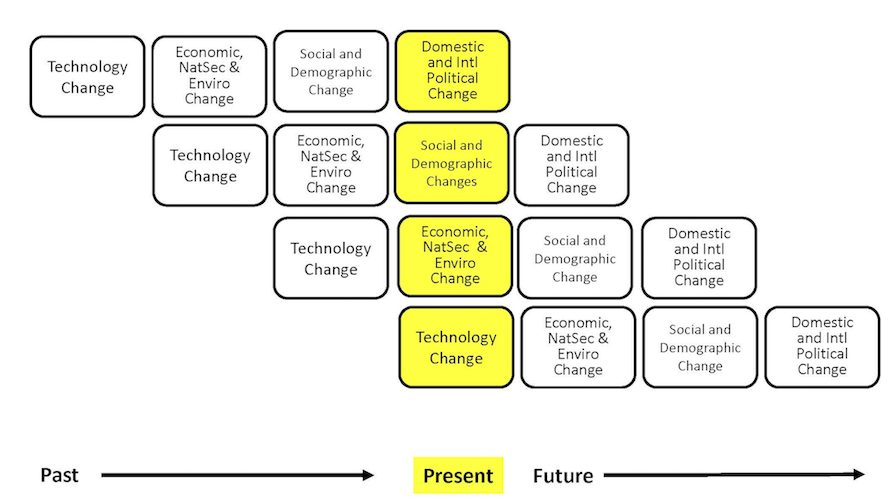
While most media coverage of these systems focused on flows (e.g., the size of the government deficit), rapid non-linear change in complex adaptive systems is often caused by a key stock (e.g., the amount of outstanding government debt) exceeding a critical threshold.
The next table highlights the key macro system stocks that we monitor.
In the next section, we will discuss information received over the past month that is related to these stocks, and which we believe is significant to our assessment of the probabilities that a critical threshold will be reached and a regime change will occur. We will conclude with our estimate, at the end of this month, of how close the macro system is to these critical thresholds, and the implications for financial market regime change probabilities.
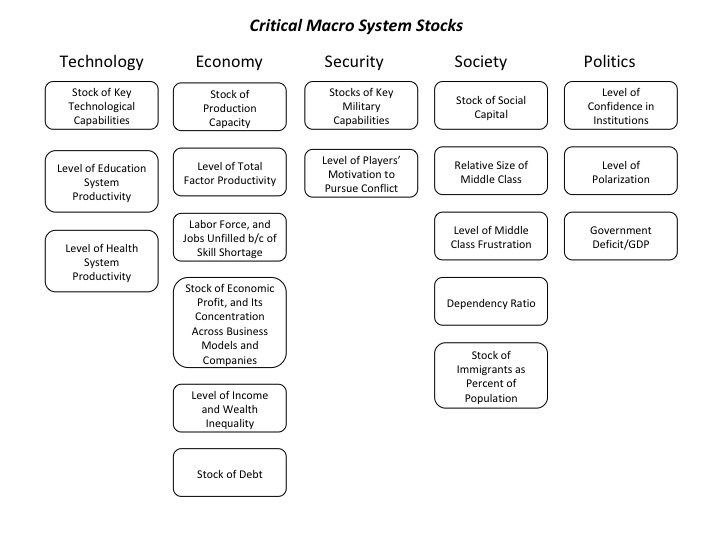
How Close is the Macro System to One or More Critical Thresholds?
As we have noted, the macro drivers of financial market regime changes typically follow a rough chronological sequence, from technology to economic, security, social, and political causes and effects. Yet there are many feedbacks loops between them, creating complex root causes for many of the critical thresholds we have identified.
Understanding the time dynamics in this complex system is critical to avoiding substantial downside investment risk.
We use the UK Met Office Warning Model to communicate our assessment of these time dynamics. We estimate the time remaining before a critical macro system threshold is reached that could trigger a regime change, which is usually accompanied by substantial changes in asset class valuations.
The model uses three increasingly serious levels of warning, from “Be Aware” (condition yellow), to “Be Prepared” (condition orange), to “Take Action” (condition red).
For our purposes, we denote as “Be Aware” (yellow) critical thresholds that we assess to be three or more years away. We estimate that “Be Prepared” (orange) thresholds could be reached within 1 to 3 years. “Take Action” thresholds are very likely to be reached within one year.
Given their nature, we also note that in our three “wildcard” areas (Environment and Energy related; Disease and Human Caused Bioevents; and Cyber and Electromagnetic Events), our forecasts have higher levels of uncertainty.
The following charts summarize our current estimate of the time remaining before different critical thresholds will be reached.
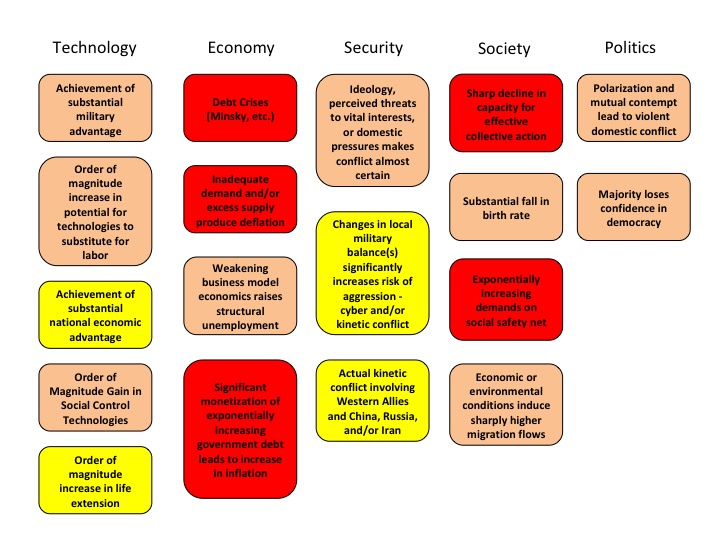
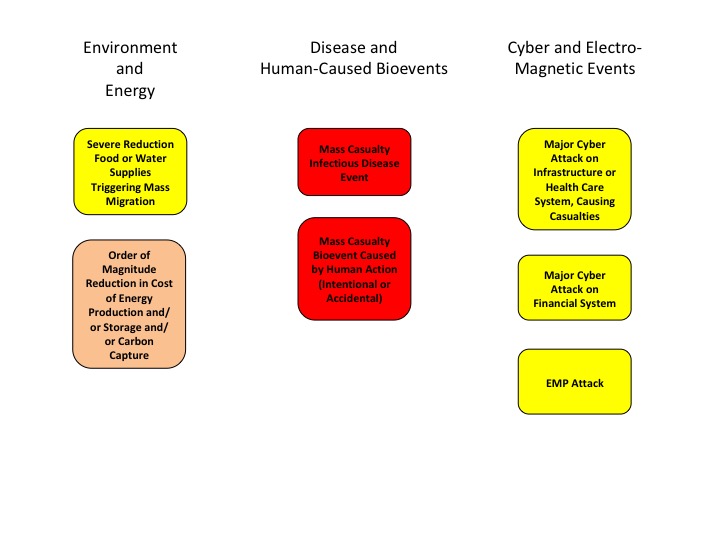
At the highest level, we believe the complex adaptive global macro system can be in one of four states, based on its degree of order versus disorder, and degree of social cooperation versus conflict. A very coarse-grained reading of history suggests that these states evolve in a predictable cycle, from ordered/cooperative, to disordered/cooperative, to disordered/conflicted, to ordered/conflicted.
We believe that the system is currently in its most uncertain state, characterized by high degrees of underlying disorder and social conflict, both domestically and internationally. Beyond some point, intensifying conflict eventually increases the degree of order in the system. That appears to be happening now, via the increasing conflict between China, Russia, and Iran and the United States and other Western nations.
If you have any questions about anything we have written in this issue, please don’t hesitate to get in touch, at contact@indexinvestor.com
Appendix: Anticipatory Thinking and Forecasting Methodologies
Our process is based on methods and tools developed over the past seven years at our affiliate, Britten Coyne Partners, which provides consulting services and education courses to executive teams and boards on strategic risk governance and management.
At The Index Investor, we engage in both anticipatory thinking to identify what could happen (e.g., different macro regimes and related events), and forecasting, to estimate the probability that events and regimes will happen, and the impact they will have if they do (e.g., on macro variables and broad asset class returns).
With respect to what could happen, we are acutely conscious of the conclusion reached by a 1983 CIA study of failed forecasts: "each involved historical discontinuity, and, in the early stages…unlikely outcomes. The basic problem was…situations in which trend continuity and precedent were of marginal, if not counterproductive value."
When it comes to forecasting, we know that in complex socio-technical systems that are constantly evolving, the accuracy of statistical or machine learning based forecasting methods declines exponentially as the time horizon lengthens, since the historical data set on which they were trained will (depending on the speed and effectiveness of any retraining cycle) bear less and less resemblance to the distribution of outcomes the system is likely to produce in the future.
Under these circumstances, forecast accuracy over longer time horizons depends on causal and counterfactual reasoning about the possible future effects of multiple interacting trends and uncertainties that are hard to quantify.
And we are acutely aware of the economist Rudi Dornbusch's famous warning: "Crises take a much longer time coming than you think, then happen much faster than you would have thought."
Our forecasting process also draws on lessons Tom Coyne learned from spending four years as a member of the Good Judgment Project team, which won the Intelligence Advanced Research Projects Activity’s forecasting tournament with forecast accuracy that was more than 50% better than the tournament's control groups (the team's experience is described in Professor Philip Tetlock's book, “Superforecasting").
Our analysis focuses on the probability of the global macro system being in four possible macro regimes 12 and 36 months from the date of our forecast: (1) Normal Times, where equity asset classes perform well; (2) a High Uncertainty regime that is usually short and transitory, where asset classes like short-term government bonds perform best and equities suffer significant declines; (3) High Inflation (which we deem 5% or more, year-on-year), where commercial property, real return bonds and other traditional hedges are favored; and (4) Persistent Deflation (a year-on-year decline in the US CPI), which up to now has only been seen in Japan, and in which the relative performance of different asset classes remains uncertain, but will likely favor high quality bonds and the consumer staples equity sector.
In response to subscriber requests, we have added a 36-month regime forecast to our existing 12 month forecast. The logic is that, in a complex evolving system like global macro, a longer forecast horizon gets beyond the “detection range” of algorithmic forecasting approaches, and therefore raises probability that a manager/investor can gain an edge in identifying emerging threats and opportunities.
That said, because evolving (i.e., “non-stationary”) complex systems populated by highly connected human agents are also capable of sudden non-linear changes (with which are hard for algorithmic approaches to predict), we are also keeping our 12 month forecast.
Our forecasting methodology starts with base rate/reference case data about the historical probability of large changes in equity and bond valuations. We then analyze the current situation from both a quantitative and qualitative perspective. In the latter, we focus on the key endogenous drivers of macro regime change, including technological, economic, national security, social, and political trends and uncertainties. We also focus on three potential sources of exogenous shocks that could also produce a macro regime change, caused by environmental, disease, and cyber related events.
While most of our attention typically focuses on various flows (e.g., economic growth, change in the price level, sales, earnings, job creation, etc.), endogenously caused regime changes result when those flows push key stocks beyond a critical threshold or tipping point, often setting off non-linear reactions across multiple areas. As noted by Hyman Minsky and others, a classic example is the steady accumulation of outstanding debt until it reaches the point where it can no longer be serviced and triggers a crisis.
Base Rate Data
Since the end of World War Two, there have been fifteen months where a downturn in the US equity market began that eventually reduced asset class value by 20% of more. That is a hazard rate of about 1.75% per month. Put differently, in any given month there is a 98.25% probability that a 20%+ downturn won’t occur, or, in a given year, an 81% probability.
However, as the time without a 20%+ downturn extends, the compound probability that one will not occur shrinks. At the end of August 2018, it is more than nine years since the last equity market decline of 20% or more. The probability of that happening is only 15%.
To estimate the base rate for a 20% fall in bond prices (which historically has been caused by a sharp increase in inflation, as we saw in the late 1970s and early 1980s), we analyzed monthly historical AAA bond yields since 1919. For consistency, we used them to calculate the price of a ten-year zero coupon bond. We then calculated the probability of a price decline of 20% or more over three different holding periods: 12, 18, and 24 months. In any month, the annualized probability of a decline of 20% or more over the subsequent 12 months is 12%; over 18 months, 20%, and over 24 months, 25%.
Market Stress Indicators Methodology
We view financial markets as a complex adaptive system. The size of changes generated by such a system follows a power law rather than a normal (Gaussian) distribution. The critical point is that large changes are much more common in complex adaptive systems than most people’s intuition leads them to believe.
While predicting the behavior of complex adaptive systems remains far more art than a science, various researchers have found that large changes in such systems are often preceded by subtle warning signs, as stress accumulates within them. While this research is not definitive, we believe that five warning signs are worth monitoring as potential indicators of growing stress within financial markets that could suddenly give rise to large changes in asset class valuations.
Our first indicator is the month-to-month autocorrelation of broad asset class returns (i.e., the relationship of this month’s returns to last month’s). A system under increasing stress loses resiliency, causing it to take longer to recover from perturbations; hence, autocorrelation increases as it approaches a critical transition (see, “Early Warning Signals for Critical Transitions” by Scheffer, et al).
The second market stress indicator we monitor is the Economic Policy Uncertainty Index published by the Federal Reserve Bank of St. Louis (via its FRED economic database), which is based on research by Baker, Bloom, and Davis (see their paper, “Measuring Economic Policy Uncertainty”). The index is based on automated text analysis of leading newspapers and magazine publications, to identify the frequency with which words and phrases are used that indicate uncertainty.
In humans’ evolutionary past, when uncertainty increased the probability of survival was enhanced by staying close to a group. All of us still have that instinct. Research has found that as uncertainty increases, we have an unconscious bias towards higher conformity of our own views with those of a larger group (i.e., reduction in cognitive diversity). Behaviorally, heightened uncertainty induces more “social copying” of others, likely due to both conformity bias and the rational belief that others may be acting on the basis of superior information. This increase in conformity and copying makes a social system more ordered as uncertainty increases, and also reduces its responsiveness to perturbations (i.e., increases autocorrelation) because of delays in the social copying process.
The key point is that increasing uncertainty induces more, not less order in social systems, and in so doing primes them for sudden non-linear change.
Our third market stress indicator is the spread between the yield on AAA rated bonds and the 10-year US Treasury. This is a proxy for the level of investor concern about financial system funding liquidity.
Our fourth market stress indicator is the yield spread between speculative BB rated bonds and the ten-year US Treasury. Throughout history, excessive credit growth has been a root cause of many financial crises. An indicator of such growth is falling credit spreads, particularly in the case of riskier borrowers. In contrast, rising BB spreads indicate growing investor concern about the consequences of such growth, and the financial distress lower rated companies could experience in an economic downturn.
Our fifth market stress indicator is what we term the “political risk premium” that is implicit in the price of gold. Our starting point for estimating this premium is the three different roles that gold plays. First, gold is a store of value in a world of fiat currencies. When the rate of money supply growth exceeds the growth of nominal GDP, gold’s price should increase to maintain its purchasing power. Between 2007 and 2017, the US money supply (M2) grew by about 86%, while nominal US GDP grew by 35%. The stock of gold grew by 18%, based on mine production over this period. We therefore infer that 33% of the increase in the price of gold represented the maximum potential gold price change that could be attributed to a desire to hedge inflation risk (86% less 35% less 18%).
Second, gold is a unit of account. We take this to mean that the annual change in GDP expressed in terms of physical gold (i.e., nominal GDP divided by the price of gold) should equal the change in real GDP calculated using the GDP price deflator to account for actual inflation over the period. A key challenge is the point at which to start this calculation.
We chose the price of gold in 1995/1996. In that period, the change in real global GDP measured using the IMF’s price deflator just about equaled the change in GDP measured in terms of physical gold. We interpret that coincidence as indicating that at that point in time, concerns about future inflation and political risk were minimal, and the change in the price of gold was mostly driven by its role as a unit of account. We calculated a subsequent series of gold prices that would produce the same change in “gold GDP” as the actual real GDP as calculated by the IMF. Between 2007 and 2017, “gold as a unit of account” warranted a 21% increase in its price.
Gold’s third role is as a hedge against inflation and what we term “political disaster” risk. We subtract the 21% estimated compensation for actual inflation from the 33% “gross” inflation risk hedge to derive an apparent 12% increase in the gold price that reflected the true risk premium to hedge against possible future inflation. However, between 2007 and 2017 the price of gold actually increased by 81%. This implies that 48% of this (81% less 21% less 12%) represented a premium for some other type of uncertainty at the end of 2017. The interesting question is the nature of the uncertainty for which gold is believed by some investors to be a superior hedge than traditional ports in a storm like short-term US government securities, or similar securities issued by other developed countries.
The logical inference is that the uncertainty in question must reflect a situation in which short term US Treasuries would be a less effective hedge than gold. This could be a world of widespread hyperinflation, capital controls, and/or radical changes in nations’ governments (of course, this would also imply a preference for investing in gold coins rather than bullion, as while the latter may be a store of value, it is far less convenient as a means of paying for transactions).
To put this in further perspective, this gold price “disaster risk” premium sharply increased from 2008 to 2012, then declined before sharply increasing again after 2016. Arguably, a significant part of the former increase reflects concerns about the potential inflationary consequences of dramatic quantitative easing by central banks. But this is not likely to be the case after 2016.