Feature Article: Understanding the Critical Difference Between Macro Threats and Threat Signatures
In our work at Britten Coyne Partners, we focus on helping clients anticipate, accurately assess, and adapt in time to emerging threats that could become existential – i.e., they could put the survival of the organization at risk.
We think of these threats as existing in three increasingly challenging realms, which you can visualize as three concentric circles. The innermost is the realm of risk, where the nature of a threat is well understood, including its range of possible outcomes and affects, and the probability of their occurrence. Because they can be assessed using traditional frequentist statistics, these threats seem easy to price and hedge, via insurance or derivative contracts. Yet as Long Term Capital Management demonstrated, they can still be existential, for example, because they are poorly modeled or if a hedge counterparty defaults.
A far larger circle encompasses the realm of uncertainty, in which some combination of a threat’s possible outcomes, affects, and probabilities is poorly understood. The challenge posed by uncertainty was famously described by Frank Knight in his 1921 book, “Risk, Uncertainty, and Profit.” Quantitatively, uncertainty is usually assessed using Bayesian statistics, in which probability represents not the historical frequency of a phenomenon’s occurrence, but rather an observer’s subjective belief that it will occur in the future, and the consequences it will have. The basis for such beliefs ranges from intuition, to copying the beliefs of others, to more sophisticated approaches to evaluating and weighing relevant evidence (e.g., Dempster-Shafer or Baconian methods).
The far larger circle, whose true dimensions are unknowable, is the realm of ignorance (both individual and organizational). Chapter 12 of John Maynard Keynes’ 1936 book on “The General Theory of Employment, Interest, and Money” is still one of the best descriptions to how we make decisions in the face of ignorance, and the fragility of the assumptions (“conventions”) that underlie them. As Keynes wrote:
“The state of long-term expectation, upon which our decisions are based, does not solely depend, therefore, on the most probable forecast we can make. It also depends on the confidence with which we make this forecast — on how highly we rate the likelihood of our best forecast turning out quite wrong. If we expect large changes but are very uncertain as to what precise form these changes will take, then our confidence will be weak. The state of confidence, as they term it, is a matter to which practical men always pay the closest and most anxious attention. But economists have not analysed it carefully and have been content, as a rule, to discuss it in general terms…
“The outstanding fact is the extreme precariousness of the basis of knowledge on which our estimates of prospective yield have to be made. Our knowledge of the factors which will govern the yield of an investment some years hence is usually very slight and often negligible. If we speak frankly, we have to admit that our basis of knowledge for estimating the yield ten years hence of a railway, a copper mine, a textile factory, the goodwill of a patent medicine, an Atlantic liner, a building in the City of London amounts to little and sometimes to nothing; or even five years hence. In fact, those who seriously attempt to make any such estimate are often so much in the minority that their behaviour does not govern the market.
“In practice we have tacitly agreed, as a rule, to fall back on what is, in truth, a convention. The essence of this convention — though it does not, of course, work out quite so simply — lies in assuming that the existing state of affairs will continue indefinitely, except in so far as we have specific reasons to expect a change. This does not mean that we really believe that the existing state of affairs will continue indefinitely. We know from extensive experience that this is most unlikely. The actual results of an investment over a long term of years very seldom agree with the initial expectation. Nor can we rationalise our behaviour by arguing that to a man in a state of ignorance errors in either direction are equally probable, so that there remains a mean actuarial expectation based on equi-probabilities. For it can easily be shown that the assumption of arithmetically equal probabilities based on a state of ignorance leads to absurdities. We are assuming, in effect, that the existing market valuation, however arrived at, is uniquely correct in relation to our existing knowledge of the facts which will influence the yield of the investment, and that it will only change in proportion to changes in this knowledge; though, philosophically speaking it cannot be uniquely correct, since our existing knowledge does not provide a sufficient basis for a calculated mathematical expectation. In point of fact, all sorts of considerations enter into the market valuation which are in no way relevant to the prospective yield…”
“A conventional valuation which is established as the outcome of the mass psychology of a large number of ignorant individuals is liable to change violently as the result of a sudden fluctuation of opinion due to factors which do not really make much difference to the prospective yield; since there will be no strong roots of conviction to hold it steady. In abnormal times in particular, when the hypothesis of an indefinite continuance of the existing state of affairs is less plausible than usual even though there are no express grounds to anticipate a definite change, the market will be subject to waves of optimistic and pessimistic sentiment, which are unreasoning and yet in a sense legitimate where no solid basis exists for a reasonable calculation…”
“Thus the professional investor is forced to concern himself with the anticipation of impending changes, in the news or in the atmosphere, of the kind by which experience shows that the mass psychology of the market is most influenced.”
As Keynes noted, in the face of uncertainty and ignorance, our capacity for anticipation is critical.
Our methodology decomposes anticipation into four challenges, as shown the following matrix:
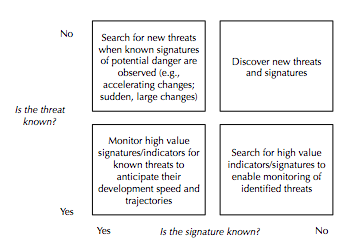
As the terms are used in this matrix, “threats” are distinguished by a clear causal story that links trends and/or events to specific negative consequences (e.g., for an individual, company, or nation). Threats can be further categorized by the time remaining before negative consequences are expected to occur, and the extent of those consequences – e.g., an imminent existential threat.
In contrast, a “signature” is a signal or set of signals that has a high probability of being associated with a threat. Such probabilities can be derived by multiple means, including the study of history, simulation modeling, deduction from axioms and theories, identification of patterns in current intelligence (e.g., the monthly reports in our Evidence File, which are chronologically organized by issue area in the subscribers-only section of our website), and intuition.
In the matrix above, most individuals and organizations likely spend most of their time in the bottom two quadrants – monitoring signals that are associated with known threats, and identifying new signals that can be used for this purpose.
We would argue, however, that when it comes to successful anticipation, activities in the upper half of the matrix are even more important.
For example, the upper right box of the matrix at first seems an impossible task: Where does one begin when trying to simultaneously discover new threats and signatures?
In the intelligence community, a new methodology in this quadrant is known as “Activity Based Intelligence” or ABI. It integrates a huge volume of data from multiple sources and “analyzes the interactions of people, activities, and events, in order to discover relevant patterns, and characterize those patterns” in order to identify new threats and signatures.
Even newer is the Defense Advanced Research Project Agency’s “KAIROS” initiative, which stands for “Knowledge-directed Artificial Intelligence Reasoning Over Schemas.”
A “schema” is an “organized unit of knowledge about an event or series of events”, that is based on past experience. Schemas are the building blocks of more complex mental models.
The goal of KAIROS is to use artificial intelligence to induce schemas from massive sets of unstructured (and often textual) data, and use them “to enable contextual and temporal reasoning about complex real-world events, in order to generate an actionable understanding fo them and predict how they will unfold.”
Lacking the resources of the world’s military and intelligence services, in our consulting work we have found that organizations can more usefully focus their anticipation efforts in the top left quadrant of the matrix, where they seek to recognize common threat signatures, and then use them as the starting point for identifying specific threats that could be associated with them.
Here are some examples:
- Evolution has primed human beings to automatically allocate attention to changes in their environment that are unanticipated (i.e., surprising), large, and/or rapid. We are less sensitive (at least at first) to changes whose rate is accelerating, though these are no less important.
- As individuals, we are also primed to rapidly recognize indications fear in others, and to stick more closely to our group when we receive signals indicating our environment has become more uncertain (which leads to higher levels of conformity and copying the behavior of others).
- In recent years, complex adaptive systems research has provided us with new threat signatures, including the “critical slowing down” (e.g., rising autocorrelation) of some systems before large changes occur. In social systems, both “Conviction Narrative Theory” (see David Tuckett’s work) and “Narrative Economics” (see Robert Shiller’s work) have highlighted the critical role of narrative in group behavior, and how shrinkage in the number of or support for competing narratives (i.e., the emergence of a dominant narrative), is an indicator of increasing fragility and a precursor of non-linear changes. Finally, Benoit Mandelbrot’s research on fractals, as well as Murray Gell Mann‘s and Didier Sornette’s related work have demonstrated that in many systems the size of changes follows a power-law pattern, with a growing number of smaller changes often indicating the buildup of stresses within a system that eventually gives rise to an exponentially larger change.
Complex adaptive systems like financial markets are characterized by multiple links between causes and effects, which are themselves often time-delayed and non-linear. This is why the identification of specific threats – with clear causal pathways and indicators – is so notoriously difficult, and why many narrow forecasts turn out to be inaccurate.
In our forecasting work over the years, we have found it is more productive to pay attention to the signatures that indicate growing stresses within a complex adaptive system, which can eventually produce changes that are sudden, large, and usually very disruptive.
Here are some examples of signatures in the five issue areas we focus on when developing our macro regime forecasts:
Technology
- New functionality
- Improvements in form/convenience
- Large gains in the performance of existing functionality
Economy
- Rapid growth in all forms of debt (e.g., bank, bond, pension, unfunded entitlements, etc.)
- Substantial change in energy prices
- Slowing demographic and/or productivity growth
- Introduction of significantly different business models and architectures that drive large changes in profitability
- Increasing and increasingly visible inequality
- Rapid environmental change
National Security
- Increasing mismatch between goals and resources, with minimal change in strategy (e.g., Paul Kennedy’s “imperial overstretch”).
- Rising challenger powers
- Increasing system disorder and level of conflict
- Rapid changes in weapons capabilities, along with military doctrine and organization, leading to increasing asymmetry between nations
Society
- Worsening educational and health outcomes
- Declining social mobility
- Increasing middle class frustration
- Declining popular legitimacy of traditional elites
- Rising migration pressures
Politics
- Increasing polarization
- Political shifts away from the center, especially of they are extreme and symmetrical
- Weakened institutional capacity to implement policy to produce improving results
- Political gridlock
Individually or in combination, these signatures can be used to trigger and guide the search for more specific threats when one or more of them are observed. And collectively, they can also provide a “coarse grained” warning that dangerous stresses are building up within the macro system.
If you have any questions about anything we have written in this issue, please don’t hesitate to get in touch, at contact@indexinvestor.com