Feature Article: Ten Years Later: Threats to Political Legitimacy Have Grown More Dangerous
Political legitimacy is a difficult concept to define. For example, the entry for it in the Stanford Encyclopedia of Philosophy goes on for pages. Francis Fukuyama takes a narrower view, noting that, “legitimacy is a generally accepted set of limits imposed on conflict and change. When the limits are respected, an outcome is perceived to be legitimate.” We take the position that, as US Supreme Court Justice Potter Steward famously said about pornography, while political legitimacy may be hard to define, you know it when you see it – and when you don’t.
In May and September of 2010, The Index Investor published feature articles on what we then called “the growing threat to political legitimacy.” You can download both of them here.
The story actually begins much earlier. I still remember listening to a speech my father gave, back n 1977 or 1978, when he was sixty. He recounted all the shocks that had hit everyone in the room over the past decade, including the assassinations of Martin Luther King Jr. and Robert Kennedy; the riots at the 1968 Democratic Convention, the election of Richard Nixon, the tremendous shift in the Democratic Party followed by the landslide loss of George McGovern in 1972, Watergate and Nixon’s resignation, the 1973 oil shock, the rise of inflation and how it devastated many people’s standard of living, and the fall of Saigon and shock that the United States had lost a war.
For the generation who thought they had seen it all, after having grown up through the Depression and won World War Two, the events of the past decade had left them stunned and disoriented.
I’ve never forgotten what my father said next. What really worried him that night was two things: the decline of manufacturing in southern New England, and the rise of conspicuous consumption by a generation that, not having been raised on stories of the bitter conflicts that accompanied industrialization or lived through the Depression, could not see it for the “social cancer” it was. His pessimistic conclusion that night was that if things didn’t change, the years ahead were going to get harder and harder for “Joe Middle Income.”
And that, unfortunately, is what has happened over the past 40 plus years.
I have a collection of books that documents different observers’ concerns about the path the country has been on. Here are the ones that were published in the eighties and nineties:
The Culture of Narcissism: American Life in an Age of Diminishing Expectations, by Christopher Lasch (1979)
Managing Our Way to Economic Decline, by Hayes and Abernathy (1980)
The Rise and Decline of Nations, by Mancur Olson (1982)
The Closing of the American Mind, by Allan Bloom (1987)
The Rise and Fall of the Great Powers, by Paul Kennedy (1987)
The Bonfire of the Vanities, by Tom Wolfe (1987)
The Collapse of Complex Societies, by Joseph Tainter (1988)
Fear of Falling, by Barbara Ehrenreich (1989)
The Politics of Rich and Poor, by Kevin Phillips (1990)
The Overworked American, by Juliet Schor (1991)
Culture Wars: The Struggle to Define America, by James Davison Hunter (1991)
Post Modernism: The Cultural Logic of Late Capitalism, by Frederic Jameson (1991)
Whither the Middle Class? by Duncan and Smeeding (1991)
Populism and Elitism, by Jeffrey Bell (1992)
Boiling Point: Democrats, Republicans, and the Decline of the Middle Class, by Kevin Phillips (1993)
Culture of Complaint: The Fraying of America, by Robert Hughes (1993)
The Revolt of the Elites and the Betrayal of Democracy, by Christopher Lasch (1994)
The Good Life and Its Discontents, by Robert Samuelson (1995)
The End Of Affluence: The Causes And Consequences Of America's Economic Dilemma, by Jeff Madrick (1995)
The Overspent American, by Juliet Schorr (1997)
What’s Wrong with Critical Race Theory: Reopening the Case for Middle Class Values, by Daniel Subotnik (1998)
Luxury Fever, by Robert Frank (1999)
One Nation, Two Cultures, by Gertrude Himmelfarb (1999)
Bobos in Paradise, by David Brooks (2000)
Why the White Working Class Still Matters, by Teixeira and Rogers (2000)
Bowling Alone, by Robert Putnam (2000)
The 2000s proved to be a far more tumultuous decade that the 80s or 90s, as we were hit with a series of shocks.
These included Al Gore challenging the legitimacy of the 2000 election outcome in the courts, the 9/11 terrorist attacks (and others in Europe), the exponential increase in globalization and outsourcing of production following China joining the World Trade Organization at the end of 2001, the 2003 Iraq War, the housing boom, and the Great Financial Crisis in 2008.
Throughout the decade, the economic and social challenges facing the middle class continued to worsen and its resentments increased as a rising share of income went to those at the top, and fueled their conspicuous consumption. The elite’s growing contempt for the masses was painfully brought into widespread public view by Barak Obama’s jarring comment about working class voters in old industrial towns during his 2008 campaign for president: “They get bitter, they cling to guns or religion or antipathy to people who aren't like them or anti-immigrant sentiment or anti-trade sentiment as a way to explain their frustrations.”
That was the background for our 2010 analyses of what we termed, “the growing threat to political legitimacy.”
Summary of our 2010 Analysis
In 2010 we observed that, “It is safe to say that the world economy has entered a period characterized by complex and dangerous dynamics that few people even begin to understand. And even fewer people have tried to think more than a few steps ahead, about where these dynamics may take us, much less what those future scenarios imply for asset allocation and risk management decisions today.
“It goes without saying that any attempt at such thinking is bound to be imperfect, given the complex and evolving nature of the underlying system that is generating the rapid and often confusing changes we see all around us today. Nevertheless, professionals who have been entrusted with the management of other people’s money, and especially those who have a fiduciary duty to their clients, have an obligation to think about these issues” …
“Our current analytical framework is based on the assumption that the world faces four critical and interrelated challenges whose potential effects are non-linear. This makes them both hard to understand, and raises the likelihood that we will underestimate their potential impact and will be surprised by the rapid changes they may cause.
“The first challenge is the fragile nature of the global financial system, in which a very large amount of debt of highly uncertain quality rests on a very thin capital base. On the other side of this equation is the precarious position of many parties that are struggling to repay and/or rollover that debt, including households, some corporations (e.g., commercial property developers), and various levels of government, up to and including some sovereign nations.
“The second challenge is the weakened and imbalanced state of global aggregate demand…
“The third challenge facing the world economy is the risk that developed economies will slip into an extended period of deflation, similar to Japan’s experience since the bursting of its property and equity bubble in 1989…
“The final challenge we face is maintaining the legitimacy of various political institutions that function as control parameters for the global economy and financial markets. These institutions are both international (e.g. rules governing multilateral trade and capital flows) and domestic (e.g., rules governing taxation and redistribution), and face economic and social stresses not seen since in most countries since the 1930s…
“In essence, the “muddling through” scenario assumes that all these challenges will be met, and that the main price we will pay is a prolonged period of slower economic growth (the truly rosy scenario assumes that rising domestic demand in emerging markets will cause them to become the new motor of the world economy, which in turn will return global growth to its previously high levels).
“The downside scenario assumes that we will fail to meet one or more of these challenges, and, given their complex interrelationships and non-linear effects, the result will be an extended period of stagnation whose severity will take many people by surprise…
In our 2010 analysis, we applied different frameworks to better understand the growing political legitimacy crisis.
“Perhaps the best inductive framework has been developed by the Political Instability Task Force, a group of scholars that was originally formed in 1994 and whose work was funded by the U.S. Central Intelligence Agency (the task force’s public website can be found here). In their paper “Modeling Transitions To and From Democracy”, Ulfelder and Lustik summarize the key factors that are associated with these two types of political legitimacy crises (see also, “How to Construct Stable Democracies” by Goldstone and Ufelder).
“This research concludes that increasingly factionalized political competition increases the probability of transition away from democracy. These transitions are also characterized by (1) heightened parochialism (major political parties focus on the interests of a narrow group, rather than nation as a whole); (2) heightened polarization (competition over central authority is increasingly a winner-take-all struggle); and (3) rising mobilization (rival groups begin to pursue their interests through collective action). All of these are amplified by deteriorating economic performance.”
From a deductive perspective, we observed that the growing crisis of political legitimacy could be described as a complex contagion that was driven by causes deeply rooted in our evolutionary past.
“For complex contagions to spread, multiple sources of activation are required. Hence, complex contagions are more likely to spread when individuals in a network observe a new behavior or belief in a significant number of the other individuals to whom they are linked…
“More specifically, two conditions are required for the transmission of a complex contagion.
“First, an individual has to be susceptible to it, in the sense that his or her current behavior or beliefs are not achieving goals or satisfying needs that are important to the individual. Second, a threshold must be met, with a minimum number of other linked individuals adopting the new behavior or belief.
“In the context of the changes in collective beliefs and behavior that triggers a political legitimacy crisis, we believe the susceptibility criterion is ultimately grounded in a sufficient number of people fearing for their future. A person must have a very powerful motivator to question the legitimacy of a political system; only fear can provide that.
“In previous issues, we have written at length about the complex neurobiology of fear, and its relationship to the role played by the amygdala (a primitive part of our brain). To simplify, there are two key primary fear triggers: the experience of uncertainty, and the experience of loss. The latter can be either absolute, as in the loss of resources, or relative, as in the loss of relative social status. Once a primary fear is triggered, people also experience a heightened secondary fear of social isolation. All of these emotional reactions probably increased our ancestors’ chances for survival on the East African plain, and are therefore likely hardwired into us by evolution.
“With respect to the threshold criterion, research has shown that there is a complicated relationship between the emotions triggered by gains and losses and whether these outcomes result from our action or inaction.
“Our emotional reactions to gains and losses, and our preferences for errors of commission and omission, seem to be deeply connected with whether those gains and losses are private or visible to a social group within which we believe our relative social status is important.
“When they know the results of a decision will be private, human beings prefer errors of omission, in order to avoid feeling regret. However, when the results will be public, they prefer errors of commission to avoid feelings of envy (see “Interdependent Utilities: How Social Ranking Affects Choice Behavior” by Bault, Coricelli, and Rustichini).
“Think of this as a switch from a system dominated by negative feedback to one dominated by positive feedback.
“From this perspective, political legitimacy crises result when a social network passes two critical points: first, feelings of fear arise in a sufficiently large number of people, and second, there is a willingness to go beyond our natural preference for errors of omission rather than errors of commission, because enough socially important individuals to whom we are linked are adopting new beliefs and behaviors.
This is not to say that all situations that pass the susceptibility and social threshold tests will trigger a legitimacy crisis. A full-blown crisis requires that collective action is undertaken not just by isolated local networks of individuals, but by many such networks in parallel. In this regard, modern technology has made this transition much more likely, as it has enabled the creation of vastly more network links, both between local individuals and between local networks themselves. So called “flash mobs” are one example of this, as are the “color revolutions” we have seen in a number of countries in recent years…
“From a social network perspective, more and more people are fearful for their jobs and their futures, and increasingly frustrated by the inability of the political system to respond in a manner that reduces these fears.
“More important, people increasingly realize that many other people in their social networks – and in similar networks around their countries, if not the world – share their fears. The Tea Party movement in the United States is a logical result of this situation, and shows that for a growing number of people, the collective action threshold has been passed.
“However, this still begs the question of the extent to which these growing frustrations and signs of collective action are translating into a growing crisis of political legitimacy.
“In our view, there is evidence that this is, in fact, occurring. For example, a growing number of commentators have noted the sharply widening gap in the United States, and likely in other countries as well, between the views of the elite and the views of the masses.
“For example, the pollster Scott Rasumussen has found that 68% of likely voters “say the political class doesn’t care what most Americans think”, while 84% say that America is headed in the wrong direction. In contrast, 67% of what Rasmussen terms the “political class” thinks America is headed in the right direction (for more of his analysis, see Rasmussen’s recently published book, In Search of Self Governance).
“Peggy Noonan also captured this sentiment in a recent Wall Street Journal column (“America Is At Risk of Boiling Over”, 6Aug10). She noted that, “The biggest change in my political lifetime is that Americans no longer assume that their children will have it better than they did. This is a huge break with the past, with assumptions and traditions that have shaped us.”
As the following chart shows, Noonan was spot on:
In May and September of 2010, The Index Investor published feature articles on what we then called “the growing threat to political legitimacy.” You can download both of them here.
The story actually begins much earlier. I still remember listening to a speech my father gave, back n 1977 or 1978, when he was sixty. He recounted all the shocks that had hit everyone in the room over the past decade, including the assassinations of Martin Luther King Jr. and Robert Kennedy; the riots at the 1968 Democratic Convention, the election of Richard Nixon, the tremendous shift in the Democratic Party followed by the landslide loss of George McGovern in 1972, Watergate and Nixon’s resignation, the 1973 oil shock, the rise of inflation and how it devastated many people’s standard of living, and the fall of Saigon and shock that the United States had lost a war.
For the generation who thought they had seen it all, after having grown up through the Depression and won World War Two, the events of the past decade had left them stunned and disoriented.
I’ve never forgotten what my father said next. What really worried him that night was two things: the decline of manufacturing in southern New England, and the rise of conspicuous consumption by a generation that, not having been raised on stories of the bitter conflicts that accompanied industrialization or lived through the Depression, could not see it for the “social cancer” it was. His pessimistic conclusion that night was that if things didn’t change, the years ahead were going to get harder and harder for “Joe Middle Income.”
And that, unfortunately, is what has happened over the past 40 plus years.
I have a collection of books that documents different observers’ concerns about the path the country has been on. Here are the ones that were published in the eighties and nineties:
The Culture of Narcissism: American Life in an Age of Diminishing Expectations, by Christopher Lasch (1979)
Managing Our Way to Economic Decline, by Hayes and Abernathy (1980)
The Rise and Decline of Nations, by Mancur Olson (1982)
The Closing of the American Mind, by Allan Bloom (1987)
The Rise and Fall of the Great Powers, by Paul Kennedy (1987)
The Bonfire of the Vanities, by Tom Wolfe (1987)
The Collapse of Complex Societies, by Joseph Tainter (1988)
Fear of Falling, by Barbara Ehrenreich (1989)
The Politics of Rich and Poor, by Kevin Phillips (1990)
The Overworked American, by Juliet Schor (1991)
Culture Wars: The Struggle to Define America, by James Davison Hunter (1991)
Post Modernism: The Cultural Logic of Late Capitalism, by Frederic Jameson (1991)
Whither the Middle Class? by Duncan and Smeeding (1991)
Populism and Elitism, by Jeffrey Bell (1992)
Boiling Point: Democrats, Republicans, and the Decline of the Middle Class, by Kevin Phillips (1993)
Culture of Complaint: The Fraying of America, by Robert Hughes (1993)
The Revolt of the Elites and the Betrayal of Democracy, by Christopher Lasch (1994)
The Good Life and Its Discontents, by Robert Samuelson (1995)
The End Of Affluence: The Causes And Consequences Of America's Economic Dilemma, by Jeff Madrick (1995)
The Overspent American, by Juliet Schorr (1997)
What’s Wrong with Critical Race Theory: Reopening the Case for Middle Class Values, by Daniel Subotnik (1998)
Luxury Fever, by Robert Frank (1999)
One Nation, Two Cultures, by Gertrude Himmelfarb (1999)
Bobos in Paradise, by David Brooks (2000)
Why the White Working Class Still Matters, by Teixeira and Rogers (2000)
Bowling Alone, by Robert Putnam (2000)
The 2000s proved to be a far more tumultuous decade that the 80s or 90s, as we were hit with a series of shocks.
These included Al Gore challenging the legitimacy of the 2000 election outcome in the courts, the 9/11 terrorist attacks (and others in Europe), the exponential increase in globalization and outsourcing of production following China joining the World Trade Organization at the end of 2001, the 2003 Iraq War, the housing boom, and the Great Financial Crisis in 2008.
Throughout the decade, the economic and social challenges facing the middle class continued to worsen and its resentments increased as a rising share of income went to those at the top, and fueled their conspicuous consumption. The elite’s growing contempt for the masses was painfully brought into widespread public view by Barak Obama’s jarring comment about working class voters in old industrial towns during his 2008 campaign for president: “They get bitter, they cling to guns or religion or antipathy to people who aren't like them or anti-immigrant sentiment or anti-trade sentiment as a way to explain their frustrations.”
That was the background for our 2010 analyses of what we termed, “the growing threat to political legitimacy.”
Summary of our 2010 Analysis
In 2010 we observed that, “It is safe to say that the world economy has entered a period characterized by complex and dangerous dynamics that few people even begin to understand. And even fewer people have tried to think more than a few steps ahead, about where these dynamics may take us, much less what those future scenarios imply for asset allocation and risk management decisions today.
“It goes without saying that any attempt at such thinking is bound to be imperfect, given the complex and evolving nature of the underlying system that is generating the rapid and often confusing changes we see all around us today. Nevertheless, professionals who have been entrusted with the management of other people’s money, and especially those who have a fiduciary duty to their clients, have an obligation to think about these issues” …
“Our current analytical framework is based on the assumption that the world faces four critical and interrelated challenges whose potential effects are non-linear. This makes them both hard to understand, and raises the likelihood that we will underestimate their potential impact and will be surprised by the rapid changes they may cause.
“The first challenge is the fragile nature of the global financial system, in which a very large amount of debt of highly uncertain quality rests on a very thin capital base. On the other side of this equation is the precarious position of many parties that are struggling to repay and/or rollover that debt, including households, some corporations (e.g., commercial property developers), and various levels of government, up to and including some sovereign nations.
“The second challenge is the weakened and imbalanced state of global aggregate demand…
“The third challenge facing the world economy is the risk that developed economies will slip into an extended period of deflation, similar to Japan’s experience since the bursting of its property and equity bubble in 1989…
“The final challenge we face is maintaining the legitimacy of various political institutions that function as control parameters for the global economy and financial markets. These institutions are both international (e.g. rules governing multilateral trade and capital flows) and domestic (e.g., rules governing taxation and redistribution), and face economic and social stresses not seen since in most countries since the 1930s…
“In essence, the “muddling through” scenario assumes that all these challenges will be met, and that the main price we will pay is a prolonged period of slower economic growth (the truly rosy scenario assumes that rising domestic demand in emerging markets will cause them to become the new motor of the world economy, which in turn will return global growth to its previously high levels).
“The downside scenario assumes that we will fail to meet one or more of these challenges, and, given their complex interrelationships and non-linear effects, the result will be an extended period of stagnation whose severity will take many people by surprise…
In our 2010 analysis, we applied different frameworks to better understand the growing political legitimacy crisis.
“Perhaps the best inductive framework has been developed by the Political Instability Task Force, a group of scholars that was originally formed in 1994 and whose work was funded by the U.S. Central Intelligence Agency (the task force’s public website can be found here). In their paper “Modeling Transitions To and From Democracy”, Ulfelder and Lustik summarize the key factors that are associated with these two types of political legitimacy crises (see also, “How to Construct Stable Democracies” by Goldstone and Ufelder).
“This research concludes that increasingly factionalized political competition increases the probability of transition away from democracy. These transitions are also characterized by (1) heightened parochialism (major political parties focus on the interests of a narrow group, rather than nation as a whole); (2) heightened polarization (competition over central authority is increasingly a winner-take-all struggle); and (3) rising mobilization (rival groups begin to pursue their interests through collective action). All of these are amplified by deteriorating economic performance.”
From a deductive perspective, we observed that the growing crisis of political legitimacy could be described as a complex contagion that was driven by causes deeply rooted in our evolutionary past.
“For complex contagions to spread, multiple sources of activation are required. Hence, complex contagions are more likely to spread when individuals in a network observe a new behavior or belief in a significant number of the other individuals to whom they are linked…
“More specifically, two conditions are required for the transmission of a complex contagion.
“First, an individual has to be susceptible to it, in the sense that his or her current behavior or beliefs are not achieving goals or satisfying needs that are important to the individual. Second, a threshold must be met, with a minimum number of other linked individuals adopting the new behavior or belief.
“In the context of the changes in collective beliefs and behavior that triggers a political legitimacy crisis, we believe the susceptibility criterion is ultimately grounded in a sufficient number of people fearing for their future. A person must have a very powerful motivator to question the legitimacy of a political system; only fear can provide that.
“In previous issues, we have written at length about the complex neurobiology of fear, and its relationship to the role played by the amygdala (a primitive part of our brain). To simplify, there are two key primary fear triggers: the experience of uncertainty, and the experience of loss. The latter can be either absolute, as in the loss of resources, or relative, as in the loss of relative social status. Once a primary fear is triggered, people also experience a heightened secondary fear of social isolation. All of these emotional reactions probably increased our ancestors’ chances for survival on the East African plain, and are therefore likely hardwired into us by evolution.
“With respect to the threshold criterion, research has shown that there is a complicated relationship between the emotions triggered by gains and losses and whether these outcomes result from our action or inaction.
“Our emotional reactions to gains and losses, and our preferences for errors of commission and omission, seem to be deeply connected with whether those gains and losses are private or visible to a social group within which we believe our relative social status is important.
“When they know the results of a decision will be private, human beings prefer errors of omission, in order to avoid feeling regret. However, when the results will be public, they prefer errors of commission to avoid feelings of envy (see “Interdependent Utilities: How Social Ranking Affects Choice Behavior” by Bault, Coricelli, and Rustichini).
“Think of this as a switch from a system dominated by negative feedback to one dominated by positive feedback.
“From this perspective, political legitimacy crises result when a social network passes two critical points: first, feelings of fear arise in a sufficiently large number of people, and second, there is a willingness to go beyond our natural preference for errors of omission rather than errors of commission, because enough socially important individuals to whom we are linked are adopting new beliefs and behaviors.
This is not to say that all situations that pass the susceptibility and social threshold tests will trigger a legitimacy crisis. A full-blown crisis requires that collective action is undertaken not just by isolated local networks of individuals, but by many such networks in parallel. In this regard, modern technology has made this transition much more likely, as it has enabled the creation of vastly more network links, both between local individuals and between local networks themselves. So called “flash mobs” are one example of this, as are the “color revolutions” we have seen in a number of countries in recent years…
“From a social network perspective, more and more people are fearful for their jobs and their futures, and increasingly frustrated by the inability of the political system to respond in a manner that reduces these fears.
“More important, people increasingly realize that many other people in their social networks – and in similar networks around their countries, if not the world – share their fears. The Tea Party movement in the United States is a logical result of this situation, and shows that for a growing number of people, the collective action threshold has been passed.
“However, this still begs the question of the extent to which these growing frustrations and signs of collective action are translating into a growing crisis of political legitimacy.
“In our view, there is evidence that this is, in fact, occurring. For example, a growing number of commentators have noted the sharply widening gap in the United States, and likely in other countries as well, between the views of the elite and the views of the masses.
“For example, the pollster Scott Rasumussen has found that 68% of likely voters “say the political class doesn’t care what most Americans think”, while 84% say that America is headed in the wrong direction. In contrast, 67% of what Rasmussen terms the “political class” thinks America is headed in the right direction (for more of his analysis, see Rasmussen’s recently published book, In Search of Self Governance).
“Peggy Noonan also captured this sentiment in a recent Wall Street Journal column (“America Is At Risk of Boiling Over”, 6Aug10). She noted that, “The biggest change in my political lifetime is that Americans no longer assume that their children will have it better than they did. This is a huge break with the past, with assumptions and traditions that have shaped us.”
As the following chart shows, Noonan was spot on:
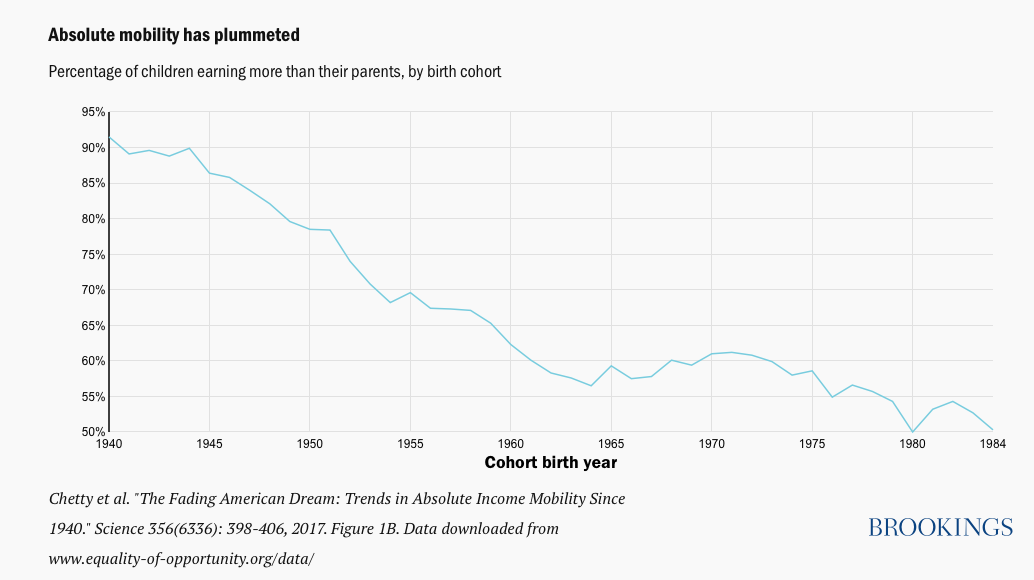
In her column, Noonan then asked, “but do our political leaders have any sense of what people are feeling deep down? They don’t act as if they do. I think their detachment from how normal people think is more dangerous and disturbing than it has been in the past… I’ve never seen the gap wider than it is now. I think it is a chasm… When the adults of a great nation feel long term pessimism, it only makes matters worse when those in authority take actions that reveal their detachment from those concerns – even from the essential nature of their fellow citizens. And it makes those citizens feel powerless. Inner pessimism and powerlessness: That is a dangerous combination” …
“In sum, we see widespread evidence today of an accelerating decline in the perceived legitimacy of the political institutions that govern the behavior of critical aspects of the global economic system”.
“We believe that this legitimacy crisis is most visible today at the international level. However, there is also evidence that domestic legitimacy crises are also building in the United States, China and the European Union. This trend represents a significant source of increased uncertainty for the operation of financial markets and the future returns on different asset classes.”
What Happened Between 2010 and 2020?
In the ten years since our report on the rising threat to political legitimacy was written, a number of critical changes have occurred:
• An ever growing number of people are experiencing either stagnant or declining living standards in the evolving 21st century economy, in which it has become harder and harder to maintain a middle class standard of living;
• This has led to the broadening and worsening of multiple social pathologies, including family breakdown, addiction, and a rising number of “deaths of despair.”
• Across economic, social, and political dimensions, the gap between various elites and the masses has grown wider, with the former increasingly treating the latter with condescension and contempt. In return, the masses have grown increasingly angry with and contemptuous of elite individuals and institutions because, “nobody’s helping us.” For example, Peggy Noonan wrote this in her February 2016 column on “Trump and the Rise of the Unprotected”: “What marks this political moment, in Europe and the U.S., is the rise of the unprotected. It is the rise of people who don’t have all that much against those who’ve been given many blessings and seem to believe they have them not because they’re fortunate but because they’re better” (for more on this, see Daniel Markovits’ 2019 book, “The Meritocracy Trap: How America's Foundational Myth Feeds Inequality, Dismantles the Middle Class, and Devours the Elite”).
• This increasingly poisonous social conflict has transformed politics from an arena in which policy differences are discussed and compromises reached in order to move the nation forward to one in which political parties have become tribal identities, increasingly pulled towards their populist extremes. In short, politics is now seen as a zero sum game in which one party increasingly denounce “wins” by the other party as “illegitimate.”
The Capitol riot on January 6, 2021 was just the latest step down the dangerous road we have been on for a long time.
This has not gone unnoticed; in the last ten years vastly more books have been written about our deteriorating economy, society, and politics than was the case in the eighties, nineties, and noughties.
Since we published our 2010 analysis, here is just a small selection of the many books that have appeared:
The Ruling Class, by Angelo Codevilla (2010)
Age of Greed: The Triumph of Finance and the Decline of America, 1970 to the Present, by Jeff Madrick (2011)
The Great Stagnation, by Tyler Cowen (2011)
Time to Start Thinking: America in the Age of Descent, by Edward Luce (2012)
Coming Apart: The State of White America 1960 - 2010, by Charles Murray (2012)
The Great Degeneration: How Institutions Decay and Economies Die, by Niall Ferguson (2013)
The New Class Conflict, by Joel Kotkin (2014)
The Revolt of the Public, by Martin Gurri (2014)
Political Order and Political Decay, by Francis Fukuyama (2014)
Our Kids: The American Dream in Crisis, by Robert Putnam (2015)
Makers and Takers: How Wall Street Destroyed Main Street, by Rana Foroohar (2016)
Hillbilly Elegy: A Memoir of a Family and Culture in Crisis, by JD Vance (2016)
The End of Loyalty: The Rise and Fall of Good Jobs in America, by Rick Wartzman (2017)
The Vanishing Middle Class: Prejudice and Power in a Dual Economy, by Peter Temin (2017)
Crashed: How a Decade of Financial Crises Changed the World, by Adam Tooze (2018)
Them: Why We Hate Each Other and How to Heal, by Ben Sasse (2018)
Squeezed: Why Our Families Can't Afford America, by Alissa Quart (2018)
The Forgotten Americans: An Economic Agenda for a Divided Nation, by Isabel Sawhill (2018)
The Coming Neo Feudalism, by Joel Kotkin (2020)
Deaths of Despair and the Future of Capitalism, by Deaton and Case (2020)
A New Contract with the Middle Class, by Reeves and Sawhill (2020)
What were the critical changes that accelerated the deterioration of political legitimacy between 2010 and today?
New Technologies Improved and/or Emerged.
• Perhaps the most important were automation (which led to more losses of previously well paying jobs), supply chain management (which led to more job losses due to offshoring, especially previously well-paid manufacturing jobs), smartphones and platform apps that enabled the rise of the euphemistically named “sharing economy” (which in practice facilitated the growth of poor quality “gig work” jobs); and social media apps which resulted in people becoming “hyperconnected” via text, photos, and video to multiple individuals and networks that provided us with exponentially increasing volumes of information.
Many Developed Country Economies Ceased to Create Enough Well Paid Jobs to Replace the Ones That They Lost.
• Historically, the introduction of new “general purpose technologies” like electricity created as many new jobs as they destroyed. In recent years, however, that has not been happening. Many hypotheses have been advanced to explain this, including tax systems that make it more expensive to hire workers than to automate and outsource jobs; stagnant education systems that have haven’t produced enough talented graduates to enable the diffusion of new technologies beyond a limited number of companies that have the necessary talent, leading to “winner-take-all” industry dynamics;
• Legalization of share buybacks in the United States in 1982, which depressed corporate investment (e.g., “How the Looting of the Business Corporation Became the U.S. Norm and How Sustainable Prosperity Can Be Restored” by Lazonick and Shin); and the financialization of the economy, leading to much greater use of leverage (debt), which further depressed investment rates (and thus productivity growth). The result has been the emergence of a growing bloc of politically volatile under and unemployed people, many of whom are young men who are frustrated and angry at a system they believe has failed them. Throughout history, this has been a dangerous combination.
The Emergence of a “Dual Economy”, Which Added Geographic Inequality to Worsening Inequalities of Income and Wealth.
• Digital industries with relatively high productivity, profits, and pay migrated to the coasts, while the middle of the country retained traditional physical capital industries like energy, agriculture, and manufacturing that were creating fewer jobs than the “new economy” companies. As Joel Kotkin notes in his essay “Economic Civil War”, “Our national divide is usually cast in terms of ideology, race, climate, and gender. But it might be more accurate to see our national conflict as regional and riven by economic function. The schism is between two ways of making a living, one based in the incorporeal world of media and digital transactions, the other in the tangible world of making, growing, and using real things.”
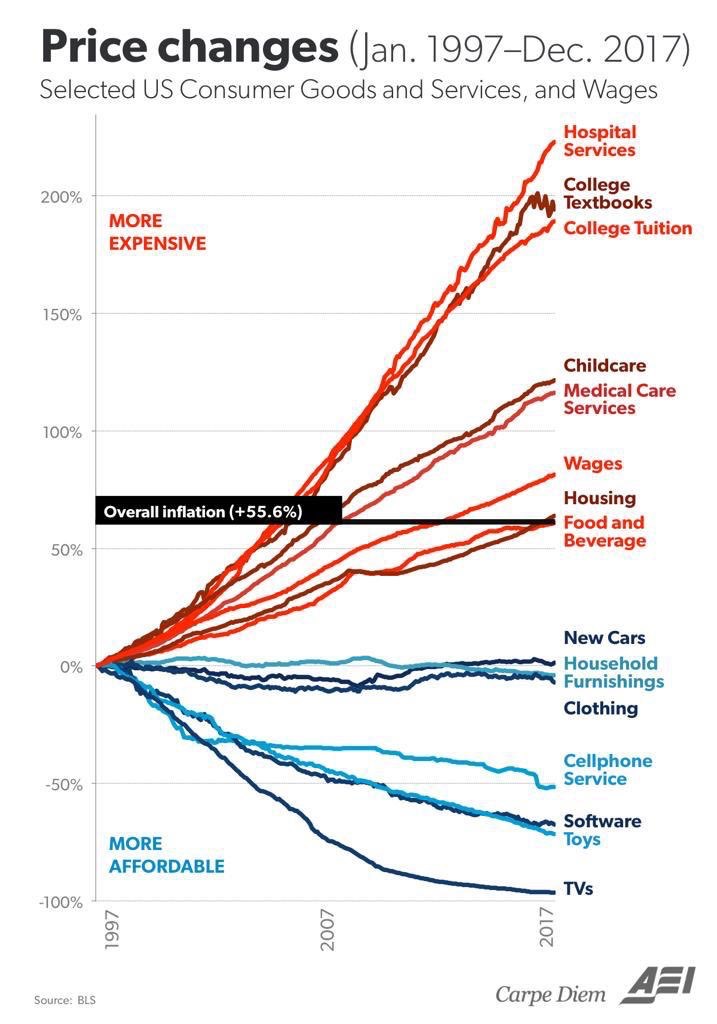
The Costs Of Key Elements of a Middle Class Living Standard Have Increased Much Faster Than Average Hourly Wages.
• At the same time, the profusion of social media photo and video apps has led to a steady flow of posts in which people convey to their networks the carefully crafted image of a lifestyle that is increasingly out of reach of the masses. This supercharging of conspicuous consumption has further increased middle class frustration and anger at a system they no longer believe is fair
“In sum, we see widespread evidence today of an accelerating decline in the perceived legitimacy of the political institutions that govern the behavior of critical aspects of the global economic system”.
“We believe that this legitimacy crisis is most visible today at the international level. However, there is also evidence that domestic legitimacy crises are also building in the United States, China and the European Union. This trend represents a significant source of increased uncertainty for the operation of financial markets and the future returns on different asset classes.”
What Happened Between 2010 and 2020?
In the ten years since our report on the rising threat to political legitimacy was written, a number of critical changes have occurred:
• An ever growing number of people are experiencing either stagnant or declining living standards in the evolving 21st century economy, in which it has become harder and harder to maintain a middle class standard of living;
• This has led to the broadening and worsening of multiple social pathologies, including family breakdown, addiction, and a rising number of “deaths of despair.”
• Across economic, social, and political dimensions, the gap between various elites and the masses has grown wider, with the former increasingly treating the latter with condescension and contempt. In return, the masses have grown increasingly angry with and contemptuous of elite individuals and institutions because, “nobody’s helping us.” For example, Peggy Noonan wrote this in her February 2016 column on “Trump and the Rise of the Unprotected”: “What marks this political moment, in Europe and the U.S., is the rise of the unprotected. It is the rise of people who don’t have all that much against those who’ve been given many blessings and seem to believe they have them not because they’re fortunate but because they’re better” (for more on this, see Daniel Markovits’ 2019 book, “The Meritocracy Trap: How America's Foundational Myth Feeds Inequality, Dismantles the Middle Class, and Devours the Elite”).
• This increasingly poisonous social conflict has transformed politics from an arena in which policy differences are discussed and compromises reached in order to move the nation forward to one in which political parties have become tribal identities, increasingly pulled towards their populist extremes. In short, politics is now seen as a zero sum game in which one party increasingly denounce “wins” by the other party as “illegitimate.”
The Capitol riot on January 6, 2021 was just the latest step down the dangerous road we have been on for a long time.
This has not gone unnoticed; in the last ten years vastly more books have been written about our deteriorating economy, society, and politics than was the case in the eighties, nineties, and noughties.
Since we published our 2010 analysis, here is just a small selection of the many books that have appeared:
The Ruling Class, by Angelo Codevilla (2010)
Age of Greed: The Triumph of Finance and the Decline of America, 1970 to the Present, by Jeff Madrick (2011)
The Great Stagnation, by Tyler Cowen (2011)
Time to Start Thinking: America in the Age of Descent, by Edward Luce (2012)
Coming Apart: The State of White America 1960 - 2010, by Charles Murray (2012)
The Great Degeneration: How Institutions Decay and Economies Die, by Niall Ferguson (2013)
The New Class Conflict, by Joel Kotkin (2014)
The Revolt of the Public, by Martin Gurri (2014)
Political Order and Political Decay, by Francis Fukuyama (2014)
Our Kids: The American Dream in Crisis, by Robert Putnam (2015)
Makers and Takers: How Wall Street Destroyed Main Street, by Rana Foroohar (2016)
Hillbilly Elegy: A Memoir of a Family and Culture in Crisis, by JD Vance (2016)
The End of Loyalty: The Rise and Fall of Good Jobs in America, by Rick Wartzman (2017)
The Vanishing Middle Class: Prejudice and Power in a Dual Economy, by Peter Temin (2017)
Crashed: How a Decade of Financial Crises Changed the World, by Adam Tooze (2018)
Them: Why We Hate Each Other and How to Heal, by Ben Sasse (2018)
Squeezed: Why Our Families Can't Afford America, by Alissa Quart (2018)
The Forgotten Americans: An Economic Agenda for a Divided Nation, by Isabel Sawhill (2018)
The Coming Neo Feudalism, by Joel Kotkin (2020)
Deaths of Despair and the Future of Capitalism, by Deaton and Case (2020)
A New Contract with the Middle Class, by Reeves and Sawhill (2020)
What were the critical changes that accelerated the deterioration of political legitimacy between 2010 and today?
New Technologies Improved and/or Emerged.
• Perhaps the most important were automation (which led to more losses of previously well paying jobs), supply chain management (which led to more job losses due to offshoring, especially previously well-paid manufacturing jobs), smartphones and platform apps that enabled the rise of the euphemistically named “sharing economy” (which in practice facilitated the growth of poor quality “gig work” jobs); and social media apps which resulted in people becoming “hyperconnected” via text, photos, and video to multiple individuals and networks that provided us with exponentially increasing volumes of information.
Many Developed Country Economies Ceased to Create Enough Well Paid Jobs to Replace the Ones That They Lost.
• Historically, the introduction of new “general purpose technologies” like electricity created as many new jobs as they destroyed. In recent years, however, that has not been happening. Many hypotheses have been advanced to explain this, including tax systems that make it more expensive to hire workers than to automate and outsource jobs; stagnant education systems that have haven’t produced enough talented graduates to enable the diffusion of new technologies beyond a limited number of companies that have the necessary talent, leading to “winner-take-all” industry dynamics;
• Legalization of share buybacks in the United States in 1982, which depressed corporate investment (e.g., “How the Looting of the Business Corporation Became the U.S. Norm and How Sustainable Prosperity Can Be Restored” by Lazonick and Shin); and the financialization of the economy, leading to much greater use of leverage (debt), which further depressed investment rates (and thus productivity growth). The result has been the emergence of a growing bloc of politically volatile under and unemployed people, many of whom are young men who are frustrated and angry at a system they believe has failed them. Throughout history, this has been a dangerous combination.
The Emergence of a “Dual Economy”, Which Added Geographic Inequality to Worsening Inequalities of Income and Wealth.
• Digital industries with relatively high productivity, profits, and pay migrated to the coasts, while the middle of the country retained traditional physical capital industries like energy, agriculture, and manufacturing that were creating fewer jobs than the “new economy” companies. As Joel Kotkin notes in his essay “Economic Civil War”, “Our national divide is usually cast in terms of ideology, race, climate, and gender. But it might be more accurate to see our national conflict as regional and riven by economic function. The schism is between two ways of making a living, one based in the incorporeal world of media and digital transactions, the other in the tangible world of making, growing, and using real things.”
The Costs Of Key Elements of a Middle Class Living Standard Have Increased Much Faster Than Average Hourly Wages.
• At the same time, the profusion of social media photo and video apps has led to a steady flow of posts in which people convey to their networks the carefully crafted image of a lifestyle that is increasingly out of reach of the masses. This supercharging of conspicuous consumption has further increased middle class frustration and anger at a system they no longer believe is fair
The Breakdown of Traditional Social Organizations Led People to Seek New Ways to Satisfy Their Human Need for “Belonging”.
• In his 2000 book “Bowling Alone”, Robert Putnam documented the decline of traditional sources of individual belonging and “social capital”, including fraternal organizations, sports leagues, and religious organizations. In the succeeding years, new sources of belonging and identity have arisen with regional, national, or global characteristics, rather than the local organizations documented by Putnam.
• Four examples stand out. I’m old enough to remember when people didn’t wear team jerseys and other kit to sports games and matches to communicate to others their shared loyalty to a team. That began to change in the 80s, and has now become a multibillion-dollar business. Paralleling this (in the United States) has been the transformation of the military from an object of derision after Vietnam, to the object of unquestioning praise and affiliation that shocked my father and his friends who served in World War 2 (and knew from experience that the military was far from perfect). Do you remember people wearing camoflauge and military-style kit in the 1970s or 1980s (well, at least until Top Gun came out)? Or (in the US) such widespread ownership of military style weapons?
• Elsewhere, for some environmentalism has become a powerful source of affiliation, complete with creation, fall, and redemption stories that remind one of a religion. More recently, the “woke” movement has at times seemed like the latest of the “Great Awakenings” that have occurred throughout America’s religious history.
Post-Modernism and Critical Theory (Including Critical Race Theor) First Grew on the Campuses, Then in the Wider Society.
• By far the most important aspects of this were three beliefs. First, that truth and facts is socially constructed, and therefore relative; there are no “objective” facts. Second, that the social construction of truth reflects the relative power of different/cross-sectional identity groups, all of which have been systematically discriminated against by “the patriarchy” of whites, and especially white males. By various routes (especially hyperconnectivity and social media apps) this initially facilitated the emergence of demands for “politically correct” speech, and, more recently, “woke” and “cancel culture” that demands positive discrimination in favor of members of previously oppressed identity groups, and repression of any speech that any member of those groups might find offensive or “problematic.” The highly destructive result of this (beyond the danger it poses to First Amendment freedoms) is that the United States of America has effectively lost its unifying national narrative.
The Business Models of Traditional Journalism and Legacy Media Were Overwhelmed by the Hyperconnectivity and Social Media Tsunami.
• When the news business was a combination of local and national advertising based oligopolies, journalists focused on collecting and accurately reporting facts to their audience, with opinions segregated from reporting on separate “Editorial” and “OpEd” pages. The rise of smart phones, hyperconnectivity, social media apps, and critical theory’s claim that facts and truth are social constructions, not absolutes destroyed the traditional model.
• Roger Ailes sensed the change that was underway when he took over as CEO of FOX News in 2000 and began to build “a Republican oriented CNN.” Others quickly followed, with the realization that traditional industry definitions and barriers had crumbled, and they were now in a brutal competition to deliver an economically attractive audience to advertisers. From here, it was only a short step to the de facto elimination of the barriers between reporting and opinion, and then the increasing use of emotionally arousing “clickbait” stories, the use of algorithms to curate and deliver this content to increasingly microtargeted audiences prized by various advertisers, and the collection of ever increasing amounts of personal data to further optimize this business model. The age of “echochambers” (or, as Shoshana Zuboff calls it, “surveillance capitalism”) was born.
Inevitably, All These Trends Have Led to Political Parties Becoming “Super Identities”, that Are Highly Correlated with Other Identities.
• With greater accuracy than ever before, just by knowing a person’s party affiliation today, you can predict a wide range of their other affiliations and characteristics. Unfortunately, political parties as “Super” or “Meta” identities also leads to tribalism and seeing politics as a zero sum game. Most dangerous of all, a rising number of partisans now treat members of the other party with undisguised condescension and contempt (e.g., “Partisan Antipathy: More Intense, More Personal” by Pew Research, and “Our Radicalized Republic: Can President Biden, Or Anyone Else, Overcome Years Of Rising Partisan Hatred?” by Koerth and Thomson-DeVeaux).
• As the Financial Times’ Isabella Kaminsky bluntly observed, “the groups in play have not just become tribal; they have become splintered into entirely opposing perspectives on cultural norms and reality…This leads to an extremely frightening framing of the fight between them in terms of good and evil” (“A Wilderness of Mirrors in the US”). When a marriage has reached this stage, divorce is almost certain. This is not an environment in which the perceived political legitimacy of government is likely to improve.
Last but not least, political legitimacy has also come directly under attack from two other sources.
The First Was the Democratic and Republican Parties Themselves.
• This began with the 2000 election, when Al Gore challenged the legitimacy of the vote count in Florida, causing the election to effectively be decided by the Supreme Court. After Obama was elected, the “birther” movement challenged his legitimacy. In 2016, the election of Donald Trump triggered the rise of the Democratic “Resistance”, which yet again challenged the legitimacy of an election and the president who won it. In 2020, this routine challenging of the legitimacy of electoral outcomes metastasized into Donald Trump’s repeated denial of his election loss, which led to the January 6th attack on the Capitol as Congress was certifying Joe Biden’s election.
The Other Attack on Political Legitimacy Has Come From Within Government Itself.
• Paul Light is not a name that is familiar to most Americans, including many of those who are most involved in politics. That is a shame. For years, Light has analyzed and publicized the declining competence and capacity of government bureaucracies to effectively resolve the increasingly complex problems they confront (e.g., “The Rebuilder’s Dilemma”, February 2020). Every day, across the United States people experience poor infrastructure, stagnant education systems, overpriced and impenetrable health care systems, and a growing Gordian Knot of regulation, presided over the government bureaucrats whose technical competence and interpersonal skills increasingly resemble the old Soviet Nomenklatura.
• When a government fails to effectively serve the people, and, worse, appears indifferent to their needs, its political legitimacy plummets. And when people increasingly believe the value they get from government in exchange for the taxes they pay is declining, and repeated promises to improve government performance are boken, people logically become more resistant to paying higher taxes – another sign of government’s declining legitimacy. Now the COVID pandemic has made the decline of government competence painfully clear to the entire nation – this time with deadly consequences.
In his recent article, “Rotten to the Core?” Francis Fukuyama summed up his view of the current situation.
“Writing in Foreign Affairs in 2014, I lamented the political decay that had taken root in the United States, where governing institutions had become increasingly dysfunctional. ‘A combination of intellectual rigidity and the power of entrenched political actors is preventing those institutions from being reformed,’ I wrote. ‘And there is no guarantee that the situation will change much without a major shock to the political order.’
“In the years that immediately followed, it seemed possible that the rise of Bernie Sanders and Donald Trump might present a shock of that sort. Revisiting the question of political decay during the presidential campaign of 2016, I was encouraged to see that ‘voters on both sides of the spectrum have risen up against what they see as a corrupt, self-dealing Establishment, turning to radical outsiders in the hopes of a purifying cleanse.’ I also warned, however, that ‘the nostrums being hawked by the populist crusaders are nearly entirely unhelpful, and if embraced, they would stifle growth, exacerbate malaise, and make the situation worse rather than better.’
“Those nostrums were, in fact, embraced by Americans—or at least by enough of them to send Trump to the White House. And the situation has indeed gotten worse. The process of deterioration has continued at a startling pace and on a scale that was hard to anticipate back then, culminating in developments such as the January 6th mob attack on the U.S. Capitol.
“Meanwhile, the underlying conditions that brought on this crisis remain unchanged. The U.S. government is still captured by powerful elite groups that distort policy to their own benefit and undermine the legitimacy of the regime as a whole. And the system is still too rigid to reform itself. These conditions, however, have morphed in unexpected ways. Two emerging phenomena have worsened the situation enormously: new communications technologies have contributed to the disappearance of a common factual basis for democratic deliberation, and what were once policy differences between blue and red factions have hardened into divisions over cultural identity.”
Where do we go from here?
In the 2020 election, Joe Biden received a record 81 million votes. But Donald Trump – in spite of everything – received 74 million. Too many Democrats can’t understand how this happened, or why anybody could vote for a man they so revile and hold in utter contempt. Yet however much Democrats would like to deny it, many of those Trump voters were neither miserably ignorant nor seduced by fake news and foreign manipulation. They had – and still have – serious grievances and needs that they apparently didn’t think a Biden administration would or could meet.
So, ten years after we published our first analysis of declining political legitimacy, how do we think this threat will evolve in the future?
Let’s start with the biggest uncertainty of them all: The future of the US/China conflict. If it continues to intensify and leads to armed conflict with significant American and allied casualties (e.g., as would almost certainly be the case of China attempts to conquer Taiwan by force), political legitimacy will sharply increase, as it did after 9/11, and long ago, after Pear Harbor.
However, sustaining that increase will require successfully overcoming the obstacles Paul Light has identified to substantially improving government’s competence and capacity for addressing the complex problems we face. Pressures created by a war with China could lead to those obstacles being overcome. However, the ability of many sectors of government (outside the military, law enforcement, and intelligence communities) to resist performance improvement even after the 9/11 attacks argues for keeping one’s optimism in check.
But what happens in the absence of a dangerous external threat to the United States?
That depends on the answer to another question: Will the Biden administration be able to successfully address some of the most pressing problems facing the non-elite masses?
Winning the battle against COVID is necessary – but it isn’t likely to be sufficient to reverse the decline in political legitimacy. More will be required.
Restoring economic growth is also necessary – but it is also likely to be insufficient, unless its benefits substantially accrue to the masses rather than the elite.
Unfortunately, this is unlikely to happen, at least in the short term, even if Biden succeeds in forcing companies to “reshore” their supply chains or finds a way to enact some version of the “Green New Deal” to “Build Back Better”. The ugly reality is that, given a stagnant education system (whose performance improvement is largely controlled not at the federal or state level, but rather at the local school district level where elections are dominated by the teachers unions, which are dead set against change), accelerated job losses due to increasing investments in AI and automation are still very likely to happen. And the returns from those investments (even with higher taxes) will largely flow to elites (e.g., “The Pandemic Is Replacing People With Tech — Threatening The Jobs Rebound” in Politico).
In addition, as noted in last month’s issue, the evolving structure of the economy is creating more (but still relatively low wage) jobs in healthcare and other service industries that have traditionally had a relatively large proportion of female workers.
Even if worker productivity and wages could be increased in these growing sectors (a big if, given a stagnant education system), the cultural challenge of attracting more men into these jobs will very likely remain significant. All else being equal, this is a recipe for continued anger among the masses, directed towards the elites.
If all else is not to remain equal, what change in the current status quo could make a substantial impact on perceived political legitimacy and have a good chance of being successfully implemented?
Repeated polls find that addressing the challenges and frustrations most Americans face when dealing with the healthcare system seems the most likely candidate.
This doesn’t necessarily mean a national single payer system, like Medicare for all, which is almost certainly too high a political mountain for the Biden administration to climb. Rather, a public option (e.g., to opt-in to Medicare even if you’re younger than 65) seems more politically achievable (as it wouldn’t require people to give up their private or employer-provided health insurance). If enacted, a public option would very likely lead to a number of benefits, including increased geographic mobility for individuals (which would boost productivity growth), and greater scale that would enable Medicare buyers to put more downward pressure on healthcare suppliers’ prices (which are very high compared to other nations). Based on polling data, this is a change that many citizens would welcome, that would raise the perceived political legitimacy of government.
Not far behind a public health care option would be a Universal National Service program for all young men and women, perhaps linked to government payments for later education or training.
This idea was repeatedly proposed by the late Senator John McCain, who claimed it would force children of the elite and the masses to work together to achieve common goals. This happened in World War Two and the experience of the Greatest Generation paid dividends for nation the next forty years, in social bonds and, politically, the ability work across party lines for the common good. Whether this could happen again is uncertain. But, as McCain often said, it is well worth a try.
But what are the chances either of these proposals would ever be enacted, and well-implemented?
Unfortunately, they are probably less than 50/50. As multiple researchers have found, elite actors have much stronger influence over Congress than the masses (e.g., “Predicting United States Policy Outcomes with Random Forests”, by McGuire and Delahunt). And elites would likely oppose both ideas (e.g., just look at the percentage of elite children who serve in the volunteer military).
There is also another risk to the success of the Biden administration. The chance that intra-party politics will lead the Biden administration to propose to Congress or implement via executive order policy changes that will win praise from the progressive left while antagonizing everyone to their right – not just the 74 million Trump voters, but also many centrist Democrats.
One of the underappreciated facts about US politics is that the largest share of the American electorate is composed of voters who are relatively liberal on economic issues, and relatively conservative on social issues. This segment is not well represented by either major party these days, and because of that is, electorally, up for grabs. To the extent that the Biden administration’s policy proposals aim at this “sweet spot” and are enacted and implemented, it has a good chance of restoring some measure of political legitimacy. But that is a very unlikely outcome if too many of the Biden administration’s policy proposals come from left wing progressives.
What happens if the Biden administration (and the political center with it) fails?
According to the National Opinion Research Center, “today just 16% of Americans say democracy is working well or extremely well, a pessimism that spans the political spectrum. Nearly half of Americans, 45%, think democracy isn’t functioning properly, while another 38% say it’s working only somewhat well” (“AP-NORC Poll: Few In US Say Democracy Is Working Very Well”, by Sloan and Beaumont).
A failure by the Biden administration to significantly improve the lives of the masses, even if doing so makes the elites worse off, will further worsen people’s view of government’s competence and legitimacy and erode the political strength of the center left and center right.
This could lead to at least two possibilities: The election of a populist left or a populist right government.
If elected, a populist left administration might choose move in the direction of techno-authoritarianism, using social control technologies (e.g., as Xi Jinping has greatly expanded in China) to minimize resistance to its progressive economic and especially social programs. Yet given the political unpopularity of many of progressives’ “woke” social proposals, it seems unlikely that a “progressive populist” could win election in the United States, particularly in the middle of an even deeper political legitimacy crisis following a failed Biden administration.
In contrast, it seems far more likely that a right wing populist, perhaps with authoritarian tendencies, could win, again conditional upon avoiding more extreme positions on social issues.
Beyond the fact that 74 million people voted for Donald Trump, nothing made the continuing appeal of right wing populism more shockingly clear than the profiles of people who were arrested for attacking the Capitol on January 6th.
As Pape and Ruby noted in The Atlantic, “a closer look at the people suspected of taking part in the Capitol riot suggests a different and potentially far more dangerous problem: a new kind of violent mass movement in which more ‘normal’ Trump supporters—middle-class and, in many cases, middle-aged people without obvious ties to the far right—joined with extremists in an attempt to overturn a presidential election” (“The Capitol Rioters Aren’t Like Other Extremists”).
In trying to explain this, the Financial Times’ Isabella Kaminska keenly observed that, “to all those who have abandoned trust in the system (no doubt because they no longer believe it works for them), nothing is above suspicion. As a result everything, including the idea the judiciary may be too corrupt or compromised by threatening behaviour behind the scenes, is all within the realm of possibility. It’s happened before in other occupied or corrupt authoritarian systems. So why not in the US? Once we understand this perspective, we can understand why in the minds of the most radical Q supporters January 6 wasn’t an insurrection as much as a last-ditch attempt to restore the democracy they believe was being stolen from them.”
Given popular demands for “government that works” and “politics that finally helps the people instead of the elite” it would not come as a surprise if, in the wake of a failed Biden administration, a winning Republican ticket in 2024 included a former senior military officer. After all, Gallup’s polling has repeatedly found that the military is the institution that is, by far, most respected by Americans today.
To be sure, that still begs the question of the extent to which even a populist Republican administration could increase the competence and capacity of government and restore its popular legitimacy. And even if it did so at the federal level, would this be offset by its inability to improve state and local government, assuming the continuation of government business as usual (e.g., no declaration of an extraordinary national emergency)?
In trying to forecast these questions, there is a precedent in US history that can serve as one reference case. As the agricultural economy gave way to industrialization at the end of the 19th / beginning of the 20th century, economic dislocation and social strife were rampant in the United States. These years saw both a populist (William Jennings Bryan) and a socialist (Eugene Debs) run for president multiple times. Three developments finally arrested the process of increasing domestic conflict and declining political legitimacy, and returned the country to economic prosperity and social peace.
The first was the Progressivism (in the older, not current meaning of that term) of Theodore Roosevelt’s presidency, which implemented many reforms to reduce the negative effects of the economy’s jarring transition. The second was Franklin Roosevelt’s New Deal, which arose from a Depression that painfully revealed where the Progressives’ reforms had been incomplete. And the third, unfortunately, was World War Two.
They say that while history doesn’t repeat, it often rhymes. In that sense, we can only hope that if a Republican administration is elected in 2024, it resembles not the Trump administration, but rather the reforming populism of TR. Indeed, there are signs of the emergence of this type of program, aimed at the needs of the large economically liberal/socially conservative segment of the population.
One example is where Boris Johnson appears to be taking the UK Conservative Party. Another is where people like Oren Cass (see AmericanCompass.org) would like to take the US Republican Party. But that’s an optimistic take. There are other, more destructive paths the Republican Party could take between now and 2024.
Conclusion
In our October 2020 feature article, we forecasted a 25% (+/- 15%) probability that China will attack Taiwan before the 20th CCP Congress, which is scheduled for November. If that doesn’t happen, the crisis of political legitimacy will almost certainly continue.
At this point, we forecast a 40% (+/- 15%) probability that the Biden administration will succeed in significantly reversing it.
If Biden fails and perceived political legitimacy continues its dangerous decline for four more years, we forecast a 30% (+/- 10%) probability that a left wing, progressive populist administration will be elected in 2024, and 70% (+/- 10%) probability that the Biden administration will be replaced by a right wing populist (but likely more competently led) Republican administration.
In sum, here are our forecast scenarios to the 2024 US election, and their respective probabilities:
• War with China (25% probability)
• No War, and Biden administration program succeeds and increases political legitimacy (30% = 75% x 40%)
• No War, Biden fails, and left wing populist elected in 2024 (13.5% = 75% x 60% x 30%)
• No War, Biden Fails, and right wing populist elected in 2024 (31.5% = 75% x 60% x 70%)
• In his 2000 book “Bowling Alone”, Robert Putnam documented the decline of traditional sources of individual belonging and “social capital”, including fraternal organizations, sports leagues, and religious organizations. In the succeeding years, new sources of belonging and identity have arisen with regional, national, or global characteristics, rather than the local organizations documented by Putnam.
• Four examples stand out. I’m old enough to remember when people didn’t wear team jerseys and other kit to sports games and matches to communicate to others their shared loyalty to a team. That began to change in the 80s, and has now become a multibillion-dollar business. Paralleling this (in the United States) has been the transformation of the military from an object of derision after Vietnam, to the object of unquestioning praise and affiliation that shocked my father and his friends who served in World War 2 (and knew from experience that the military was far from perfect). Do you remember people wearing camoflauge and military-style kit in the 1970s or 1980s (well, at least until Top Gun came out)? Or (in the US) such widespread ownership of military style weapons?
• Elsewhere, for some environmentalism has become a powerful source of affiliation, complete with creation, fall, and redemption stories that remind one of a religion. More recently, the “woke” movement has at times seemed like the latest of the “Great Awakenings” that have occurred throughout America’s religious history.
Post-Modernism and Critical Theory (Including Critical Race Theor) First Grew on the Campuses, Then in the Wider Society.
• By far the most important aspects of this were three beliefs. First, that truth and facts is socially constructed, and therefore relative; there are no “objective” facts. Second, that the social construction of truth reflects the relative power of different/cross-sectional identity groups, all of which have been systematically discriminated against by “the patriarchy” of whites, and especially white males. By various routes (especially hyperconnectivity and social media apps) this initially facilitated the emergence of demands for “politically correct” speech, and, more recently, “woke” and “cancel culture” that demands positive discrimination in favor of members of previously oppressed identity groups, and repression of any speech that any member of those groups might find offensive or “problematic.” The highly destructive result of this (beyond the danger it poses to First Amendment freedoms) is that the United States of America has effectively lost its unifying national narrative.
The Business Models of Traditional Journalism and Legacy Media Were Overwhelmed by the Hyperconnectivity and Social Media Tsunami.
• When the news business was a combination of local and national advertising based oligopolies, journalists focused on collecting and accurately reporting facts to their audience, with opinions segregated from reporting on separate “Editorial” and “OpEd” pages. The rise of smart phones, hyperconnectivity, social media apps, and critical theory’s claim that facts and truth are social constructions, not absolutes destroyed the traditional model.
• Roger Ailes sensed the change that was underway when he took over as CEO of FOX News in 2000 and began to build “a Republican oriented CNN.” Others quickly followed, with the realization that traditional industry definitions and barriers had crumbled, and they were now in a brutal competition to deliver an economically attractive audience to advertisers. From here, it was only a short step to the de facto elimination of the barriers between reporting and opinion, and then the increasing use of emotionally arousing “clickbait” stories, the use of algorithms to curate and deliver this content to increasingly microtargeted audiences prized by various advertisers, and the collection of ever increasing amounts of personal data to further optimize this business model. The age of “echochambers” (or, as Shoshana Zuboff calls it, “surveillance capitalism”) was born.
Inevitably, All These Trends Have Led to Political Parties Becoming “Super Identities”, that Are Highly Correlated with Other Identities.
• With greater accuracy than ever before, just by knowing a person’s party affiliation today, you can predict a wide range of their other affiliations and characteristics. Unfortunately, political parties as “Super” or “Meta” identities also leads to tribalism and seeing politics as a zero sum game. Most dangerous of all, a rising number of partisans now treat members of the other party with undisguised condescension and contempt (e.g., “Partisan Antipathy: More Intense, More Personal” by Pew Research, and “Our Radicalized Republic: Can President Biden, Or Anyone Else, Overcome Years Of Rising Partisan Hatred?” by Koerth and Thomson-DeVeaux).
• As the Financial Times’ Isabella Kaminsky bluntly observed, “the groups in play have not just become tribal; they have become splintered into entirely opposing perspectives on cultural norms and reality…This leads to an extremely frightening framing of the fight between them in terms of good and evil” (“A Wilderness of Mirrors in the US”). When a marriage has reached this stage, divorce is almost certain. This is not an environment in which the perceived political legitimacy of government is likely to improve.
Last but not least, political legitimacy has also come directly under attack from two other sources.
The First Was the Democratic and Republican Parties Themselves.
• This began with the 2000 election, when Al Gore challenged the legitimacy of the vote count in Florida, causing the election to effectively be decided by the Supreme Court. After Obama was elected, the “birther” movement challenged his legitimacy. In 2016, the election of Donald Trump triggered the rise of the Democratic “Resistance”, which yet again challenged the legitimacy of an election and the president who won it. In 2020, this routine challenging of the legitimacy of electoral outcomes metastasized into Donald Trump’s repeated denial of his election loss, which led to the January 6th attack on the Capitol as Congress was certifying Joe Biden’s election.
The Other Attack on Political Legitimacy Has Come From Within Government Itself.
• Paul Light is not a name that is familiar to most Americans, including many of those who are most involved in politics. That is a shame. For years, Light has analyzed and publicized the declining competence and capacity of government bureaucracies to effectively resolve the increasingly complex problems they confront (e.g., “The Rebuilder’s Dilemma”, February 2020). Every day, across the United States people experience poor infrastructure, stagnant education systems, overpriced and impenetrable health care systems, and a growing Gordian Knot of regulation, presided over the government bureaucrats whose technical competence and interpersonal skills increasingly resemble the old Soviet Nomenklatura.
• When a government fails to effectively serve the people, and, worse, appears indifferent to their needs, its political legitimacy plummets. And when people increasingly believe the value they get from government in exchange for the taxes they pay is declining, and repeated promises to improve government performance are boken, people logically become more resistant to paying higher taxes – another sign of government’s declining legitimacy. Now the COVID pandemic has made the decline of government competence painfully clear to the entire nation – this time with deadly consequences.
In his recent article, “Rotten to the Core?” Francis Fukuyama summed up his view of the current situation.
“Writing in Foreign Affairs in 2014, I lamented the political decay that had taken root in the United States, where governing institutions had become increasingly dysfunctional. ‘A combination of intellectual rigidity and the power of entrenched political actors is preventing those institutions from being reformed,’ I wrote. ‘And there is no guarantee that the situation will change much without a major shock to the political order.’
“In the years that immediately followed, it seemed possible that the rise of Bernie Sanders and Donald Trump might present a shock of that sort. Revisiting the question of political decay during the presidential campaign of 2016, I was encouraged to see that ‘voters on both sides of the spectrum have risen up against what they see as a corrupt, self-dealing Establishment, turning to radical outsiders in the hopes of a purifying cleanse.’ I also warned, however, that ‘the nostrums being hawked by the populist crusaders are nearly entirely unhelpful, and if embraced, they would stifle growth, exacerbate malaise, and make the situation worse rather than better.’
“Those nostrums were, in fact, embraced by Americans—or at least by enough of them to send Trump to the White House. And the situation has indeed gotten worse. The process of deterioration has continued at a startling pace and on a scale that was hard to anticipate back then, culminating in developments such as the January 6th mob attack on the U.S. Capitol.
“Meanwhile, the underlying conditions that brought on this crisis remain unchanged. The U.S. government is still captured by powerful elite groups that distort policy to their own benefit and undermine the legitimacy of the regime as a whole. And the system is still too rigid to reform itself. These conditions, however, have morphed in unexpected ways. Two emerging phenomena have worsened the situation enormously: new communications technologies have contributed to the disappearance of a common factual basis for democratic deliberation, and what were once policy differences between blue and red factions have hardened into divisions over cultural identity.”
Where do we go from here?
In the 2020 election, Joe Biden received a record 81 million votes. But Donald Trump – in spite of everything – received 74 million. Too many Democrats can’t understand how this happened, or why anybody could vote for a man they so revile and hold in utter contempt. Yet however much Democrats would like to deny it, many of those Trump voters were neither miserably ignorant nor seduced by fake news and foreign manipulation. They had – and still have – serious grievances and needs that they apparently didn’t think a Biden administration would or could meet.
So, ten years after we published our first analysis of declining political legitimacy, how do we think this threat will evolve in the future?
Let’s start with the biggest uncertainty of them all: The future of the US/China conflict. If it continues to intensify and leads to armed conflict with significant American and allied casualties (e.g., as would almost certainly be the case of China attempts to conquer Taiwan by force), political legitimacy will sharply increase, as it did after 9/11, and long ago, after Pear Harbor.
However, sustaining that increase will require successfully overcoming the obstacles Paul Light has identified to substantially improving government’s competence and capacity for addressing the complex problems we face. Pressures created by a war with China could lead to those obstacles being overcome. However, the ability of many sectors of government (outside the military, law enforcement, and intelligence communities) to resist performance improvement even after the 9/11 attacks argues for keeping one’s optimism in check.
But what happens in the absence of a dangerous external threat to the United States?
That depends on the answer to another question: Will the Biden administration be able to successfully address some of the most pressing problems facing the non-elite masses?
Winning the battle against COVID is necessary – but it isn’t likely to be sufficient to reverse the decline in political legitimacy. More will be required.
Restoring economic growth is also necessary – but it is also likely to be insufficient, unless its benefits substantially accrue to the masses rather than the elite.
Unfortunately, this is unlikely to happen, at least in the short term, even if Biden succeeds in forcing companies to “reshore” their supply chains or finds a way to enact some version of the “Green New Deal” to “Build Back Better”. The ugly reality is that, given a stagnant education system (whose performance improvement is largely controlled not at the federal or state level, but rather at the local school district level where elections are dominated by the teachers unions, which are dead set against change), accelerated job losses due to increasing investments in AI and automation are still very likely to happen. And the returns from those investments (even with higher taxes) will largely flow to elites (e.g., “The Pandemic Is Replacing People With Tech — Threatening The Jobs Rebound” in Politico).
In addition, as noted in last month’s issue, the evolving structure of the economy is creating more (but still relatively low wage) jobs in healthcare and other service industries that have traditionally had a relatively large proportion of female workers.
Even if worker productivity and wages could be increased in these growing sectors (a big if, given a stagnant education system), the cultural challenge of attracting more men into these jobs will very likely remain significant. All else being equal, this is a recipe for continued anger among the masses, directed towards the elites.
If all else is not to remain equal, what change in the current status quo could make a substantial impact on perceived political legitimacy and have a good chance of being successfully implemented?
Repeated polls find that addressing the challenges and frustrations most Americans face when dealing with the healthcare system seems the most likely candidate.
This doesn’t necessarily mean a national single payer system, like Medicare for all, which is almost certainly too high a political mountain for the Biden administration to climb. Rather, a public option (e.g., to opt-in to Medicare even if you’re younger than 65) seems more politically achievable (as it wouldn’t require people to give up their private or employer-provided health insurance). If enacted, a public option would very likely lead to a number of benefits, including increased geographic mobility for individuals (which would boost productivity growth), and greater scale that would enable Medicare buyers to put more downward pressure on healthcare suppliers’ prices (which are very high compared to other nations). Based on polling data, this is a change that many citizens would welcome, that would raise the perceived political legitimacy of government.
Not far behind a public health care option would be a Universal National Service program for all young men and women, perhaps linked to government payments for later education or training.
This idea was repeatedly proposed by the late Senator John McCain, who claimed it would force children of the elite and the masses to work together to achieve common goals. This happened in World War Two and the experience of the Greatest Generation paid dividends for nation the next forty years, in social bonds and, politically, the ability work across party lines for the common good. Whether this could happen again is uncertain. But, as McCain often said, it is well worth a try.
But what are the chances either of these proposals would ever be enacted, and well-implemented?
Unfortunately, they are probably less than 50/50. As multiple researchers have found, elite actors have much stronger influence over Congress than the masses (e.g., “Predicting United States Policy Outcomes with Random Forests”, by McGuire and Delahunt). And elites would likely oppose both ideas (e.g., just look at the percentage of elite children who serve in the volunteer military).
There is also another risk to the success of the Biden administration. The chance that intra-party politics will lead the Biden administration to propose to Congress or implement via executive order policy changes that will win praise from the progressive left while antagonizing everyone to their right – not just the 74 million Trump voters, but also many centrist Democrats.
One of the underappreciated facts about US politics is that the largest share of the American electorate is composed of voters who are relatively liberal on economic issues, and relatively conservative on social issues. This segment is not well represented by either major party these days, and because of that is, electorally, up for grabs. To the extent that the Biden administration’s policy proposals aim at this “sweet spot” and are enacted and implemented, it has a good chance of restoring some measure of political legitimacy. But that is a very unlikely outcome if too many of the Biden administration’s policy proposals come from left wing progressives.
What happens if the Biden administration (and the political center with it) fails?
According to the National Opinion Research Center, “today just 16% of Americans say democracy is working well or extremely well, a pessimism that spans the political spectrum. Nearly half of Americans, 45%, think democracy isn’t functioning properly, while another 38% say it’s working only somewhat well” (“AP-NORC Poll: Few In US Say Democracy Is Working Very Well”, by Sloan and Beaumont).
A failure by the Biden administration to significantly improve the lives of the masses, even if doing so makes the elites worse off, will further worsen people’s view of government’s competence and legitimacy and erode the political strength of the center left and center right.
This could lead to at least two possibilities: The election of a populist left or a populist right government.
If elected, a populist left administration might choose move in the direction of techno-authoritarianism, using social control technologies (e.g., as Xi Jinping has greatly expanded in China) to minimize resistance to its progressive economic and especially social programs. Yet given the political unpopularity of many of progressives’ “woke” social proposals, it seems unlikely that a “progressive populist” could win election in the United States, particularly in the middle of an even deeper political legitimacy crisis following a failed Biden administration.
In contrast, it seems far more likely that a right wing populist, perhaps with authoritarian tendencies, could win, again conditional upon avoiding more extreme positions on social issues.
Beyond the fact that 74 million people voted for Donald Trump, nothing made the continuing appeal of right wing populism more shockingly clear than the profiles of people who were arrested for attacking the Capitol on January 6th.
As Pape and Ruby noted in The Atlantic, “a closer look at the people suspected of taking part in the Capitol riot suggests a different and potentially far more dangerous problem: a new kind of violent mass movement in which more ‘normal’ Trump supporters—middle-class and, in many cases, middle-aged people without obvious ties to the far right—joined with extremists in an attempt to overturn a presidential election” (“The Capitol Rioters Aren’t Like Other Extremists”).
In trying to explain this, the Financial Times’ Isabella Kaminska keenly observed that, “to all those who have abandoned trust in the system (no doubt because they no longer believe it works for them), nothing is above suspicion. As a result everything, including the idea the judiciary may be too corrupt or compromised by threatening behaviour behind the scenes, is all within the realm of possibility. It’s happened before in other occupied or corrupt authoritarian systems. So why not in the US? Once we understand this perspective, we can understand why in the minds of the most radical Q supporters January 6 wasn’t an insurrection as much as a last-ditch attempt to restore the democracy they believe was being stolen from them.”
Given popular demands for “government that works” and “politics that finally helps the people instead of the elite” it would not come as a surprise if, in the wake of a failed Biden administration, a winning Republican ticket in 2024 included a former senior military officer. After all, Gallup’s polling has repeatedly found that the military is the institution that is, by far, most respected by Americans today.
To be sure, that still begs the question of the extent to which even a populist Republican administration could increase the competence and capacity of government and restore its popular legitimacy. And even if it did so at the federal level, would this be offset by its inability to improve state and local government, assuming the continuation of government business as usual (e.g., no declaration of an extraordinary national emergency)?
In trying to forecast these questions, there is a precedent in US history that can serve as one reference case. As the agricultural economy gave way to industrialization at the end of the 19th / beginning of the 20th century, economic dislocation and social strife were rampant in the United States. These years saw both a populist (William Jennings Bryan) and a socialist (Eugene Debs) run for president multiple times. Three developments finally arrested the process of increasing domestic conflict and declining political legitimacy, and returned the country to economic prosperity and social peace.
The first was the Progressivism (in the older, not current meaning of that term) of Theodore Roosevelt’s presidency, which implemented many reforms to reduce the negative effects of the economy’s jarring transition. The second was Franklin Roosevelt’s New Deal, which arose from a Depression that painfully revealed where the Progressives’ reforms had been incomplete. And the third, unfortunately, was World War Two.
They say that while history doesn’t repeat, it often rhymes. In that sense, we can only hope that if a Republican administration is elected in 2024, it resembles not the Trump administration, but rather the reforming populism of TR. Indeed, there are signs of the emergence of this type of program, aimed at the needs of the large economically liberal/socially conservative segment of the population.
One example is where Boris Johnson appears to be taking the UK Conservative Party. Another is where people like Oren Cass (see AmericanCompass.org) would like to take the US Republican Party. But that’s an optimistic take. There are other, more destructive paths the Republican Party could take between now and 2024.
Conclusion
In our October 2020 feature article, we forecasted a 25% (+/- 15%) probability that China will attack Taiwan before the 20th CCP Congress, which is scheduled for November. If that doesn’t happen, the crisis of political legitimacy will almost certainly continue.
At this point, we forecast a 40% (+/- 15%) probability that the Biden administration will succeed in significantly reversing it.
If Biden fails and perceived political legitimacy continues its dangerous decline for four more years, we forecast a 30% (+/- 10%) probability that a left wing, progressive populist administration will be elected in 2024, and 70% (+/- 10%) probability that the Biden administration will be replaced by a right wing populist (but likely more competently led) Republican administration.
In sum, here are our forecast scenarios to the 2024 US election, and their respective probabilities:
• War with China (25% probability)
• No War, and Biden administration program succeeds and increases political legitimacy (30% = 75% x 40%)
• No War, Biden fails, and left wing populist elected in 2024 (13.5% = 75% x 60% x 30%)
• No War, Biden Fails, and right wing populist elected in 2024 (31.5% = 75% x 60% x 70%)
If you have any questions about anything we have written in this issue, please don’t hesitate to get in touch, at contact@indexinvestor.com