Feature Article: What Do We Know About Escaping From the Persistent Deflation Regime?
Introduction
One of The Index Investor’s core deliverables is a monthly forecast of the probabilities that the global macro system will be operating in each of four regimes over the next 12 and 36 months.
One of the inputs into our forecasting process is our estimate of the base case probability of the system staying in the same regime or moving to another one, as depicted in the following table (based on our qualitative and quantitative assessments of the past).
Introduction
One of The Index Investor’s core deliverables is a monthly forecast of the probabilities that the global macro system will be operating in each of four regimes over the next 12 and 36 months.
One of the inputs into our forecasting process is our estimate of the base case probability of the system staying in the same regime or moving to another one, as depicted in the following table (based on our qualitative and quantitative assessments of the past).
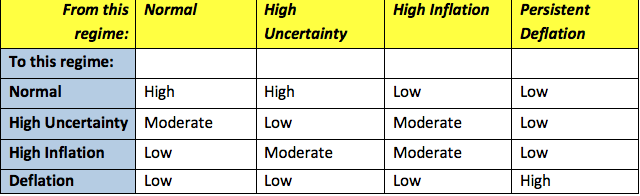
As you can see, the high uncertainty regime is typically transitory, and is usually a sign of the system transitioning from one more stable regime to another (e.g., from the normal regime through a business cycle recession and back go the normal regime). High inflation is somewhat more persistent, but also has natural limits (e.g., self-reinforcing hyperinflation that is followed by collapse). In contrast, both the normal and deflation regimes are highly persistent, though at least in the 20th and 21st centuries, systems entering the latter have been relatively rare compared, for example, with the 19th century.
Yet today, we forecast that the probability of entering the deflation regime over the next 36 months is substantial. Given the historical tendency of deflation regimes to persist, it is critically important that investors understand what we know about what causes transitions into this regime, and how to escape its grasp.
This is an issue that has preoccupied us for nearly twenty years. We previously wrote about it in November 2002 (“Are We Headed Towards Global Deflation?”) and August 2010 (“The Risk of Deflation and Its Impact on Asset Class Returns”).
The Causes of Deflation
A frequently heard saying (at least if you spend time around macroeconomists) is that there are three kinds of deflation (defined as a decline in a broad index measuring the price of goods and services): good deflation, bad deflation, and ugly deflation (e.g., see “Deflation in a Historical Perspective”, by Bordo and Filardo). Let’s look at simplified examples of each of these.
Good deflation is caused by a sharp increase in the productive capacity of the economy — also known as a supply side shock (i.e., to simplify, the supply curve shifts to the right while the demand curve stays constant). Let’s look at two examples: One narrow, and the other broad.
In the USA, average natural gas price at Henry Hub (a major delivery point) was $8.86 per million cubic feet. Ten years later, it had declined to $3.17/mmcf. This happened because even though demand for natural gas grew over this period, total production grew even faster, from 25.6 trillion cubic feet per year, to 37.1 tcf.
To be sure, this fall in prices forced out of business those producers with the highest marginal cost of production. But this didn’t increase unemployment, because more efficient companies were growing, and laid off employees could switch to them. Moreover, this good deflation also generated significant social benefits — for example, the lower cost of natural gas enabled a reduction in CO2 emissions as electric power generation from gas replaced generation from coal.
A broader example of the same type of “good” deflation was the fall in the US price level at the end of the 19th century that was caused by the expansion of production of many goods as the industrial revolution entered its second phase. Note that in many “good deflations”, real per capita GDP continues to increase.
Bad deflation is caused not by an increase in supply, but rather by a reduction in demand (i.e., the demand curve shifts to the left while the supply curve stays constant). This is the type of deflation that Japan has faced (e.g., see, “Understanding the Costs of Deflation in the Japanese Context”, by Taimur Baig of the IMF). The extended fall in global demand between 1890 and 1896 (which, before the 1930s, was referred to as the “Great Depression”) is another example.
In bad deflations, in order to stay in business, producers are forced to cut prices down to the marginal cost of production. However, because of employees’ resistance to wage reduction, companies facing deflation often find it hard to reduce costs. As a result, the least efficient companies are forced out of business. In this case, however, because of weak overall demand, laid off employees will be more likely to become unemployed, which will further reduce aggregate demand. The classic policy remedy for this situation includes expanded government spending and/or tax cuts (fiscal stimulus) as well as expansion of the money supply to reduce interest rates in the hope of incentivizing more investment and consumption spending.
Ugly deflation occurs when the negative impact of bad deflation is amplified by the presence of high levels of debt throughout an economy, as happened in the United States during the 1930s Great Depression. High leverage lowers the threshold at which a fall in revenues will force a company into financial distress (which can lead to cost cutting and layoffs) or bankruptcy (which can result in its liquidation). Deflation worsens this dynamic by raising the real value of outstanding debt, without raising the debtor’s real capacity to service it. This process can also result in the lenders on the other side of those debt contracts falling into financial distress if a sufficient number of loans go bad. Finally, for consumers, high debt levels can cause even a slight fall in income to trigger financial problems.
The situation facing the world economy
Today we face a triple whammy of all three kinds of deflation:
Increased Productive Capacity
Over the past 25 years, the global economy has experienced a series of supply shocks, including, for example, the introduction of the internet and innovations in other information and communication technologies (ICT) and the profusion of new business models they spawned; the entry of China into the World Trade Organization in 2001; and with the advent of fracking (as well as the falling cost of electricity generation from wind and solar) the reversal of what had been a steady increase in the cost of energy. Looking ahead, the exponential improvement of automation, artificial intelligence, biotechnology, and advanced materials technologies promises to deliver further expansions of global production capacity in a wide range of economic sectors.
Weak Demand
In our August and September 2019 issues, we described the complex mix of interacting trends that are contributing to weak global demand (secular stagnation), including, for example, population ageing, weak productivity growth, rising inequality, increasing corporate concentration and pricing power, burdensome debt service payments, and high levels of general uncertainty and fear (“The Next Downturn: How Different? How Deep? How Long?” and “Future Labor Productivity Growth: The Supply Side Secular Stagnation Story”).
Excessive Debt
Global debt levels today are at unprecedented levels as a percentage of GDP, especially when off-balance sheet items like unfunded social security and defined benefit public pension liabilities are included. Particularly worrisome are high levels of corporate debt, much of which is now held by credit hedge funds, exchange traded funds, and other non-bank lenders that despite lacking access to liquidity via central bank discount windows, have still promised their investors access to liquidity over periods of time that are considerably shorter than the tenor of the debt they hold. This is the Russian Roulette version of maturity transformation. On top of this are still very high levels of consumer and student debt, despite attempts to deleverage for a decade after the 2008 Global Financial Crisis (a cause which certainly hasn’t been helped by rising inequality, social pressures for aspirational spending driven by conspicuous elite consumption, and still lax lending standards, for autos and student debt).
What do we know about escaping from the deflation regime, once we’ve fallen into it?
The glib answer is that it’s bloody hard once deflation expectations become entrenched, as we have seen in Japan.
Not so glibly, the historical record teaches us that successful exits from the deflation regime critically depend on an accurate diagnosis of the type of deflation policymakers are dealing with.
Unfortunately, today we face a very complex, interacting, and dangerous mix of all three types of deflation. Should we enter it, successful exit from the deflation regime will therefore require deft use of the monetary, fiscal, and structural policy tools that are available to national decision makers.
Reversing national exposure to the global supply shocks that cause good deflation is the least important challenge to address. That said, this seems to be one of the Trump administration’s policy objectives in the current US/China trade war.
Addressing secular demand stagnation that causes bad deflation is not only far more important, but also much more difficult, given the complex tangle of underlying root causes we face today.
With government debt rates at or below the “zero lower bound”, the ability of monetary policy to further stimulate demand is now much weaker than it has been in the past. A possible exception to this would be deliberate attempts to reduce a nation’s exchange rate, in order to raise import prices (and thus the overall price level), while boosting demand for cheaper exports. However, this type of “beggar-thy-neighbor” approach would almost certainly trigger retaliation by other countries.
That makes government fiscal policy much more important. However, this faces many challenges, including not only deciding on the mix of initiatives to pursue in the face of high uncertainty (e.g., tax cuts versus increased spending on transfer payments, infrastructure, R&D, defense, and other investments, and whether to pay for these via higher taxes on the wealthy and/or via deficit spending), but also gaining approval for these initiatives in the face of what is likely to be opposition from highly polarized and antagonistic legislatures and electorates. Moreover, as we saw when the United States attempted to pursue fiscal stimulus to moderate the impact of the 2008 downturn, the implementation of approved initiatives (like infrastructure projects) is highly likely to face local opposition (e.g., environmental litigation) and further delays.
As we have seen in Japan, the challenges of using monetary and fiscal policy to escape deflation pale in comparison to the political obstacles to the use of structural policy, such as changes to education healthcare, and financial systems, or the markets for goods, services, and labor, where defenders of the status quo are usually very firmly entrenched. Unfortunately, these are the very areas where change is likely to be critical to sustainable resolution of the weak demand problem.
However, all these challenges pale in comparison to the real elephant in the room: the debt problem that can trigger ugly deflation. As a veteran of the Latin American debt crisis (as well as assorted other workouts in North America and Europe), I long ago learned that there are only four solutions to excessive debt:
Prolonged Austerity – Cut spending in other areas in order to make debt service payments to creditors. The longer this approach continues, the more likely it will become self-defeating. Economically it depresses demand, which can worsen deflation and increase the real size of the debt, while also increasing political opposition to austerity.
Higher Growth – Everybody’s favorite silver bullet. Increase revenue/income to enable you to repay your debts without cutting, and hopefully while increasing consumption and investment spending. Unfortunately, it usually doesn’t work both because of the complex mix of challenges that must be resolved to increase aggregate demand, and because heavy debt service payments are often a critical obstacle to growth (e.g., they limit investment from internal cash flow, and restrict access to external financing).
Higher Inflation – This only works under three conditions that rarely fully apply: (1) your debt is denominated in a high inflation currency; (2) if this isn’t the currency in which you generate your revenue, then you have sufficient access to foreign exchange at the depreciating exchange rate inflation should cause; (3) the debt is fixed rate; and (4) the debt had a tenor/duration that is long enough for the inflation rate to substantially reduce its real value.
Restructuring and Write Offs – This is where most situations of excessive leverage and financial distress usually end up. Sometimes this process works well, as in the case of US Chapter 11 bankruptcies that often effectively convert debt to equity, and enable the company to keep operating. But the debt workout process can also get very ugly. Seizure and liquidation of collateral, particularly if it becomes widespread, can easily make a bad situation much worse, as falls in collateral reduce lenders’ incentives to roll over maturing loans that borrowers can’t repay, triggering more collateral liquidation, business failures, increased unemployment, weaker demand, and what the economist Irving Fisher termed a vicious “debt deflation” spiral. And Fisher wrote long before the invention of Credit Default Swaps, which, as we’ve seen in cases like the Thomas Cook Group Plc bankruptcy, can easily make debt restructurings much more complicated and push them towards collateral seizure and corporate failure.
It is almost certain that some people will claim there is a fifth alternative, commonly called “extend and pretend”. This entails using monetary policy to lower interest rates to reduce debt servicing burdens, and political and regulatory pressure to induce lenders to rollover maturing loans, or even increase them to cover interest payments that companies can’t pay out of operating cash flow or the proceeds from asset sales. However, as Japan has shown, kicking the can down the road like this (usually in the hope that an eventual revival of demand will enable excess debt to be repaid) can actually worsen the situation. So-called “zombie” companies on life support are unable make the investments (e.g., in research, training, and capital assets) that are needed to increase productivity, wages, profits, and aggregate demand. Instead, they serve as a drag on the economy.
One of the economic policymakers I most admire has reached the same conclusion. William White chaired the Economic and Development Review Committee at the Organisation for Economic Co-operation and Development from 2009 to 2018. Before that he was the Economic Adviser and Head of the Monetary and Economic Department at the Bank for International Settlements. He was one of the few who accurately forecasted the 2008 Global Financial Crisis.
In an interview earlier this year with “The Market” (www.themarket.ch), White noted that, “The path that we have been on has led us to a dead end…Years of expansionary fiscal and monetary policies have left the world economy overburdened with debt. In the next downturn, much of that debt will become unserviceable… Our economies would benefit greatly from more voluntary debt restructuring by creditors, and the sooner the better; orderly solutions are better than disorderly solutions. Moreover, there is a political advantage in forcing those who have made imprudent loans to pay a price for it. This would take the sting out of the populist cry that the elite always get off, while ordinary citizens suffer…
“Recently, the OECD, the IMF, and the Group of Thirty have drawn attention to the serious inadequacies in the legal framework for restructuring private sector debt in many countries. Laws are poorly drafted and the judicial framework is inadequate. There are not enough out of court deals, nor specialized judges, nor adequate flows of information, nor adequate enforcement…Many banks also have an inadequate capacity to manage bad loans internally, and in most countries no external market exists for distressed loans…All of this could and should be dealt with.”
Conclusion
As it turns out, we actually know quite a bit about how to escape the persistent deflation regime, should we fall into it. But that is the easy part. We also know from recent experience just how difficult it will be to gain political approval for the policy changes that will be required. And even if that challenge is met, the actual implementation of those policies will face equally daunting obstacles, with large-scale debt restructuring the biggest of all.
Asset Allocation Implications
There is a reason so much government debt has negative yields today. Rather than a source of income, it has become a defacto source of insurance against capital loss for which investors are willing to pay a premium. In the deflation regime, fiscal deficits will sharply increase, and government debt issuance will grow. However, to keep interest rates low (to minimize debt servicing problems), much of this new issuance will almost certainly end up on central bank balance sheets. With respect to real return government bonds (like TIPS), it is important to recognize that the way they adjust for inflation substantially differs across issues. Some of them increase capital value to compensate for inflation, but do not decrease it in the case of deflation. As such, these will produce very attractive returns in the deflation regime.
The deflation scenario will sharply increase yields (and defaults) on non-government bonds and loans. Withdrawals from bond and loan funds that promise investors daily liquidity will very likely trigger sharp price falls and market liquidity problems, which will likely have a non-linear impact on public uncertainty and fear. On the other hand, it is almost certain that bonds issues by companies with strong business models and balance sheets (i.e., low leverage) will be unfairly penalized during the period of market panic, and become underpriced relative to the risk they represent.
As the capital structures of most commercial property projects have high levels of debt, the same cautions regarding corporate debt apply here too. That said, commercial property will likely benefit by the tendency of some investors to move into this asset class when political-economic uncertainty sharply increases. In contrast, housing is usually highly leveraged and owned by individuals who will be exposed to much higher employment and income uncertainty in the deflation regime. As such, returns will likely be negative.
Returns on gold will almost certainly be high in the deflation regime. Timber will likely also deliver attractive returns, particularly if and when fears increase that exploding government debt levels will eventually result in high inflation. Due to very weak demand, other commodities are very unlikely to deliver attractive returns.
Returns on equity asset classes – including private equity (which specializes in highly leveraged investments) – are almost certain to be low during the deflation regime. However, sectoral returns within them – such as the consumer staples sector – will very likely be positive.
In terms of uncorrelated alpha strategies (that aim to deliver positive returns with a low correlation to returns on broad asset classes), higher levels of uncertainty will likely produce positive returns for global macro. Distressed debt strategies are also likely to deliver attractive returns. However, as the number of these funds is very likely to grow during the deflation regime, declining average manager quality will likely reduce overall average returns for this strategy.
Yet today, we forecast that the probability of entering the deflation regime over the next 36 months is substantial. Given the historical tendency of deflation regimes to persist, it is critically important that investors understand what we know about what causes transitions into this regime, and how to escape its grasp.
This is an issue that has preoccupied us for nearly twenty years. We previously wrote about it in November 2002 (“Are We Headed Towards Global Deflation?”) and August 2010 (“The Risk of Deflation and Its Impact on Asset Class Returns”).
The Causes of Deflation
A frequently heard saying (at least if you spend time around macroeconomists) is that there are three kinds of deflation (defined as a decline in a broad index measuring the price of goods and services): good deflation, bad deflation, and ugly deflation (e.g., see “Deflation in a Historical Perspective”, by Bordo and Filardo). Let’s look at simplified examples of each of these.
Good deflation is caused by a sharp increase in the productive capacity of the economy — also known as a supply side shock (i.e., to simplify, the supply curve shifts to the right while the demand curve stays constant). Let’s look at two examples: One narrow, and the other broad.
In the USA, average natural gas price at Henry Hub (a major delivery point) was $8.86 per million cubic feet. Ten years later, it had declined to $3.17/mmcf. This happened because even though demand for natural gas grew over this period, total production grew even faster, from 25.6 trillion cubic feet per year, to 37.1 tcf.
To be sure, this fall in prices forced out of business those producers with the highest marginal cost of production. But this didn’t increase unemployment, because more efficient companies were growing, and laid off employees could switch to them. Moreover, this good deflation also generated significant social benefits — for example, the lower cost of natural gas enabled a reduction in CO2 emissions as electric power generation from gas replaced generation from coal.
A broader example of the same type of “good” deflation was the fall in the US price level at the end of the 19th century that was caused by the expansion of production of many goods as the industrial revolution entered its second phase. Note that in many “good deflations”, real per capita GDP continues to increase.
Bad deflation is caused not by an increase in supply, but rather by a reduction in demand (i.e., the demand curve shifts to the left while the supply curve stays constant). This is the type of deflation that Japan has faced (e.g., see, “Understanding the Costs of Deflation in the Japanese Context”, by Taimur Baig of the IMF). The extended fall in global demand between 1890 and 1896 (which, before the 1930s, was referred to as the “Great Depression”) is another example.
In bad deflations, in order to stay in business, producers are forced to cut prices down to the marginal cost of production. However, because of employees’ resistance to wage reduction, companies facing deflation often find it hard to reduce costs. As a result, the least efficient companies are forced out of business. In this case, however, because of weak overall demand, laid off employees will be more likely to become unemployed, which will further reduce aggregate demand. The classic policy remedy for this situation includes expanded government spending and/or tax cuts (fiscal stimulus) as well as expansion of the money supply to reduce interest rates in the hope of incentivizing more investment and consumption spending.
Ugly deflation occurs when the negative impact of bad deflation is amplified by the presence of high levels of debt throughout an economy, as happened in the United States during the 1930s Great Depression. High leverage lowers the threshold at which a fall in revenues will force a company into financial distress (which can lead to cost cutting and layoffs) or bankruptcy (which can result in its liquidation). Deflation worsens this dynamic by raising the real value of outstanding debt, without raising the debtor’s real capacity to service it. This process can also result in the lenders on the other side of those debt contracts falling into financial distress if a sufficient number of loans go bad. Finally, for consumers, high debt levels can cause even a slight fall in income to trigger financial problems.
The situation facing the world economy
Today we face a triple whammy of all three kinds of deflation:
Increased Productive Capacity
Over the past 25 years, the global economy has experienced a series of supply shocks, including, for example, the introduction of the internet and innovations in other information and communication technologies (ICT) and the profusion of new business models they spawned; the entry of China into the World Trade Organization in 2001; and with the advent of fracking (as well as the falling cost of electricity generation from wind and solar) the reversal of what had been a steady increase in the cost of energy. Looking ahead, the exponential improvement of automation, artificial intelligence, biotechnology, and advanced materials technologies promises to deliver further expansions of global production capacity in a wide range of economic sectors.
Weak Demand
In our August and September 2019 issues, we described the complex mix of interacting trends that are contributing to weak global demand (secular stagnation), including, for example, population ageing, weak productivity growth, rising inequality, increasing corporate concentration and pricing power, burdensome debt service payments, and high levels of general uncertainty and fear (“The Next Downturn: How Different? How Deep? How Long?” and “Future Labor Productivity Growth: The Supply Side Secular Stagnation Story”).
Excessive Debt
Global debt levels today are at unprecedented levels as a percentage of GDP, especially when off-balance sheet items like unfunded social security and defined benefit public pension liabilities are included. Particularly worrisome are high levels of corporate debt, much of which is now held by credit hedge funds, exchange traded funds, and other non-bank lenders that despite lacking access to liquidity via central bank discount windows, have still promised their investors access to liquidity over periods of time that are considerably shorter than the tenor of the debt they hold. This is the Russian Roulette version of maturity transformation. On top of this are still very high levels of consumer and student debt, despite attempts to deleverage for a decade after the 2008 Global Financial Crisis (a cause which certainly hasn’t been helped by rising inequality, social pressures for aspirational spending driven by conspicuous elite consumption, and still lax lending standards, for autos and student debt).
What do we know about escaping from the deflation regime, once we’ve fallen into it?
The glib answer is that it’s bloody hard once deflation expectations become entrenched, as we have seen in Japan.
Not so glibly, the historical record teaches us that successful exits from the deflation regime critically depend on an accurate diagnosis of the type of deflation policymakers are dealing with.
Unfortunately, today we face a very complex, interacting, and dangerous mix of all three types of deflation. Should we enter it, successful exit from the deflation regime will therefore require deft use of the monetary, fiscal, and structural policy tools that are available to national decision makers.
Reversing national exposure to the global supply shocks that cause good deflation is the least important challenge to address. That said, this seems to be one of the Trump administration’s policy objectives in the current US/China trade war.
Addressing secular demand stagnation that causes bad deflation is not only far more important, but also much more difficult, given the complex tangle of underlying root causes we face today.
With government debt rates at or below the “zero lower bound”, the ability of monetary policy to further stimulate demand is now much weaker than it has been in the past. A possible exception to this would be deliberate attempts to reduce a nation’s exchange rate, in order to raise import prices (and thus the overall price level), while boosting demand for cheaper exports. However, this type of “beggar-thy-neighbor” approach would almost certainly trigger retaliation by other countries.
That makes government fiscal policy much more important. However, this faces many challenges, including not only deciding on the mix of initiatives to pursue in the face of high uncertainty (e.g., tax cuts versus increased spending on transfer payments, infrastructure, R&D, defense, and other investments, and whether to pay for these via higher taxes on the wealthy and/or via deficit spending), but also gaining approval for these initiatives in the face of what is likely to be opposition from highly polarized and antagonistic legislatures and electorates. Moreover, as we saw when the United States attempted to pursue fiscal stimulus to moderate the impact of the 2008 downturn, the implementation of approved initiatives (like infrastructure projects) is highly likely to face local opposition (e.g., environmental litigation) and further delays.
As we have seen in Japan, the challenges of using monetary and fiscal policy to escape deflation pale in comparison to the political obstacles to the use of structural policy, such as changes to education healthcare, and financial systems, or the markets for goods, services, and labor, where defenders of the status quo are usually very firmly entrenched. Unfortunately, these are the very areas where change is likely to be critical to sustainable resolution of the weak demand problem.
However, all these challenges pale in comparison to the real elephant in the room: the debt problem that can trigger ugly deflation. As a veteran of the Latin American debt crisis (as well as assorted other workouts in North America and Europe), I long ago learned that there are only four solutions to excessive debt:
Prolonged Austerity – Cut spending in other areas in order to make debt service payments to creditors. The longer this approach continues, the more likely it will become self-defeating. Economically it depresses demand, which can worsen deflation and increase the real size of the debt, while also increasing political opposition to austerity.
Higher Growth – Everybody’s favorite silver bullet. Increase revenue/income to enable you to repay your debts without cutting, and hopefully while increasing consumption and investment spending. Unfortunately, it usually doesn’t work both because of the complex mix of challenges that must be resolved to increase aggregate demand, and because heavy debt service payments are often a critical obstacle to growth (e.g., they limit investment from internal cash flow, and restrict access to external financing).
Higher Inflation – This only works under three conditions that rarely fully apply: (1) your debt is denominated in a high inflation currency; (2) if this isn’t the currency in which you generate your revenue, then you have sufficient access to foreign exchange at the depreciating exchange rate inflation should cause; (3) the debt is fixed rate; and (4) the debt had a tenor/duration that is long enough for the inflation rate to substantially reduce its real value.
Restructuring and Write Offs – This is where most situations of excessive leverage and financial distress usually end up. Sometimes this process works well, as in the case of US Chapter 11 bankruptcies that often effectively convert debt to equity, and enable the company to keep operating. But the debt workout process can also get very ugly. Seizure and liquidation of collateral, particularly if it becomes widespread, can easily make a bad situation much worse, as falls in collateral reduce lenders’ incentives to roll over maturing loans that borrowers can’t repay, triggering more collateral liquidation, business failures, increased unemployment, weaker demand, and what the economist Irving Fisher termed a vicious “debt deflation” spiral. And Fisher wrote long before the invention of Credit Default Swaps, which, as we’ve seen in cases like the Thomas Cook Group Plc bankruptcy, can easily make debt restructurings much more complicated and push them towards collateral seizure and corporate failure.
It is almost certain that some people will claim there is a fifth alternative, commonly called “extend and pretend”. This entails using monetary policy to lower interest rates to reduce debt servicing burdens, and political and regulatory pressure to induce lenders to rollover maturing loans, or even increase them to cover interest payments that companies can’t pay out of operating cash flow or the proceeds from asset sales. However, as Japan has shown, kicking the can down the road like this (usually in the hope that an eventual revival of demand will enable excess debt to be repaid) can actually worsen the situation. So-called “zombie” companies on life support are unable make the investments (e.g., in research, training, and capital assets) that are needed to increase productivity, wages, profits, and aggregate demand. Instead, they serve as a drag on the economy.
One of the economic policymakers I most admire has reached the same conclusion. William White chaired the Economic and Development Review Committee at the Organisation for Economic Co-operation and Development from 2009 to 2018. Before that he was the Economic Adviser and Head of the Monetary and Economic Department at the Bank for International Settlements. He was one of the few who accurately forecasted the 2008 Global Financial Crisis.
In an interview earlier this year with “The Market” (www.themarket.ch), White noted that, “The path that we have been on has led us to a dead end…Years of expansionary fiscal and monetary policies have left the world economy overburdened with debt. In the next downturn, much of that debt will become unserviceable… Our economies would benefit greatly from more voluntary debt restructuring by creditors, and the sooner the better; orderly solutions are better than disorderly solutions. Moreover, there is a political advantage in forcing those who have made imprudent loans to pay a price for it. This would take the sting out of the populist cry that the elite always get off, while ordinary citizens suffer…
“Recently, the OECD, the IMF, and the Group of Thirty have drawn attention to the serious inadequacies in the legal framework for restructuring private sector debt in many countries. Laws are poorly drafted and the judicial framework is inadequate. There are not enough out of court deals, nor specialized judges, nor adequate flows of information, nor adequate enforcement…Many banks also have an inadequate capacity to manage bad loans internally, and in most countries no external market exists for distressed loans…All of this could and should be dealt with.”
Conclusion
As it turns out, we actually know quite a bit about how to escape the persistent deflation regime, should we fall into it. But that is the easy part. We also know from recent experience just how difficult it will be to gain political approval for the policy changes that will be required. And even if that challenge is met, the actual implementation of those policies will face equally daunting obstacles, with large-scale debt restructuring the biggest of all.
Asset Allocation Implications
There is a reason so much government debt has negative yields today. Rather than a source of income, it has become a defacto source of insurance against capital loss for which investors are willing to pay a premium. In the deflation regime, fiscal deficits will sharply increase, and government debt issuance will grow. However, to keep interest rates low (to minimize debt servicing problems), much of this new issuance will almost certainly end up on central bank balance sheets. With respect to real return government bonds (like TIPS), it is important to recognize that the way they adjust for inflation substantially differs across issues. Some of them increase capital value to compensate for inflation, but do not decrease it in the case of deflation. As such, these will produce very attractive returns in the deflation regime.
The deflation scenario will sharply increase yields (and defaults) on non-government bonds and loans. Withdrawals from bond and loan funds that promise investors daily liquidity will very likely trigger sharp price falls and market liquidity problems, which will likely have a non-linear impact on public uncertainty and fear. On the other hand, it is almost certain that bonds issues by companies with strong business models and balance sheets (i.e., low leverage) will be unfairly penalized during the period of market panic, and become underpriced relative to the risk they represent.
As the capital structures of most commercial property projects have high levels of debt, the same cautions regarding corporate debt apply here too. That said, commercial property will likely benefit by the tendency of some investors to move into this asset class when political-economic uncertainty sharply increases. In contrast, housing is usually highly leveraged and owned by individuals who will be exposed to much higher employment and income uncertainty in the deflation regime. As such, returns will likely be negative.
Returns on gold will almost certainly be high in the deflation regime. Timber will likely also deliver attractive returns, particularly if and when fears increase that exploding government debt levels will eventually result in high inflation. Due to very weak demand, other commodities are very unlikely to deliver attractive returns.
Returns on equity asset classes – including private equity (which specializes in highly leveraged investments) – are almost certain to be low during the deflation regime. However, sectoral returns within them – such as the consumer staples sector – will very likely be positive.
In terms of uncorrelated alpha strategies (that aim to deliver positive returns with a low correlation to returns on broad asset classes), higher levels of uncertainty will likely produce positive returns for global macro. Distressed debt strategies are also likely to deliver attractive returns. However, as the number of these funds is very likely to grow during the deflation regime, declining average manager quality will likely reduce overall average returns for this strategy.
If you have any questions about anything we have written in this issue, please don’t hesitate to get in touch, at contact@indexinvestor.com