The Index Investor
November 2019
Market Stress Indicators
Macro Regime Forecast
Tactical Asset Allocation Implications of Our Forecasts
Pre-Mortem Analysis
Critical System Thresholds/Tipping Points Analysis
Combining and Extremizing Forecasts to Improve Predictive Accuracy
High Value Information Observed Last Month
Feature Article: Macro and Asset Allocation Implications of Environmental Trends and Uncertainties
Appendix: Anticipatory Thinking and Forecasting Methodologies
Asset Class Valuation and Momentum Indicators (@31Oct19)
| Asset Class (ETF) | Valuation | 1 Month Return | Conclusion |
| US Real Return Govt Bond (TIP) | Likely Overvalued* | (0.03)% | Decreasing Overvaluation |
| US Nom Return Govt Bond (GOVT) | Likely Overvalued* | 0.00% | No Change |
| US Investment Grade Credit (LQD) | Close to Fairly Valued* | 0.44% | Close to Fairly Valued |
| US High Yield Credit (HYG) | Almost Certainly Overvalued* | (0.01)% | Decreasing Overvaluation |
| US Commercial Property (VNQ) | Likely Undervalued* | 1.14% | Decreasing Undervaluation |
| US Equity (VTI) | Likely Overvalued* | 2.11% | Increasing Overvaluation |
| Foreign Devel Mkt Equity (VEA) | Very Likely Undervalued* | 3.21% | Decreasing Undervaluation |
| Emerging Markets Equity (VWO) | Very Likely Overvalued* | 3.95% | Increasing Overvaluation |
| Timber (WY) | Almost Certainly Undervalued* | 5.45% | Decreasing Undervaluation |
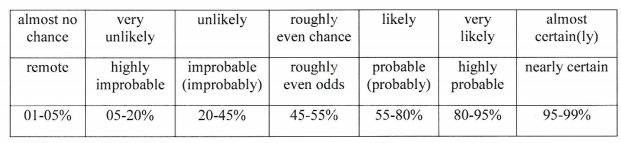
Note: The language we use to describe our estimated likelihood of asset class over or undervaluation is based on US Intelligence Community Directive 203 on Analytic Standards, which includes the following table:
Market Stress Indicators (@31Oct19)
| Market Stress Indicator | This Month vs Last Month |
| Asset Class Returns Autocorrelation (this month versus last month). Higher autocorrelation is an indicator of higher market stress. | .65 vs (.50) last month. Indicates a higher level of market stress compared to last month. |
| Economic Policy Uncertainty Index (how many days over the last 30 was index in top quartile of values since 1985?) | On 8 days the index was in the top quartile of daily values since 1984 (the 63rd percentile of all rolling 30 day counts). This is a decrease from last month. |
| AAA Rated Bonds Spread over 10 Year Treasury Yield (month end). Higher spreads indicate rising concern about market liquidity. | 1.30% (51st percentile since 1983), essentially unchanged from last month. This is still considerably higher than in April 2018 when the liquidity spread was only 1.00%. |
| BB Rated Bonds Spread over 10 Year Treasury Yield (month end). High spreads indicate increasing credit risk. | 2.38% (21st percentile since 1996), essentially unchanged since last month. Extremely low after ten years without a recession. |
| Gold Price per Ounce in US Dollars (month end). Rising gold prices are an indicator of increasing market uncertainty and stress. | $1,506 vs $1,487, up 1.3% from last month. At the end of 2017, we estimated the "disaster premium" in the gold price was 47% (see our methodology in the Appendix). At the end of last month, the estimated premium was 63%. |
At the end of September, four of our five quantitative indicators showed either an unchanged level of relatively high market stress, or a slight decline, and one showed an increase. However, these must be seen in the light of qualitative evidence, like repo funding problems and rising uncertainty, that indicate a very high level of underlying market tension and potential for sudden disruptive change.
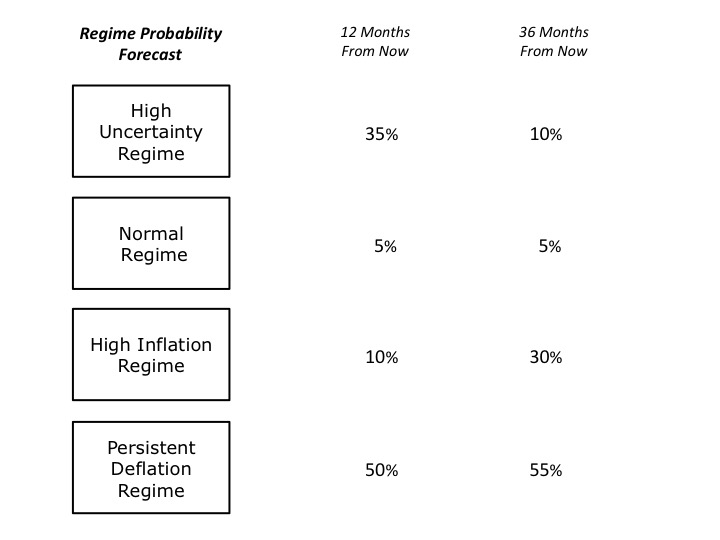
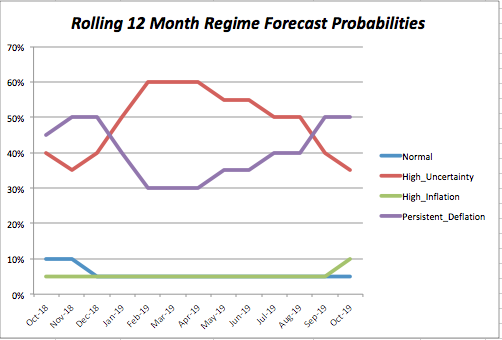
Macro Regime Forecast Probabilities (@31Oct19)
The Current State of Quantitative Regime Predictors
Our quantitative forecast methodology focuses on the level and change in three-month returns, over the most recent and previous three-month periods, for those asset classes, which should perform best under different regimes (in this sense, our regimes can be regarded as macro factors). We assume that relatively higher returns are associated with more widely held investor beliefs in the probability that a given macro regimes will develop in the future.
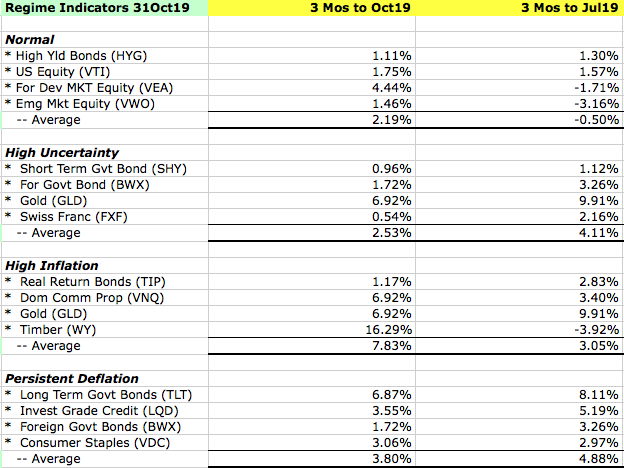
Over the last three months, there has been a relative strengthening in investors’ beliefs that either the high inflation or normal times regime lies ahead.
Qualitative Considerations
As covered in more detail in this month’s Evidence File (see below), here are the most important new indicators and surprises that influenced this month’s changes to our regime probability forecast:
Technology: Results on the US National Assessment of Educational Progress were again disappointing, and have been flat for a decade. At a time when automation and artificial intelligence technologies are rapidly improving, continued scarcity of talent will continue to support “winner take all” economics in many industries, which in turn contributes to income inequality. Also, growth in the number of working age adults whose education does not enable them to succeed in the 21st century economy will increase future demand for higher social safety net spending.
Environment: The latest International Energy Outlook by the US Energy Information Administration forecasts continued growth in coal fired electric generation to meet rising consumption demand. Another new report that analyzed uncertainty in climate forecasts found that parameter uncertainty, rather than model uncertainty, had the greatest impact, with future productivity growth particularly important.
Economy: The IMF’s semi-annual flagship reports (the World Economic Outlook and Global Financial Stability Report) presented a gloomy picture of weakening demand and an overleveraged global economy, with negative feedback loops driven by adverse trends in trade, politics (which affect the likelihood of an effective policy response when the downturn arrives), and demographics, all of which contribute to rising uncertainty and further weaken demand.
National Security: Trump’s impulsive abandonment of the Kurds has increased uncertainty in the Middle East, and in foreign relations among Western nations. At the same time, more violent unrest in Hong Kong seems increasingly likely to provoke Chinese repression, which will intensify the developing New Cold War between China and the West (even as there were other indications of mounting internal problems in China). Meanwhile a new report from the Heritage Foundation presented a sobering picture of the ability of America’s military to meet some of the contingencies it may face in the future.
Society: New data showed that median priced homes are now out of reach for average wage earners in 74% of US housing markets. Also, Pew Research found that partisan antipathy has grown more intense and more personal. Finally, another new report found that Job Retraining programs have badly underestimated the time required to make displaced workers employable in new roles.
Politics: The UK election has raised uncertainty, given the very different futures that would be likely under a Johnson or Corbyn government. In the US the release of more evidence about Trump’s dealing with the Ukraine has significantly moved poll numbers in favor of impeachment, while intensifying his and his defenders attacks on the process in the House (including witnesses testifying against him). Meanwhile, concerns continued about whether the split between US Progressives and Traditional Democrats can be healed in time to win the November 2020 election. Finally, continuing riots in Chile provided more evidence of the consequences of unresolved and growing gaps between elites and the economic circumstances (and attendant fears and anger) of increasingly populist and interconnected (due to social media) mass protest movements.
Financial Markets: Financial markets continued to display schizoid behavior, with yields rising in the lower reaches of the credit markets as potential problems become more apparent (e.g., WeWork’s cash shortage), while equity markets grasped at whatever bit of good news (e.g., rumors of a potential US-China trade deal) they could find to push prices a bit higher.
Tactical Asset Allocation Implications of Our Forecasts
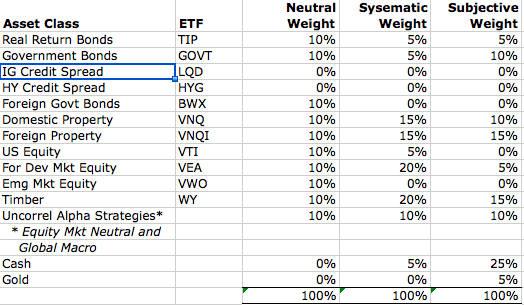
Based on subscriber requests, this month we are re-introducing a feature from the previous version of The Index Investor: Tactical Asset Allocation Implications from our analyses.
These take two forms. The first takes a systematic approach, and is based on relative asset class valuations. Our starting point is our “neutral” model portfolio, which is equally weighted across nine broad asset classes, and also includes a 10% allocation to alpha strategies (equity market neutral and global macro) that are designed to have a low correlation to returns on broad asset classes. Based on asset class valuations, we systematically vary the asset class weights (but not the active strategy weight), increasing from 10% to 15% when an asset class is likely undervalued, and 15% when it is very likely undervalued. In the case of overvaluations, we go to 5% and then into cash, if there are no undervalued asset classes with room for an increase. In effect, this replicates the systematic rebalancing strategy we used for 15 years in our previous model portfolios.
The second tactical approach is based on our subjective view not only of current asset class valuations, but also of the implications of the broader macro trends and uncertainties that we analyze each month. Importantly, this subjective view reflects our primary goal of avoiding large downside losses, rather than seeking large upside gains.
Two final notes. First, with respect to US fixed income, we include credit products (investment grade and high yield) in the same asset class as government debt, and will shift into the former when their valuations become attractive. Second, we regard gold not as a separate asset class to be held long-term, but rather as a complement to cash, into which we shift in periods of substantial overvaluation across multiple asset classes.
Here are our tactical asset allocation views for November:
Pre-Mortem Analysis
One of the most important forecasting disciplines is to ask yourself why your forecast could be wrong. Dr. Gary Klein’s research has shown that a very powerful and insightful way to do this is via a “pre-mortem analysis.” This method asks you to assume that it is a point in the future, and your forecast has been proven wrong (or your strategy or company has failed). You are then asked to look backward from this imagined point in the future, to explain why you failed, what you missed, and what you could have done differently to avoid your fate.
The pre-mortem method takes advantage of the fact that humans reason much more concretely and in more detail when explaining the past than they do when trying to forecast the future.
So let us assume that it is one year from now, and our current forecast has turned out to be wrong.
How did this happen? What developments did we fail to anticipate? Here are three possibilities:
- The leaders of the world’s three major powers – Xi Jinping, Donald Trump, and Vladimir Putin are all facing weakening economies and declining political popularity. History teaches us that this can lead to increased “foreign adventurism” to distract the public from worsening domestic conditions, as a nation rallies around its leader in a period of heightened external conflict. Should a “kinetic” conflict develop between China and the United States, or between Russia and one or more European countries (e.g., due to a Russian incursion into the Baltics), it would generate a very sharp increase in uncertainty that would likely cause an equally sharp economic slowdown which, given high debt levels, would speed the arrival of the Persistent Deflation Regime.
- While the probability is remote, a supply side shock of some type could produce a sudden increase in inflation – the most likely scenario being a reduction in oil supplies due to a prolonged kinetic conflict between Iran and the US that produced a extended disruption in global oil supplies, or, less likely, an infectious disease pandemic or major crop failures (e.g., due to climate change and/or disease).
- Another route to the high inflation regime would be a sudden loss of confidence in the US dollar relative to other currencies (driving up import prices), perhaps because of deficit monetization and policy paralysis as a severe downturn continues. However, this would also require that there was relatively more confidence in another currency, with the Euro being the most likely candidate. This currently seems unlikely, given both the Eurozone’s economic and political situation, and the prospect of an intensifying conflict between the West and China. However, if confidence collapsed in all major currencies, the price of gold would sharply increase.
- Though we believe it is still unlikely, it is becoming easier envision a scenario in which both Xi Jinping and Donald Trump leave their current roles, and are replaced by leaders who are more committed to lessening the intensifying conflict between China and other nations. This would likely provide a strong boost to confidence (and thus lead to an equally strong reduction in uncertainty). However, a reduction in perceived external threats might also intensify already substantial internal divisions and conflicts in China and the United States, which could, ironically, also lead to the deflation regime.
System Tipping Points/Critical Threshold Analysis
Like Professors Andrew Lo, Doyne Farmer and others, we regard financial markets as a complex adaptive system (CAS), that exist as part of a larger macro system comprised of other CAS between which there are multiple feedback loops. These other systems include those that produce technology innovations, and economic, environmental, national security (including cyber), social, demographic, and political outcomes.
We also find that these systems tend to operate and generate effects in a rough chronological sequence, albeit with many feedback loops between them. The following chart highlights that the changes we observe in different areas at any point in time are actually part of a much more complex evolutionary process.
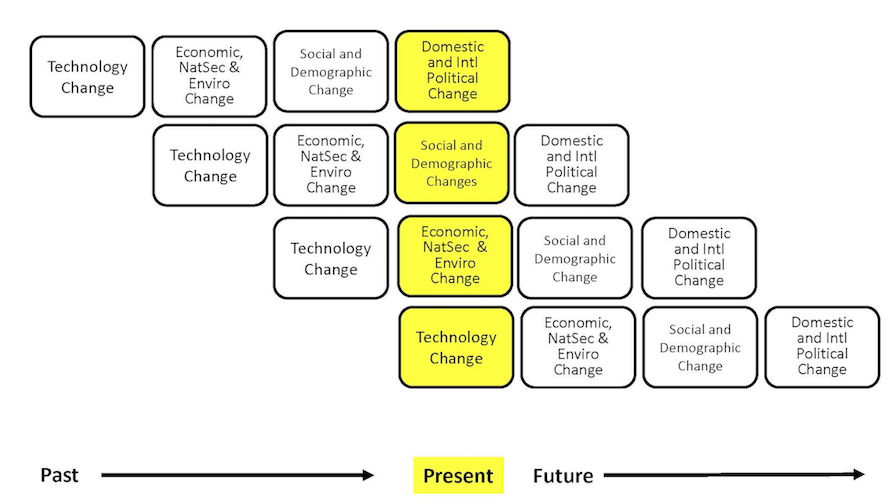
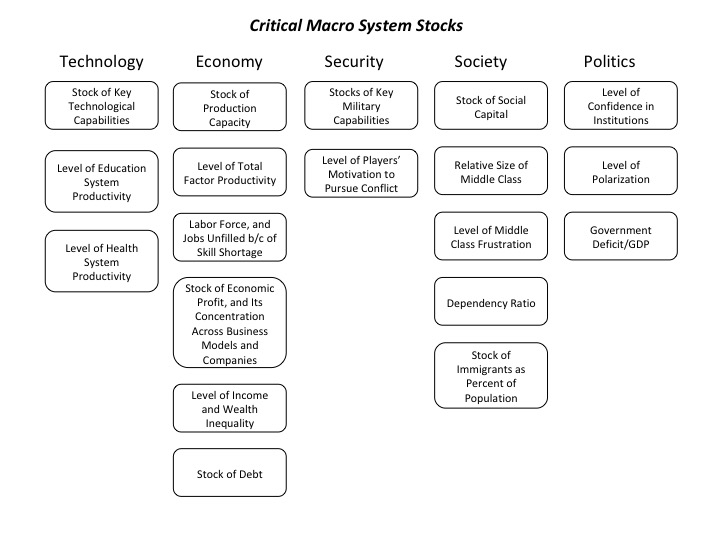
While most media coverage of these systems focused on flows (e.g., the size of the government deficit), rapid non-linear change in complex adaptive systems is often caused by a key stock (e.g., the amount of outstanding government debt) exceeding a critical threshold.
The next table highlights the key macro system stocks that we monitor.
In the next section, we will discuss information received over the past month that is related to these stocks, and which we believe is significant to our assessment of the probabilities that a critical threshold will be reached and a regime change will occur. We will conclude with our estimate, at the end of this month, of how close the macro system is to these critical thresholds, and the implications for financial market regime change probabilities.
How Close is the Macro System to One or More Critical Thresholds?
As we have noted, the macro drivers of financial market regime changes typically follow a rough chronological sequence, from technology to economic, security, social, and political causes and effects. Yet there are many feedbacks loops between them, creating complex root causes for many of the critical thresholds we have identified.
Understanding the time dynamics in this complex system is critical to avoiding substantial downside investment risk.
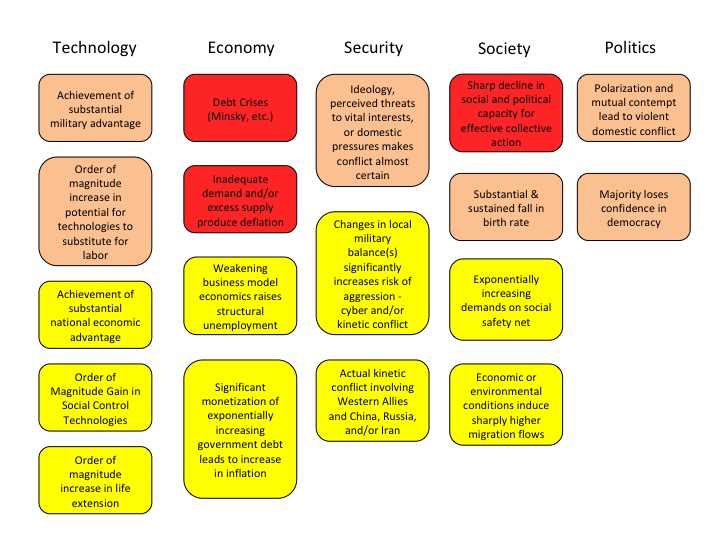
We use the UK Met Office Warning Model to communicate our assessment of these time dynamics. We estimate the time remaining before a critical macro system threshold is reached that could trigger a regime change, which is usually accompanied by substantial changes in asset class valuations.
The model uses three increasingly serious levels of warning, from “Be Aware” (condition yellow), to “Be Prepared” (condition orange), to “Take Action” (condition red).
For our purposes, we denote as “Be Aware” (yellow) critical thresholds that we assess to be three or more years away. We estimate that “Be Prepared” (orange) thresholds could be reached within 1 to 3 years. “Take Action” thresholds are very likely to be reached within one year.
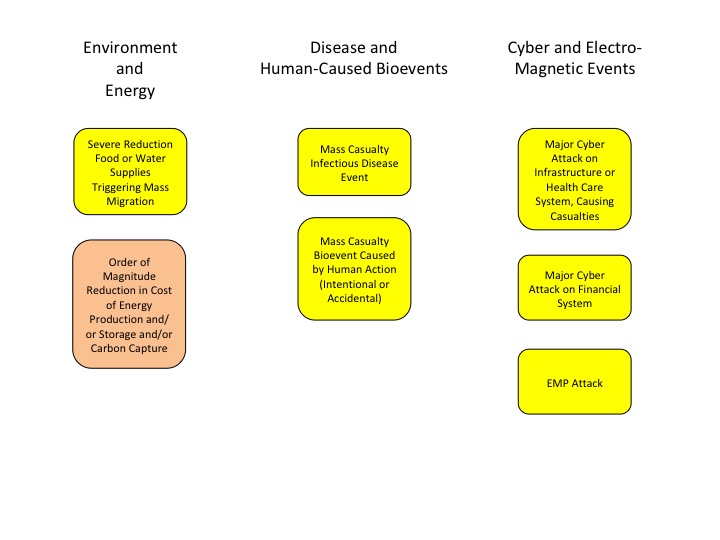
Given their nature, we also note that in our three “wildcard” areas (Environment and Energy related; Disease and Human Caused Bioevents; and Cyber and Electromagnetic Events), our forecasts have higher levels of uncertainty.
The following charts summarize our current estimate of the time remaining before different critical thresholds will be reached.
At the highest level, we believe the complex adaptive global macro system can be in one of four states, based on its degree of order versus disorder, and degree of social cooperation versus conflict. A very coarse-grained reading of history suggests that these states evolve in a predictable cycle, from ordered/cooperative, to disordered/cooperative, to disordered/conflicted, to ordered/conflicted.
We believe that the system is currently in its most uncertain state, characterized by high degrees of underlying disorder and social conflict, both domestically and internationally. Beyond some point, intensifying conflict eventually increases the degree of order in the system. That appears to be happening now, via the increasing conflict between China, Russia, and Iran and the United States and other Western nations.
Note: Combining Our Forecasts with Others From Other Sources and Extremizing the Result Should Increase Your Predictive Accuracy
Research has found that three steps can improve forecast accuracy. The first is seeking forecasts based on different forecasting methodologies, or prepared by forecasters with significantly different backgrounds (as a proxy for different mental models and information). The second is combining those forecasts (using a simple average if few are included, or the median if many are). The final step, which significantly improved the performance of the Good Judgment Project team in the IARPA forecasting tournament, is to “extremize” the average (mean) or median forecast by moving it closer to 0% or 100%.
Forecasts for binary events (e.g., the probability an event will or will not happen within a given time frame) are most useful to decision makers when they are closer to 0% or 100% than the uninformative “coin toss” 50%. As described by Baron et al in “Two Reasons to Make Aggregated Probability Forecasts More Extreme”, forecasters will often shrink their probability estimates towards 50% to take into account their subjective belief about the extent of potentially useful information that they are missing.
When you average multiple forecasters’ estimates, you are including more information, which should increase forecast confidence and push the mean estimate closer to 0% or 100%. However, this doesn’t happen when you use simple averaging. For this reason, forecast accuracy is increased when you employ a structured “extremizing” technique to move the mean estimate closer to 0% or 100%.
You can download an extremizing model from our website to use when combining the forecasts you use in your decision process.
The extremizing factors in our model are those that the Good Judgment Project found maximized the accuracy of combined forecasts. Note that the extremizing factor is lower when average forecaster expertise is higher. This is based on the assumption that a group of expert forecasters will incorporate more of the full amount of potentially useful information than will novice forecasters.
High Value Information Observed In October 2019
In our model of the complex macro change drivers are arrayed in a roughly chronological process (albeit one with many feedback loops), in which technological and environmental changes precedes changes in the economy and national security, which in turn lead to changes in society and politics, all of which produce the effects we observe in investor behavior and financial market valuations and returns.
In our methodology, we classify new information as significant and highly valuable if either it (1) is an “indicator”, which reduces our uncertainty about the value of a parameter in our mental model for making sense of the dynamic macro system, or (2) it is a “surprise” which increases our uncertainty about either the range of potential values for a parameter or the structure of our model.
| New Technology Information: Indicators and Surprises | Why Is This Information Valuable? |
| “Machines Beat Humans in a Reading Test. But Do They Understand?” by Jon Fox for Quanta Magazine | Natural Language Processing (NLP) is a critical area of AI development. Software is now beginning to best humans on reading comprehension benchmark tests. But Fox explores a critical question: “is AI actually starting to understand our language, or is it just getting better at gaming our systems?” He concludes that for now, at least, it is likely the latter, noting that, no training data set, no matter how comprehensively designed or carefully filtered, can capture all the edge cases and unforeseen inputs that humans effortlessly cope with when we use natural language.” |
| “The Current State of AI and Deep Learning”, by Gary Marcus | Marcus wrote this article on Medium as a reply to Yoshua Bengio, with whom he has been having a debate on the limitations of deep learning systems. Marcus notes the areas where they agree, including the difficulty of generalizing beyond training data sets, especially in evolving systems; the need to bring causality (per Judea Pearl) into artificial reasoning, the need to incorporate sequential or deliberative reasoning (Kahneman’s System II), and the need to incorporate prior knowledge. Marcus believes that progress in AI (beyond perceptual classification and prediction) heavily depends on the development of better systems for symbol manipulation (e.g., performing operations over variables, like relating unstructured text to existing knowledge, logical argument, or algebra). As he notes, “Mapping a set of entities onto a set of predetermined categories (as deep learning does well) is not the same as generative novel interpretations or formulating a plan that crosses multiple time scales. There is no particular reason to think that the deep learning can do the latter two sorts of problems well.” |
| Results of the 2019 US National Assessment of Educational Progress were announced, and showed that performance has now remained stagnant for a decade. | Surprise Writing in National Review (“School Reform Struggles”), Jay Greene and Rick Hess noted that, “The U.S. is distinctive for its sprawling, decentralized system of schools, which are governed in large part by 50 legislatures and more than 14,000 democratically controlled school districts.” “This means that, for better or worse, educational improvement is always a political project. The failure to improve schooling is thus, in part, inevitably a political failure. After all, improving schools nationwide requires enacting reforms across an array of contexts, and then executing, supporting, and sustaining those reforms in a patchwork of red and blue communities. This Tocquevillian challenge can be answered only with a broad, bipartisan coalition. We suspect that the dismal results recorded by the NAEP are partially due to a once-bipartisan school-reform community’s hard turn to the left.” Unfortunately, continued poor K12 education performance has long term implications. The lack of talent will only accentuate the gulf between the performance of companies that have it and those that don’t, as talent is critical to absorbing and deploying rapidly improving automation and AI technologies. Similarly, a lack of talent will tempt more companies to pursue investment in those technologies to build “labor lite” business models. That will contribute to worsening inequality, and social and political conflict. |
| “Science and Technology Advance Through Surprise”, by Shi and Evans | Surprise This new research finds that, “breakthrough discoveries and inventions involve unexpected combinations of contents including problems, methods, and natural entities, and also diverse contexts such as journals, subfields, and conferences. Drawing on data from tens of millions of research papers, patents, and researchers, we construct models that predict more than 95% of next year’s content and context combinations…[We find that] breakthroughs occur when problems in one field are unexpectedly solved by researcher from another”… “We show how surprising successes systematically emerge across, rather than within communities of researchers; most commonly when those in one field surprisingly publish problem-solving results to audiences in a distant other.” |
| “Long-range Event-level Prediction and Response Simulation for Urban Crime and Global Terrorism with Granger Networks”, by Li et al | Surprise “Large-scale trends in urban crime and global terrorism are well-predicted by socio-economic drivers, but focused, event-level predictions have had limited success” … Standard machine learning approaches are promising, but lack interpretability, are generally interpolative, and ineffective for precise future interventions with costly and wasteful false positives. Such attempts have neither adequately connected with social theory, nor analyzed disparities between urban crime and differentially motivated acts of societal violence such as terrorism. Thus, robust event level predictability is still suspect, and policy optimization via simulated interventions remains unexplored.” The authors “introduce Granger Network inference as a new forecasting approach for individual infractions with demonstrated performance far surpassing past results, yet transparent enough to validate and extend social theory.” |
| “What’s Behind the Technological Hype” by Jeffrey Funk | “The percentage of start-up companies in the United States that are profitable at the time of their initial public stock offering has dropped to levels not seen since the 1990s dotcom stock market bubble…the large losses are easily explained: extreme levels of hype about new technologies, and too many investors willing to believe it…” Funk “discuss economic data showing that many highly touted new technologies are seriously over-hyped, a phenomenon driven by online news and the professional incentives of those involved in promoting innovation and entrepreneurship. This hype comes at a cost—not only in the form of record losses by start-ups, but in their inability to pursue alternative designs and find more productive and profitable opportunities, and in the inability of America’s decision-makers to acknowledge that innovation has slowed.” |
| | |
| | |
| | |
| | |
| | |
| | |
| | |
| New Energy and Environment Information: Indicators and Surprises | Why Is This Information Valuable? |
| “Modeling Uncertainty in Integrated Assessment of Climate Change: A Multi-Model Comparison”, by Gillingham et al | Surprise “A central issue in the economics of climate change is understanding the vast array of uncertainties and synthesizing them in a way useful to policymakers… This study “examines model and parametric uncertainties for population, total factor productivity, and climate sensitivity. It estimates the probability distributions of key output variables, including CO2 concentrations, temperature, damages, and social cost of carbon (SCC). One key finding is that parametric uncertainty is more important than uncertainty in model structure”… “The outcome distributions reveal that in most cases, the uncertainty in total factor productivity has a much greater influence on outcomes than the uncertainty about population or climate sensitivity.” As we have previously noted, future productivity growth will have a critical impact in all the issue areas we cover. |
| IPCC Special Report on Climate Change and Land. Chapter 5: Food Security | As the impact of climate change on food security is perhaps the most important macro threat, we found this draft chapter of particularly interest. “Observed climate change is already affecting food security through increasing temperatures, changing precipitation patterns, and greater frequency of some extreme events…Increasing temperatures are affecting agricultural productivity in higher latitudes, raising yields of some crops (maize, cotton, wheat, sugar beets), while yields of others (maize, wheat, barley) are declining in lower-latitude regions”… “Food security will be increasingly affected by projected future climate change… global crop and economic models projected a 1% to 29% cereal price increase in 2050 due to climate change… Given increasing extreme events and interconnectedness, risks of food system disruptions are growing…[However], many practices can be optimised and scaled up to advance adaptation throughout the food system.” |
| “International Energy Outlook 2019” by the US Energy Information Administration | Commenting on this report on 19Oct19, the FT’s Nick Butler called it “a sobering analysis and should be read as a serious warning… The EIA report paints a picture of the world to 2050, on the basis of current policy, reasonable expectations of economic and population growth across the world and limited incremental gains in technology. It does not provide a forecast but rather a projection of how the world is likely to look in 30 years… “A few headlines tell the story and expose the crucial unresolved challenge… Total energy consumption rises by almost 50 percent… Demand for hydrocarbons also continues to grow, however. In 30 years’ time almost 70 percent of total energy supplies will still be accounted for by oil, natural gas and coal collectively, against almost 30 percent from renewables”… “Coal remains the largest single source of energy for industry globally. Even in 2050 it accounts for a quarter of all energy consumption. India’s use of coal is set to soar… “Perhaps most telling of all, the report gives a picture of two very different worlds. On the one hand, in the developed OECD countries energy demand in volume terms — thanks to efficiency gains, minimal population growth and public policy — is static to falling and the supply is getting progressively cleaner. On the other hand, in the rapidly growing Asian economies, population increases and the desire to escape poverty are pushing up both demand and emissions. The two worlds can coexist in economic terms, but the global environment is singular and pays no heed to political boundaries… The EIA’s projection is rational, but shows an inherently unsustainable future. The trends it describes are a recipe for serious global warming and climate instability.” |
| “Climate Change, Inequality, and Human Migration”, by Burzynskia et al | Surprise This analysis quantifies a critical uncertainty related to the potential impact of climate change, which may “intensify poverty and income inequality creating favorable conditions for urbanization and migration from low- to high-latitude countries. Encompassing slow and fast-onset mechanisms, our projections suggest that climate change will induce the voluntary and forced displacement of 100 to 160 million workers (200 to 300 million climate migrants of all ages) over the course of the 21st century. However, under current migration laws and policies, forcibly displaced people predominantly relocate within their country and merely 20% of climate migrants opt for long-haul migration to OECD countries. If climate change induces generalized and persistent conflicts over resources in regions at risk, we project significantly larger cross-border flows in the future.” |
| “New Elevation Data Triple Estimates Of Global Vulnerability To Sea-Level Rise And Coastal Flooding”, by Kulp and Strauss | Surprise “Driven by climate change, global mean sea level rose 11–16 cm in the twentieth century. Even with sharp, immediate cuts to carbon emissions, it could rise another 0.5m this century. Under higher emissions scenarios, the twenty first century rise may approach or in the extremes exceed 2m in the case of early-onset Antarctic ice sheet instability. Translating sea-level projections into potential exposure of population is critical for coastal planning and for assessing the benefits of climate mitigation, as well as the costs of failure to act… “We show that 190 million people (150–250 M, 90% Confidence Interval) currently occupy global land below projected high tide lines for 2100 under low carbon emissions, up from 110M today. These figures triple [valued calculated using previous and less accurate technology]. Under high emissions, up to 630M people live on land below projected annual flood levels for 2100, versus roughly 250M at present.” |
| | |
| | |
| | |
| | |
| | |
| | |
| | |
| | |
| New Economic Information: Indicators and Surprises | Why Is This Information Valuable? |
| This month, the IMF updated its flagship publications about the health and future of the global economy | Global Financial Stability Report: “Key vulnerabilities in the global financial system include: (1) Rising corporate debt burdens; (2) Increasing holdings of riskier and more illiquid assets by institutional investors; and (3) Greater reliance on external borrowing by emerging and frontier market economies”… “Corporate sector vulnerabilities are already elevated in several systemically important economies as a result of rising debt burdens and weakening debt service capacity. In a material economic slowdown scenario, half as severe as the global financial crisis, corporate debt-at-risk (debt owed by firms that are unable to cover their interest expenses with their earnings) could rise to $19 trillion—or nearly 40 percent of total corporate debt in major economies.” World Economic Outlook: “The global economy is in a synchronized slowdown, with growth for 2019 downgraded again—to 3 percent—its slowest pace since the global financial crisis. This is a serious climbdown from 3.8 percent in 2017, when the world was in a synchronized upswing. This subdued growth is a consequence of rising trade barriers; elevated uncertainty surrounding trade and geopolitics; idiosyncratic factors causing macroeconomic strain in several emerging market economies; and structural factors, such as low productivity growth and aging demographics in advanced economies”… “It is important to keep in mind that subdued world growth is occurring at a time when monetary policy has significantly eased almost simultaneously across advanced and emerging markets”… The global economy is at risk of “an abrupt shift in risk sentiment [that would ] expose financial vulnerabilities built up over years of low interest rates.” |
| The IMF meetings were accompanied by many media commentaries, all of which shared a pessimistic outlook about what lies ahead. | In the Financial Times, former Larry Summers opined that “The Global Economy is at Risk from a Monetary Policy Black Hole”, noting that “today’s core macroeconomic problem – chronic lack of demand… even with burgeoning government debt and unsustainable lending.” This situation “is profoundly different from the problem any living policymaker has seen before.” In the face of effective fiscal and structural policies, “central banks in Europe and Japan have embraced negative interest rates…[and] the US appears to be one recession away from entering the same black hole.” Prasad and Wu of the Brookings Institution observed that “the worldwide slowdown is giving way to a synchronized stagnation characterized by weak growth in some major economies and essentially no growth or even mild contraction in others. Fears of an imminent global recession seem premature, but policymakers seem at a loss about how to revive growth, with little appetite for fundamental reforms and limited room for effective macroeconomic stimulus… “Persistent trade tensions, political instability, geopolitical risks, and concerns about the limited efficacy of monetary stimulus continue to erode business and consumer sentiment, holding back investment and productivity growth” (“October 2019 update to TIGER: Sliding into synchronized stagnation”). Finally, writing in the FT, Megan Greene said in public what many have been worried about in private: “The politics of fiscal stimulus are problematic”. “There is widespread agreement that central banks do not have the tools needed to address the kind of supply-side shocks the global economy is facing. The world is caught in a liquidity trap, with persistently low interest rates and a glut of savings. Fiscal stimulus would be one way to escape it. But while the economics are sound, the politics are problematic… I wouldn’t hold my breath for significant fiscal stimulus from the world’s largest economies. The real question we should be asking is, what happens when it fails to materialise. There’s an old saying: hope is not a strategy” (The Politics of Fiscal Stimulus are Problematic). |
| “Economics Needs a Post-Crash Revolution” by Mervyn King on Bloomberg (27Oct19) | Surprise One hypothesis for why demand is so weak is that spending is being held back by “radical uncertainty”. If this is the case, former Bank of England Governor Mervyn King writes that, “escaping from a low-growth trap sprung by radical uncertainty isn’t like climbing out of a Keynesian downturn, with temporary monetary or fiscal stimulus restoring demand to its trend path. It requires instead a reallocation of resources from one component of demand to another, from one economic sector to another, and from one company to another… The remedy isn’t monetary policy, but measures to support the needed reallocation of resources … Asset values in many places will need to be written down to more realistic levels, and some financial intermediaries will have to be recapitalized.” We agree with Lord King (and long before him, with Keynes) that radical uncertainty has a larger negative impact on demand than modern economics recognizes. We also appreciate that high uncertainty triggers anxiety and fear in many human beings, which are often accompanied by protective anger, particularly when elites and institutions don’t seem up to the challenge of addressing the underlying root causes. We believe that at the individual level (and in no small measure thanks to the denser network connections social media has made possible) this has become a key driver of the upsurge in populist anger we observe around the world today. Finally, we suspect that today’s political polarization and the apparent paralysis of traditional approaches to addressing the challenges we face (as both Summers and Greene note above) are creating a feedback loop that will very likely deepen and prolong the inevitable downturn when it finally arrives. |
| “Vulnerabilities in the International Monetary and Financial System”, speech by Claudio Borio of the Bank for International Settlements | Surprise Borio zeroes in on an underappreciated risk in the next downturn: The buildup of international US dollar funding liabilities, especially on the balance sheets of foreign banks. A critical uncertainty is whether, in the face of a global financial crisis the Trump administration would attempt to interfere with the Federal Reserve’s use of the dollar swap lines with foreign central banks that are critical to the latter’s ability to provide dollar liquidity to borrowers in times of financial system crisis. Borio notes that, “the sharp increase in US dollar borrowing post-crisis is troubling. The corresponding debt has roughly doubled for Emerging Market Economies' non-bank borrowers, to some $3.7 trillion. And this, let me stress, does not include borrowing via FX swaps, which is not covered in the statistics as it is off-balance sheet. That borrowing, according to our estimates, is even larger. Including also advanced economies, the equivalent figure to the on-balance sheet borrowing for EMEs is $11.8 trillion while the one for FX swaps is of the order of $14 trillion or more. “It would not be surprising, therefore, if the next episode of financial stress had the US dollar segment at its epicentre, just as it was during the Great Financial Crisis in 2008.” |
| “Tracking the Forces Threatening the World’s Hottest Economies”, by Orlick et al, Bloomberg Business Week, 29Oct19 | Surprise Using the newly launched “New Economy Drivers and Disrupters Index”, the authors survey the world economy. The index “evaluates 114 economies on two sets of metrics. One captures the traditional drivers of development, while the other captures exposure to the disruptive forces creating new risks and opportunities in the new economy. The drivers consist of a composite gauge of productivity, projected growth in the labor force, the scale and quality of investment, and a measure of distance from the development frontier. The disrupters gauge economies' positions in relation to populism, protectionism, automation, digitization and climate change.” Key findings from the authors’ analysis include: (1) “When it comes to some of the changes sweeping the global economy, China is less well-placed. Protectionism threatens to hammer trade flows and slow technology catch-up with global leaders. Climate change will compound stresses on a long coastline and a population already threatened with water scarcity. High inequality and limited social mobility pose a medium-term threat to political stability”; (2) For the U.S., an immigrant-enhanced workforce and trade-boosted gains in productivity could support annual GDP growth at 2.7% in the next decade. Without those drivers, growth could slump to 1.4%”; (3) For emerging markets, lower wages reduce the incentive to automate. But that doesn’t mean the risk of disruption is low. Automation is rapidly approaching the level at which a substantial share of low value-added work can be done by machines, undermining low-cost advantage of developing markets…[and] blocking their path to prosperity.” |
| “The Inflexible Structure of Global Supply Chains” by Bayoumi et al from the IMF | Surprise This new analysis suggests that the uncertainty caused by the long-term conflict between the US and China, as well as other trade conflicts, is going to weigh on the supply side of the global economy for longer than many currently expect. “The rise of global supply chains has had profound effects on individual economies and the global trading system, thereby complicating standard macroeconomic analyses…test the degree of global-supply-chain flexibility. Our estimates show that, in the short run, the production structure is highly inflexible, and that this rigidity has, if anything, risen over time as supply chains have deepened over time. Indeed, for the 2000-15 period, we cannot reject the hypothesis that supply chains are completely inflexible… “The finding that global value chains are largely inflexible in the short-term and relatively inflexible in the long-run has important implications. From a business-cycle point of view, it underscores the importance of the international production structure in understanding how shocks to one country may reverberate around the world.” |
| “Reallocating Public Spending to Reduce Income Inequality: Can It Work?” by Doumbia and Kinda of the IMF | Surprise The authors, “assess whether and how governments could reduce income inequality by changing the composition of public spending while keeping the total level of expenditure fixed. This question is particularly important for various reasons. “First, high public debt and limited fiscal space in many advanced economies seem set to remain a lasting legacy of the global economic and financial crisis. Second, in many advanced economies, particularly in Europe, already-high spending levels combined with high taxation constrain the potential to address rising inequalities through additional spending increases. Third, many developing economies face significant challenges in realizing their tax revenue potential, limiting much-needed fiscal space for growth-enhancing and social spending”… “The results show that reallocating spending toward social protection and infrastructure is associated with lower income inequality, particularly when it is financed through cuts in defense spending. This result is only valid in countries with low risks of conflict and strong institutions. In countries with a high risk of conflict and weak institutions, the analysis does not find evidence that cutting defense spending to finance infrastructure and social outlays improves income distribution.” |
| “The Return of Geoeconomics”, by Michael Lind | Surprise Michael Lind is one of the most provocative analysts we know, and in his latest column he does not disappoint, and focuses on the logic that underlies what may be a permanent, rather than a transient, change in the nature of the United States’ relations with other nations. “For decades, the study of international security has been divorced from the study of international trade and investment, along with domestic economic development”… “Even before Donald Trump became the first president in living memory to explicitly promote U.S. economic nationalism, the wall that divided the national-security realists and the free-market economists was crumbling—mainly because of the rise of China, which has benefited from a version of statist economics while challenging U.S. military hegemony in Asia. Slowly but inevitably, debates about national security and the global economy are merging into a single dispute about relative national power”… “In the industrial era, the basis of military power is manufacturing. This still holds true, notwithstanding the current hype surrounding the so-called ‘knowledge economy.’ A country cannot defeat its enemies with cat video apps” … Any country which hopes to be an independent great power must be able to obtain and maintain its own state-of-the-art manufacturing sector … From the point of view of national security, industrial interdependence is not a courageous step toward the utopian ideal of a borderless global market and a golden age of perpetual peace. Far from that, it is a dangerous risk that must be minimized.” “In particular, national strategists must ensure that the supply chains in the country’s defense industrial base are not located in the territory of potential military rivals or in coercible third countries. They must protect the militarily-relevant industries they have and, if necessary, obtain new ones … The logic of the military-economic security dilemma suggests that a grand strategy of liberal hegemony should be abandoned by a declining hegemon that is losing relative shares of military and industrial capacity to rising powers.” “The former hegemon need not revert to the infant-industry protectionism of its own earlier catch-up phase. Rather, it should seek to open foreign markets for its exports while preserving its domestic industries from unfair competition by insisting on strict reciprocity in trade. And it should minimize its economic dealings with current and potential military rivals altogether, for fear that its consumers and capitalists will build up the power of enemies…for the last half-century, the United States, like Britain a century earlier, has done the reverse. Mesmerized by a putative liberal world order, Washington has extended its military frontier, taking on more and more imperial commitments, while allowing mercantilist Asian and European trading partners to wipe out much of American manufacturing.” “Likewise, U.S.-based multinationals have transferred over much of their production capacity to China, Mexico and other countries, where cheaper labor or government subsidies exist in abundance.” “In my view, the persistence of free trade policies in Britain and the United States, even after they became harmful, is perhaps best explained in terms of domestic political factors. The most important among these is the political influence of finance…The problem is that a politically dominant financial sector may be willing to sacrifice the interest of domestic manufacturers in the service of other goals, like opening trading partners to financial investment.” |
| | |
| | |
| | |
| | |
| New National Security Information: Indicators and Surprises | Why Is This Information Valuable? |
| “Military Artificial Intelligence Can Be Easily and Dangerously Fooled”, by Will Knight, in MIT Technology Review | “AI warfare is beginning to dominate military strategy in the US and China, but is the technology ready?” … “Tesla’s algorithms are normally brilliant at spotting drops of rain on a windshield or following the lines on the road, but they work in a way that’s fundamentally different from human perception. That makes such “deep learning” algorithms, which are rapidly sweeping through different industries for applications such as facial recognition and cancer diagnosis, surprisingly easy to fool if you find their weak points. “Leading a Tesla astray might not seem like a strategic threat to the United States. But what if similar techniques were used to fool attack drones, or software that analyzes satellite images, into seeing things that aren’t there—or not seeing things that are? … An enemy that knows how an AI algorithm works could render it useless or even turn it against its owners. The secret to winning the AI wars might rest not in making the most impressive weapons but in mastering the disquieting treachery of the software… “Fortunately, the Pentagon is starting to take notice.” Earlier this year, the Defense Advanced Research Projects Agency launched a new program focused on “Guaranteeing AI Robustness Against Deception” or GARD. |
| Trump decided to suddenly abandon the Kurds | This will likely further destabilize the Middle East, and create doubts among America’s allies at a time when China poses a growing threat to the West. On the bright side, Russia’s increasing involvement in the region may prove costly, and limit its temptation to act aggressively in the Baltics or elsewhere in Europe. |
| Stories on “Hybrid Warfare” or “Grey Zone Conflict” have migrated from specialist publications to the mainstream press, as the challenges they pose have become more widely recognized | Surprise In “Hybrid Warfare: The New Face of Global Competition”, Scott Tait writes in the Financial Times that, “In simplest terms, hybrid warfare uses capabilities not normally associated with war to coerce or subvert. Such techniques are intended to delay recognition that an attack is under way, paralyse decision making through confusion and discourage the victim from responding forcefully due to the absence of “legitimate” military targets. China, Russia (and to lesser degrees Iran and North Korea) are taking on capitalist democracies and hoping to re-make the international political, economic and trade systems through a coordinated hybrid effort that is taking place largely outside the traditional military or diplomatic realms”… “The goals of these hybrid efforts are to erode economic strength; undermine the legitimacy of key institutions such as governance bodies, academia, diplomatic entities and the media; encourage social discord; and weaken the bonds between the nations and international organisations.” “The erosion of economic strength is probably the most important element and likely the hardest to reverse once it is accomplished. The key targets in this effort are businesses. The model was best described by John Demers, US assistant attorney general, as “rob, replicate and replace. Rob the American company of its intellectual property, replicate that technology and replace the American company in the Chinese market and, one day, in the global market,” he told a US Senate hearing in December.” In “Don’t Believe Your Eyes (Or Ears): The Weaponization Of Artificial Intelligence, Machine Learning, and Deepfakes”, Joe Littell (writing on the War on the Rocks website) notes that, “For thousands of years, humanity has relied on five senses to determine threats to their wellbeing. Our ancestors used their keen senses of sight and hearing to assess risk or identify a suitable meal. With the advent of new technologies [especially generative adversarial networks, or GAN], however, this reliability may be slipping away… [Moreover], as it stands, most countries are not equipped to fight weaponized deepfakes”. Finally, in “The Emerging Risk of Virtual Social Warfare”, Mazarr et al from RAND take a very in-depth look at how present technologies and trends in “hostile social manipulation” may evolve, and present three planning scenarios for the future. The “report’s primary conclusion is that, as significant as social manipulation efforts have already been, the United States and other democracies have only glimpsed the tip of the iceberg of what these approaches may someday be able to achieve.” |
| “Prepare for the Worst”, by Graham, Woolsey, and Pry. Graham chaired the Congressional EMP Commission, Woolsey is a former Director of the CIA, and Pry was the Chief of Staff of the EMP Commission | Surprise “Among the most important findings of 2004, 2008, and 2017 reports by the congressionally mandated Commission to Assess the Threat to the United States from Electromagnetic Pulse (EMP) Attack is that millions of Americans could die and the loss of our electronic civilization to manmade or natural EMP catastrophe would be a national doomsday. Therefore, EMP is one of a very small number of existential threats that demands immediate high-priority attention from the U.S. Government” … “The President’s executive order to protect the national electric grid and other life-sustaining critical infrastructures is in danger of being undermined by a small number of highly influential non-expert career bureaucrats in the Department of Homeland Security and the Department of Energy.” |
| The Heritage Foundation published its annual (and exhaustive) “Index of U.S. Military Strength” report | Surprise The report “assesses the ease or difficulty of operating in key regions based on existing alliances, regional political stability, the presence of U.S. military forces, and the condition of key infrastructure. Threats are assessed based on the behavior and physical capabilities of actors that pose challenges to U.S. vital national interests. The condition of America’s military power is measured in terms of its capability or modernity, capacity for operations, and readiness to handle assigned missions successfully. This framework provides a single-source reference for policymakers and other Americans who seek to know whether our military power is up to the task of defending our national interests” … “Over the past few decades, three vital interests have been specified consistently and in various ways by a string of Administrations: (1) Defense of the homeland; (2) Successful conclusion of a major war that has the potential to destabilize a region of critical interest to the United States; and (3) Preservation of freedom of movement within the global commons (the sea, air, outer-space, and cyberspace domains) through which the world conducts its business.” The report’s “assessment of the adequacy of today’s U.S. military is based on the ability of America’s armed forces to engage and defeat two major competitors at roughly the same time” … “As reported in all previous editions of the Index, the common theme across the services and the U.S. nuclear enterprise is one of force degradation caused by many years of underinvestment, poor execution of modernization programs and the negative effects of budget sequestration (cuts in funding) on readiness and capacity”… “The 2020 Index concludes that the current U.S. military force is likely capable of meeting the demands of a single major regional conflict while also attending to various presence and engagement activities but that it would be very hard-pressed to do more and certainly would be ill-equipped to handle two nearly simultaneous major regional contingencies… As currently postured, the U.S. military is only marginally able to meet the demands of defending America’s vital national interests.” |
| “The Russian Military in Contemporary Perspective”, by Steven Blank of the US Army War College, and “Trends in Russia’s Armed Forces” by Crane et al from RAND | Surprise Both of these extensive analyses provide a sobering perspective on Russia and its improving military capabilities. The first notes that, “today, it cannot be so readily assumed that Russian foreign and defense policies are being guided by classic Russian national interests nor by any coherent set of beliefs or principles. While there are elements of traditional state politics and geostrategic calculus in Russian security policy, much of the behavior of the regime of President Vladimir Putin, both at home and abroad, is driven by internal forces, which possess the characteristics of the unique and potentially dysfunctional system of governance that has developed over the past two decades”… “To paraphrase Churchill, contemporary Russia is a kleptocracy inside a security services-controlled government wrapped in a failing state. It is a serious mistake for the United States and Western decision makers to view Russia today through the lens of Cold War history or even that country’s traditional struggles for security and defensible borders” … “Russia is unable to provide the broader population with a better life and growing economy, and it is consumed with fear for its own survival, driving Russia to look outside its borders in order to find the means to maintain its power within. In essence, Putin must be ever more focused on an external and hostile world both as a justification of dictatorial behavior at home and as a source of victories, which are unavailable to the Russian Government in other areas of national life” … “It is important to appreciate not only how profound the differences are between Putin’s values, perceptions, and interests and our own, but, also, the extent to which U.S. and Western Government officials are driven to explain away these differences, rather than having to deal with the cognitive dissonance that acceptance would require.” After their study of Russia’s armed forces, the RAND team concludes that, “although Russian projections of its future capabilities are often optimistic, since 2008 the Russian military has become much more capable in general, not only of defending Russian territory but also of launching invasions against its neighbors, Georgia and Ukraine. Improvements have been a result of substantial increases in expenditures on military programs and forces, as well as a focus on readiness, organization, fielding modernized weapons, and updating tactics and doctrine.” |
| In Hong Kong, violent demonstrations continued | At this point, the choices seem to be a substantial expansion of democracy in Hong Kong, or, at some point, violent repression by the People’s Armed Police. Xi Jinping’s apparent strategy up to now – hoping that the passage of time would lead to reduction in enthusiasm for demonstration – has thus far not worked. Nobody familiar with Xi is betting this will end with the expansion of democracy in Hong Kong, even if violent repression leads to a higher degree of conflict with the west. After all, the west’s negative reaction to Tiananmen Square eventually gave way to much greater commercial engagement, did it not? And as we recently saw with China’s quick and hard reaction to the “NBA tweet”, that commercial engagement has ultimately given China substantial leverage over many western companies. |
| A number of articles have highlighted China’s growing weaknesses and the internal – and external – threats they pose. | For example, “Chinese Local Government Funds Run Out of Projects to Back” (FT, 17Oct19); “China inflation hits six-year high as pork prices surge” (FT, 15Oct19); “China’s Tech Scene Struggles to Produce Valuable Start Ups” (FT 22Oct19); “A Million People are Jailed in China’s Gulags. Here’s What Really Goes on Inside” (Haaretz, 17Oct19); and “China’s Looming Class Struggle” (Quillette, 18Oct19). In “The United States Should Fear a Faltering China” (Foreign Affairs, 28Oct19), Michael Beckley reminds us that history repeatedly shows that it is precisely when they feel most threatened by internal developments that nations tend to trigger external conflicts. |
| | |
| | |
| | |
| | |
| | |
| | |
| New Health and Disease Information: Indicators and Surprises | Why Is This Information Valuable? |
| | |
| | |
| New Social Information: Indicators and Surprises | Why Is This Information Valuable? |
| “Median-Priced Homes Remain Unaffordable for Average Wage Earners In 74 Percent of U.S. Housing Markets”, by Attom Data Solutions | Surprise “The median home prices in the third quarter of 2019 were not affordable for average wage earners in 371 of 498 U.S. counties analyzed…Among the 498 counties analyzed in the report, 304 (61 percent) were less affordable than their historic affordability averages in the third quarter of 2019.” We have long noted that a key source of populist anger is that traditional trappings of a middle class lifestyle have risen far faster than median household income. These include health insurance, a house, college education, and adequate retirement savings. |
| “The Old Can Share the Wealth, or the Young Will Take It From Them”, by Joel Kotkin | Surprise “The next great political civil wars won’t be over race, the nation-state, religion or even class. They will be generational, pitching the Boomers, who still dominate the global economy, against their offspring, the Millennials, who assuredly do not…Of course, generational conflict has been a feature of politics for, well, generations, but in the past older folks had at least bequeathed their offspring the prospect of a better future. Now, according to Pew, three in four American adults think their children will not grow up to be better-off than they are. “Views about the future are, if anything, more pessimistic in France, Britain, Spain, Italy, and Germany…Even in China, many young people face a troubling economic future; in 2017, eight million graduates entered the job market, but most ended up in with salaries that could have been attained by going to work in a factory straight out of high school.” |
| “Partisan Antipathy: More Intense, More Personal” by Pew Research | “Three years ago, Pew Research Center found that the 2016 presidential campaign was “unfolding against a backdrop of intense partisan division and animosity.” Today, the level of division and animosity – including negative sentiments among partisans toward the members of the opposing party – has only deepened.” “The share of Republicans who give Democrats a “cold” rating on a 0-100 thermometer has risen 14 percentage points since 2016 – with virtually all of the increase coming in “very cold” ratings (0-24). Democrats’ views of Republicans have followed a similar trajectory: 57% give Republicans a very cold rating, up from 41% three years ago” … “The survey also finds that partisan hostility extends beyond politics. Fewer than half of Democrats (45%) and just 38% of Republicans say that while members of the other party feel differently about politics, they share many of their other values and goals. Majorities in both parties say those in the opposing party do not share their nonpolitical values and goals.” |
| “In the U.S., Decline of Christianity Continues at a Rapid Pace” by Pew Research | “65% of American adults describe themselves as Christians when asked about their religion, down 12 percentage points over the past decade. Meanwhile, the religiously unaffiliated share of the population, consisting of people who describe their religious identity as atheist, agnostic or “nothing in particular,” now stands at 26%, up from 17% in 2009” … “The data shows that just like rates of religious affiliation, rates of religious attendance are declining. Over the last decade, the share of Americans who say they attend religious services at least once or twice a month dropped by 7 percentage points, while the share who say they attend religious services less often (if at all) has risen by the same degree. In 2009, regular worship attenders (those who attend religious services at least once or twice a month) outnumbered those who attend services only occasionally or not at all by a 52%-to-47% margin. Today those figures are reversed; more Americans now say they attend religious services a few times a year or less (54%) than say they attend at least monthly (45%).” |
| “Jobs training programs are rarely flexible enough to succeed”, by Gregory Ferenstein for Brookings | Surprise This research has serious and underappreciated implications for the challenge, cost, and likelihood of success in re-employing workers who will be displaced by increasing use of automation and artificial intelligence technologies. “In America, job training is only for the young, healthy, and unattached. It was designed during a time when people held one career their whole lives and could dedicate their early post-college years to the turbulence of entry-level job search”... “Job training in America fails so often because both students and the government have radically underestimated how long it takes the average person to transition into a high-skill career. “Most adults–especially those from disadvantaged backgrounds–have family obligations, precarious financial circumstances, and health issues that systematically prevent them from dedicating regular hours to skill building and job searching. Most schools and internships require a full-time commitment, and workers need to dedicate perhaps even more unpaid time to job search and self-study. Even for the few who can take out a loan to hire babysitters and take time off work to get a minimum wage internship, unexpected family emergencies or health issues can derail workers for weeks at a time. These roadblocks can completely knock them off their career path or add months to their timeline beyond what they had originally budgeted.” |
| “UN Survey Says Africa's Best Are Emigrating”, by Christoph Titz, Spiegel, 24Oct19 | Surprise This research makes it clear that Europe’s migrant crisis is far from over. “Many Europeans are apprehensive about migrants coming to the continent. The United Nations has surveyed some 3,000 immigrants from African countries about their personal histories and plans -- and came to some astonishing conclusions” … “Almost three-quarters (71 percent) of the surveyed immigrants come from the relatively prosperous and peaceful region of West Africa, primarily Nigeria and Senegal. In addition, most immigrants are better educated than their peers at home. Fifty-eight percent had regular jobs in their home countries or were pursuing an education before they left for Europe. And their earnings were higher than the national average.” “They earned significantly more -- 60 percent more -- than their fellow citizens in their countries of origin, and thus were relatively well-off. Nevertheless, half of those who had a steady income say that it wasn't enough to live on…researchers came to the well-documented conclusion that migration is a step that only becomes possible when people experience economic and social improvements in their situation. As prosperity increases, it gives people the idea and the opportunity to embark on their journey” … “In view of European campaigns to deter migrants even before they leave…neither more information about what life is actually like in Europe nor more knowledge about the dangers of traveling would have prevented migrants from setting off.” |
| “It’s Time for ‘LGB’ and ‘T’ to Go Their Separate Ways”, by Brad Palumbo | Surprise “The growing rift between increasingly radicalized transgender-rights activists and the lesbian, gay and bisexual (LGB) communities has finally come out into the open. This week, Europe’s biggest LGBT-rights organization, the London-based Stonewall charity, was publicly accused of subordinating LGB rights to the group’s increasingly single-minded goal of replacing sex with gender as a marker of identity. As Helen Joyce recently wrote in Standpoint, ‘Stonewall went all in for gender self-ID. Its online glossary now describes biological sex as ‘assigned at birth’ (presumably by a midwife with a Hogwarts-style Sorting Hat). ‘Gay’ and ‘lesbian’ now mean same-gender, not same-sex, attraction” … “‘Transphobia’ is the ‘fear or dislike of someone based on the fact that they are trans, including the denial/refusal to accept their gender identity.’ At a stroke, anyone who declares themselves exclusively attracted to people of the same sex has become a bigot” … “In a relatively short period of time, the gay-rights movement fused with more radical campus-based gender and identity politics movements, to become the compound movement now known as “LGBTQ+”—lesbian, gay, bisexual, transgender, “queer” and more. Even many people within the movement now have trouble keeping up with all the new subcategories contained within that plus sign… We’ve been forced to watch the simple moral logic of non-discrimination be transformed into a self-parodic alphabet soup of invented identities.” |
| | |
| | |
| | |
| | |
| | |
| | |
| New Political Information: Indicators and Surprises | Why Is This Information Valuable? |
| The UK is now having an election… | The LibDems promise to somehow deliver Remain, and keep the UK in the EU. That’s a tough sell after the Brexit referendum. Labor promises a socialist paradise, with widespread nationalization, very high taxes on “the rich”. And the Tories promise Brexit, on the terms of the latest proposal by PM Boris Johnson that the EU agreed, which will leave Northern Ireland de facto inside the EU customs union, and the rest of the UK outside it. A Corbyn government would radically change the UK; so too may Brexit. What would happen with a hung parliament with the LibDems holding the swing votes remains a mystery. At this point, all we can say is that uncertainty has risen, which will have further negative effects on both the UK and quite likely the global economy, because of the outsized role the southeast of England plays in it. |
| While in Washington, DC, there is both a World Series championship and an impeachment. | It seems a foregone conclusion that Trump will be impeached by the House. Whether he will be convicted by the Senate seems much less certain at this point. We don’t share the view of those commentators who believe this is nearly impossible. Both the impulsive abandonment of the Kurds and the naked extortion of the Ukraine call will likely make the final result of the Senate trial far closer than many currently expect. That said, the Democrats are not helping themselves when some of their leading presidential candidates keep moving further to the left, and thereby reminding many swing state voters why they voted for Trump. |
| “The coming alliance of populists and greens”, by Janan Ganesh, FT 9Oct19 | Surprise The author notes that, “At the core of both movements is a mistrust of capitalism…On the face of it, populists and environmentalists are the two least reconcilable movements in world politics. One defines itself against transnational governance and the other counts on it to abate climate change. One electrifies the middle-aged and older while the other mobilises the young…Such is the surface tension that we miss what unites the two sides. At the core of both movements is a mistrust of capitalism. For the populist, it undermines nationhood. For the green, it imperils all life…Given time, the intellectual overlap might be the stuff of a political coalition…Time is likely to bring about a more coherent delineation, between those who are at ease with modernity and those who would like to unwind it some. If so, populists and environmentalists could find themselves on the same side.” |
| The Canadian election highlighted the political consequences of aggressive environmentalism | To be sure, the Liberals and Justin Trudeau won re-election (albeit with a minority government) – but did not win a single Commons seat in the nation’s energy heartland of Alberta and Saskatchewan, whose economies have paid a heavy price for increasingly stringent environmental regulation. In the aftermath of the election, a long dormant Alberta independence movement (which at this point has no chance of success) sprang back again to life. This is likely a harbinger of conflicts to come, which will be made more intense by both a deep economic downturn and political cultures in other nations that are less moderate than Canada’s. |
| “Chile’s crisis was decades in the making”, by Jennifer Pribble, FT, 28Oct19 See also, “Why Latin American was Primed to Explode”, by Naim and Winter, Foreign Affairs, 29Oct19 | The author opens her column with this insightful line (and I say this as someone who first lived in Argentina in 1975): “The chaotic protests unfolding across Chile are a crisis that has been waiting to happen since the end of General Augusto Pinochet’s 17-year dictatorship in 1990…It is a tale of rapid but unequal economic growth; of a state that has withdrawn from its regulatory and social policy roles; and of a political class that has been unwilling to transform the country’s economic and social model. Chile’s experience is an object lesson in the dangers of ignoring inequality and the importance of building inclusive political institutions” … Today the nation faces, “an increasingly polarised electorate with a strong left wing and profound frustrations over inequality… [and] a citizenry that had lost faith in political parties and elites. The combination of a delegitimised political system and a frustrated electorate has made the current government vulnerable.” This is not the last time the media will likely recount this story line. |
| “The Perils of Downscale Political Parties”, by Michael Barone | Surprise Barone is the author of the multi-edition Almanac of American Politics, and I have read his insightful commentary on this subject since the 1970s. In his latest article, he notes that, “The Republican Party has always been centered around a constituency of people thought of as typical Americans who are not by themselves a majority. The Democratic Party has always been a coalition of disparate peoples not considered typical Americans but who, when they stick together, can form a majority.” “While the Democrats’ current problems stem from “the emergence of affluent white college graduates — gentry liberals — as the dominant force in both raising money and generating ideas…the Republicans' travails arise also from the changing character in their core constituency. From the Eisenhower years to the Reagan years, it was centered on the relatively affluent. Since the 1990s, it has been changing, tilting more toward the religiously devout and economically downscale. “That change, as Ernest Hemingway said of bankruptcy, happened first gradually and then suddenly, starting with the baby-boom tussles of Bill Clinton and Newt Gingrich and then climaxing in the baby-boom Armageddon between Hillary Clinton and Donald Trump… This downscale Republican Party supports President Trump even more steadfastly than 1970s Republicans supported Richard Nixon. But a downscale party attracts articulate attackers and lacks institutional support.” Barone goes on to observe that, “Disdain for downscale parties is nothing new. Sixty years ago, when the Democratic Party was dominated by Southern whites and Northern factory workers, major newsmagazines and newspapers were complacently Republican and snidely condescending about Democrats. Arthur Schlesinger Jr.'s 1940s and 1950s writings are laced with a defensive awareness of articulate readers' disdain for the Democratic Party that corresponds to many conservative writes' attitudes today… “What's new is the downscale party's detractors' willingness to challenge the legitimacy of its victories — something Richard Nixon and Al Gore refused to do in 1960 and 2000 — and, even more, their sense of self-righteousness in the notion of overturning an election result.” |
| “The battle cry of the politically homeless”, by Bridge Phetasy, Spectator USA, 13Oct19 | This article captures a perspective on US politics that is largely ignored by the media and extreme elements in both parties. “Like millions of other Americans, I’m exhausted…Politically disinterested citizens like me have increasingly been pulled off the sidelines and into this incredibly divisive political climate, unwilling combatants in a battle fought among fiercely partisan tribes… “I understand why the silent majority is uneasy. They’re not wrong to worry that sharing their opinion on Facebook could cost them their livelihood. Most people are just trying to raise their families and pay their bills, and pine for the days when they only had to think about politics every few years. Now, millions of independent thinkers – recently polled at almost 70 percent of the American population and labeled ‘the exhausted majority’ — are harboring intense feelings of political homelessness and ideological isolation…Both parties demand totalitarian-like devotion to their ideology and if you’re indifferent, apathetic or nuanced in your approach to politics, you’ll end up in the wasteland of the center — tribeless, unprotected and increasingly insulated.” |
| | |
| | |
| | |
| New Financial Markets and Investor Behavior: Indicators and Surprises | Why Is This Information Valuable? |
| “Will These 20’s Roar?” BCG’s 2019 Report on the Global Asset Management Industry | “The global asset management industry has reached a tipping point. In 2018, after roughly a decade of positive momentum, the industry hit a wall—as was sure to happen sooner or later—amid concerns over rising interest rates and a turn in the economic cycle… “As we look toward the 2020s, we expect to encounter more market volatility, competition, and economic uncertainty… “Among the key trends that we expect to see dominating the next few years are…The winner-takes-all phenomenon will accelerate as brand recognition, distribution dominance, and scale become ever more critical…Managers will have a hard time prospering if they don’t make step changes in their use of technology. Businesses across the industry view data and analytics as a route to sharper decision making, lower costs, and turbocharged performance…The problem is the high degree of uncertainty regarding the way forward”… “Looking ahead, we expect to see an increasingly binary formula for success. The first option comprises boutique alpha shops—small, focused, nimble businesses that can achieve alpha by using capacity-constrained strategies. “The second option lies at the opposite end of the scale: distribution powerhouses with more than $1 trillion in AUM that offer a full spectrum of products. We have doubts about the ability of firms in the middle to reinvent themselves to the degree necessary to create sustainable business models. All of them will have to evolve significantly to be successful, and some will not make it to 2030. There is also a wild card: the role of tech giants. If the likes of Amazon and Google step up, as their peers in China are starting to do, the disruption will be rapid and powerful.” |
| “Machine Learning in Financial Services” by The Bank of England | “Machine learning (ML) is the development of models for prediction and pattern recognition from data, with limited human intervention” …The promise of ML is to make financial services and markets more efficient, accessible and tailored to consumer needs. At the same time, existing risks may be amplified if governance and controls do not keep pace with technological developments … "Firms validate ML applications before and after deployment. The most common validation methods are outcome-focused monitoring and testing against benchmarks. However, many firms note that ML validation frameworks still need to evolve in line with the nature, scale and complexity of ML applications… "More broadly, ML also raises profound questions around the use of data, complexity of techniques and the automation of processes, systems and decision-making.” |
| “Wework, Neil Woodford and the Modern ‘Bezzle’”, by Merryn Somerset Webb, FT, 25Oct19 | “In his 1955 book on the 1929 Wall Street crash, John Kenneth Galbraith suggested that “embezzlement is the most interesting of crimes”. It is, he said, the only one of the various forms of theft that comes with a time lag. So “weeks, months, or years may elapse between the commission of the crime and its discovery”. “During that period things are good. The person who will eventually end up with the money knows he will have and keep it. Those who will lose it don’t yet know they will. They think it is permanent wealth — even if it is really what Galbraith referred to as “psychic wealth”. This happy period is the bezzle. All booms have it — the more relaxed and trusting everyone is and the more freely money is available, the more bezzle you get”… “Our distorting easy-money environment can work to transfer large amounts of cash from ordinary savers to ridiculously overconfident individuals — a modern type of bezzle, the defining feature of which seems to be not so much theft from but lack of concern for the financial futures of those who support you. “Set up a company, do amazing PR at a time when more money than sense is looking for a home (thank you loose monetary policy), expand in such a way that no one is much bothered by the impossibility of profitability, make the game last at least until you are rich, and you have a modern bezzle.” |
| “How Best To Annuitize Defined Contribution Assets?” by Munnell et al | Surprise “Unlike defined benefit pensions that provide participants with steady benefits for as longas they live, 401(k) plans and Individual Retirement Accounts (IRAs) provide little guidance onhow to turn accumulated assets into income. As a result, retirees have to decide how much to withdraw each year and face the risk of either spending too quickly and outliving their resources or spending too conservatively and consuming too little. Surveys of individuals’ plans and several recent studies suggest that people will not draw down their accumulations for fear that they will exhaust their money and be unable to cover end-of-life health care costs. They also must consider how to invest their savings after retirement. These are difficult decisions. “Better strategies are possible that will ensure a higher level of lifetime income, reduce the likelihood that people will outlive their resources, and alleviate some of the anxiety associated with post-retirement investing. “Workers could use a portion of their 401(k) and IRA assets to purchase an immediate annuity that pays a fixed amount throughout their lives, typically starting at age 65. Or they could purchase an advanced life deferred annuity (ALDA) that requires a smaller share of accumulated assets and begins payments at a later age like 85. “Alternatively, they could use their assets to delay claiming Social Security – essentially purchasing an inflation indexed annuity. Right now, none of these three options is commonly used. Very few workers choose to purchase immediate or deferred annuities (the first two options). And few retirees appear to be deferring claiming in order to receive the maximum annuity income from Social Security – most people simply retire earlier and claim immediately… “Increasing annuitization in a meaningful way would require embedding annuities in 401(k) plans, with annuitization as the default…Moving forward would require some consensus about the appropriate share of 401(k) assets to be annuitized and the best method for annuitizing them.” |
| “Popularity: A Bridge Between Classical and Behavioral Finance”, by Ibbotson et al | Surprise “Classical finance posits that all investors are rational and fully informed. This starting point seems to lead to a recommendation to index all assets, but that advice is not necessarily where it leads. “Although most of classical finance focuses only on risk and expected return, investors differ in their tastes and preferences and assets differ in their characteristics other than risk and expected return… “Active investment strategies could also work for behavioral reasons, in the sense of allowing for the possibility that not all investor preferences are rational or well-informed… “The idea that the popularity of an asset affects its pricing, and ultimately its return, is not new but is often overlooked in the mathematics of asset pricing models...An asset could be liked (or disliked) for rational or irrational reasons. In this way, popularity spans ideas from both classical and behavioral finance, thus providing a bridge between the two camps… “Assets are priced not only by their expected cash flows but also by the popularity of the other characteristics associated with the company or security. The less popular stocks have lower prices (relative to the expected discounted value of their cash flows), thus higher expected returns.” |
| | |
| | |
| | |
Investing in funds based on the rating of companies on environmental, social, and governance metrics are undoubtedly growing in popularity. What is much less clear is whether ESG metrics provide a signal that leads either to increased relative returns (alpha) or reduced risk of loss.
In this article, I take a Bayesian approach, and start by describing two sets of prior views about the potential effectiveness of ESG information as a source of alpha. The first is deductive, based on investment theory, and the second is inductive, based on my experience as a corporate executive.
I then review recent research on ESG investing, and then weigh this evidence in light of the priors to reach a conclusion about the likely alpha generation potential of ESG-based investing.
Prior View
In general, in order to justify investing in an active strategy, like ESG, instead of a broad asset class index fund, one must believe one of these propositions is true:
(1) The active fund will deliver higher returns than the asset class fund, but with higher risk.
(2) The active fund will deliver lower returns than the asset class fund, but with lower risk.
(3) The active fund will deliver higher returns than the asset class fund, but with lower risk.
The first two propositions are consistent with mainstream investment theory. Whether then third proposition is true is the eternal question about active management. One’s belief about the likelihood that an active manager will deliver better than market returns with lower risk (after expenses) must rest on a set of further assumptions:
(1) The active manager has (legal) access to superior information; and/or,
(2) The active manager has a superior model for deriving investment insights from publicly available information; and,
(3) These advantages will last (at least for a period of time); and,
(4) You can identify these managers either because you have access to superior information about active managers and/or a superior model for making sense of public information about them.
As a starting point, we know from the evidence that the base rate of active managers who deliver higher returns (after expenses) with less risk than broad asset class index funds is historically small, declines as the time horizon lengthens (i.e., superior performance is hard to sustain), and in recent years has declines (e.g., because of the increased use of algorithmic trading strategies, and historically low price volatility in many asset classes).
So the question becomes, is there any reason to expect that an active manager would have access to superior ESG information about potential investments, or a superior model for deriving alpha generating insights from publicly available ESG information about them (e.g., their scores on various ESG metrics)?
My corporate experience helps to answer these questions. At a public company I ran, the goal we sought to maximize was total shareholder return relative to an appropriate comparable benchmark (our sector index). However, our pursuit of this goal was subject to a number of constraints, including environmental stewardship, our legal and ethical behavior, our safety record, employee, customer, host community, and supplier satisfaction, and the like.
In practice, the distinction between the objective we were trying to maximize and the constraints we faced was not cut and dried, because on some of the constraints we could act in ways that would, sometimes through multiple channels, produce a competitive advantage for us, that would drive superior value creation.
For example, a superior environmental and safety record meant that we were put on some customers’ preferred supplier list, which resulted in higher revenues. Another example was our choice to increase employees’ pay as they acquired more certified competences rather than wait for a promotion slot to open up, which reduced both employee turnover and operating costs and improved service quality, all of which drove better returns.
The key point to recognize is that we took actions that would have given us a higher rating on some of today’s ESG metrics (had they existed back then) because we believed that they would strengthen our value proposition and business model, and thus generate higher shareholder returns. Put differently, we undertook these actions because they were a part of our business strategy, not in an attempt to boost our composite score on someone’s ESG metric.
In theory, an active manager who understood all this (and we did discuss it on earnings calls) and had a model which accurately incorporated these initiatives into an earnings forecast could have invested in our stock and generated alpha (we outperformed our index benchmark by 43% while I was CEO). But this insight would have been driven by the analysis of our strategy and implementation capacity, not by our composite score on ESG metrics (which was unlikely to provide much information about whether our shares were over or undervalued).
I’ll now move on from environmental and social actions to the issue of governance. I have no doubt that high quality governance contributes to shareholder value creation. That said, I don’t believe that current governance metrics capture the interacting causes from which this advantage emerges (apart, perhaps, from whether a board has separated the chair and CEO roles). There is no metric that measures the quality of a board’s non-executive directors, the issues on a board’s agendas over the course of a year, the information it receives from management and its interaction with them, and the quality of the processes it uses to carry out its fundamental duties of setting direction, allocating resources, hiring and evaluating the CEO, monitoring strategic risk, and evaluating and fairly reporting results to stakeholders.
On balance, my prior view is that investing in companies that have high composite scores on various (and often conflicting) ESG metrics is unlikely to generate sustained risk and expense-adjusted alpha for an investor. However, there is an important caveat – it may be the case that companies that score highly on ESG indexes are less likely to suffer severe losses due to environmental, safety, and other reputational disasters that, in the worst case, could threaten their right to continue operating.
What Does the Research Say?
| Paper
| Key Points
|
| “Four Things No One Will Tell You About ESG Data”, by Kotsantonis and Serafeim See also, “ESG Reports and Ratings: What They Are, Why They Matter” by Huber and Comstock from Davis Polk | (1) “The sheer variety, and inconsistency, of the data and measures, and of how companies report them.” (2) “How data providers define companies’ peer groups can determine the performance ranking of a company.” (3) “The differences in the imputation methods used by ESG analysts to deal with data gaps.” (4) “The disagreements among ESG data providers are not only large, but actually increase with the quantity of publicly available information.” |
| “Decarbonization Factors”, by Cheema-Fox et al
| “In the face of accelerating climate change, investors are making capital allocations seeking to decarbonize portfolios by reducing the carbon emissions of their holdings. To understand the performance of portfolio decarbonization strategies and investor behavior towards decarbonization we construct decarbonization factors that go long low carbon intensity sectors, industries, or firms and short high carbon intensity. We consider several portfolio formation strategies and find strategies that lowered carbon emissions more aggressively performed better.”
|
| “Sustainable Investing: A Why Not Moment”, by BlackRock
| “We find ESG can be implemented across most asset classes without giving up risk-adjusted returns. ESG and existing quality metrics such as strong balance sheets have a lot in common. This implies ESG-friendly portfolios could underperform in ‘risk-on’ periods – but be more resilient in downturns. “They could even outperform in the long run as flows into sustainable investment products increase and climate risks compound. “New benchmarks and products are making ESG investing more accessible across asset classes and regions. Data are improving, but still patchy. This means it is critical to go beyond headline ESG scores for insights. Understanding how and why individual score components can affect returns is key. This can differ across regions, industries and companies. Our confidence in ESG as a potential source of alpha is rising, but there is still work to be done.” |
| “ESG Investing: A Literature Review” by Professor Søren Hvidkjær
| “The literature on ESG investing has been prolific during the last decade. The literature is for the most part methodologically sound, but some authors do appear to wish to make the business case for ESG investing rather than applying a more dispassionate scientific approach” … “Overall, the most consistent finding in the current review is that sin stocks exhibit outperformance. This implies that sector‐based exclusions lower expected portfolio returns”... “The evidence on investor returns to environmental screens is limited and the results are mixed. There are also relatively few studies on the effect of social screens…Good governance firms as measured by the G‐index had higher returns than poor governance firms in 1990‐1999. However, the return difference disappeared in the subsequent period”… “Using earnings announcement returns, studies suggest that the stock market initially underreacted to the information contained in ESG ratings and to governance information, but that this underreaction disappeared in the 2000s. If correct, then ESG investors should not expect outperformance based on portfolio construction with ESG ratings. On the other hand, there is presently no empirical evidence to suggest that such portfolio construction will lead to lower performance (except for sector exclusions).” |
| “Harnessing ESG as an Alpha Source in Active Quantitative Equities”, by SSGA
| “In the past, a great company had to be financially sound and operationally excellent. Looking forward, we believe that great — and sustainable — companies must be operationally excellent, financially sound and ESG-proficient… “ESG investing is based on the idea that environmentally efficient, socially responsible and well-governed firms are better positioned to withstand emerging risks and capitalize on new opportunities. This premise rests on the thesis that value creation (or destruction) is influenced by more than financial capital alone, especially longer term”... “Conventional investment analysis by itself has not adequately examined these non-traditional forces on future returns”... “How to capture the performance potential of ESG is an area of significant attention for asset managers and investors.” |
| “Can ESG Add Alpha?” by Nagy et al from MSCI
| “Institutional investors’ interest in Environmental, Social and Governance (ESG) criteria has grown considerably over the past few years, but some remain concerned that the inclusion of ESG factors in their investment process comes at the cost of weaker risk-adjusted returns. “In this paper, we find that this performance trade-off does not always necessarily occur. We analyze stock returns of two strategies constructed using MSCI’s ESG data: (1) The ”ESG Tilt” strategy overweights stocks with higher ESG ratings, and (2) The ”ESG Momentum” strategy overweights stocks that have improved their ESG rating over recent time periods. “We find that both of these strategies outperformed the global benchmark over the last eight years, while also improving the ESG profile of the portfolios. “Furthermore, a significant part of their outperformance was not explained by style factors, and thus may have been attributable to ESG factors. However, some of the less significant active factor exposures were quite stable and persistent, and thus also contributed to the performance of the portfolios.” |
| “Avoid ESG Tail Risks To Help Generate Alpha”, by Allianz Global Investors
| “ESG factors matter for downside risks…simply skewing portfolios to better ESG risk scoring holdings does not generate higher returns. Allianz’s research shows that portfolios skewed to a worse ESG risk profile can show significantly more financial portfolio tail-risk vs. the benchmark… Avoiding environmental, social and governance (ESG) tail risks is a more effective strategy to help generate alpha over a full market cycle, than tilting a portfolio towards top ESG ratings.”
|
| “The Alpha and Beta of ESG Investing” by Amundi
| “Until 2014, ESG best-in-class strategies provided neutral or slightly negative results…Starting from 2014, the improvement of ESG performance raises the concern of the mutation of ESG from an alpha source of performance for active management to a beta source, feeding the booming factor investing industry…In the global developed market universe, middle quintiles are not appreciably affected by ESG integration; the discrimination is mostly between best-in-class and worst-in-class stocks. Best-in class is rewarded while the worst-in-class is penalized”… However, in a factor framework, “the introduction of ESG and pillars (E, S and G considered individually) in multi-factor regression models does not significantly change the R-squared compared to the ones obtained by the traditional five-factor model (size, value, momentum, low volatility, quality).” |
The weight of recent research evidence on ESG investing is generally consistent with my prior view, and leads me to these conclusions:
1) Simply investing in a portfolio of companies with high ESG ratings is unlikely to generate risk and expense adjusted alpha relative to a broad asset class index return. In fact, as ESG based index funds accelerate their accumulation of assets under management, it may have just the opposite effect. As Ibbotson and his co-authors note in a new research paper (“Popularity: A Bridge Between Classical and Behavioral Finance”, which is covered in this month’s Evidence File) investors tend to bid up the price of assets that have characteristics to which they are attracted, and in so doing reduce their expected returns.
2) However, this relationship is likely not symmetrical. While assets with very low ESG ratings will have their prices bid down and thus their expected future returns increased, research indicates that these low ratings are signals of significant ESG risks of uncertain magnitude that, historically, have led to realized underperformance versus the asset class benchmark.
3) Consideration of ESG issues is most likely to lead to alpha generation when, as part of an active investment management process, they are analyzed in the broader context of a company’s business environment and value creation strategy. However, as is true of all active management, this type of ESG related alpha will likely be very difficult for investment managers to sustain over longer periods of time.
If you have any questions about anything we have written in this issue, please don’t hesitate to get in touch, at contact@indexinvestor.com
Appendix: Anticipatory Thinking and Forecasting Methodologies
Our process is based on methods and tools developed over the past seven years at our affiliate, Britten Coyne Partners, which provides consulting services and education courses to executive teams and boards on strategic risk governance and management.
At The Index Investor, we engage in both anticipatory thinking to identify what could happen (e.g., different macro regimes and related events), and forecasting, to estimate the probability that events and regimes will happen, and the impact they will have if they do (e.g., on macro variables and broad asset class returns).
With respect to what could happen, we are acutely conscious of the conclusion reached by a 1983 CIA study of failed forecasts: "each involved historical discontinuity, and, in the early stages…unlikely outcomes. The basic problem was…situations in which trend continuity and precedent were of marginal, if not counterproductive value."
When it comes to forecasting, we know that in complex socio-technical systems that are constantly evolving, the accuracy of statistical or machine learning based forecasting methods declines exponentially as the time horizon lengthens, since the historical data set on which they were trained will (depending on the speed and effectiveness of any retraining cycle) bear less and less resemblance to the distribution of outcomes the system is likely to produce in the future.
Under these circumstances, forecast accuracy over longer time horizons depends on causal and counterfactual reasoning about the possible future effects of multiple interacting trends and uncertainties that are hard to quantify.
And we are acutely aware of the economist Rudi Dornbusch's famous warning: "Crises take a much longer time coming than you think, then happen much faster than you would have thought."
Our forecasting process also draws on lessons Tom Coyne learned from spending four years as a member of the Good Judgment Project team, which won the Intelligence Advanced Research Projects Activity’s forecasting tournament with forecast accuracy that was more than 50% better than the tournament's control groups (the team's experience is described in Professor Philip Tetlock's book, “Superforecasting").
Our analysis focuses on the probability of the global macro system being in four possible macro regimes 12 and 36 months from the date of our forecast: (1) Normal Times, where equity asset classes perform well; (2) a High Uncertainty regime that is usually short and transitory, where asset classes like short-term government bonds perform best and equities suffer significant declines; (3) High Inflation (which we deem 5% or more, year-on-year), where commercial property, real return bonds and other traditional hedges are favored; and (4) Persistent Deflation (a year-on-year decline in the US CPI), which up to now has only been seen in Japan, and in which the relative performance of different asset classes remains uncertain, but will likely favor high quality bonds and the consumer staples equity sector.
In response to subscriber requests, we have added a 36-month regime forecast to our existing 12 month forecast. The logic is that, in a complex evolving system like global macro, a longer forecast horizon gets beyond the “detection range” of algorithmic forecasting approaches, and therefore raises probability that a manager/investor can gain an edge in identifying emerging threats and opportunities.
That said, because evolving (i.e., “non-stationary”) complex systems populated by highly connected human agents are also capable of sudden non-linear changes (with which are hard for algorithmic approaches to predict), we are also keeping our 12 month forecast.
Our forecasting methodology starts with base rate/reference case data about the historical probability of large changes in equity and bond valuations. We then analyze the current situation from both a quantitative and qualitative perspective. In the latter, we focus on the key endogenous drivers of macro regime change, including technological, economic, national security, social, and political trends and uncertainties. We also focus on three potential sources of exogenous shocks that could also produce a macro regime change, caused by environmental, disease, and cyber related events.
While most of our attention typically focuses on various flows (e.g., economic growth, change in the price level, sales, earnings, job creation, etc.), endogenously caused regime changes result when those flows push key stocks beyond a critical threshold or tipping point, often setting off non-linear reactions across multiple areas. As noted by Hyman Minsky and others, a classic example is the steady accumulation of outstanding debt until it reaches the point where it can no longer be serviced and triggers a crisis.
Base Rate Data
Since the end of World War Two, there have been fifteen months where a downturn in the US equity market began that eventually reduced asset class value by 20% of more. That is a hazard rate of about 1.75% per month. Put differently, in any given month there is a 98.25% probability that a 20%+ downturn won’t occur, or, in a given year, an 81% probability.
However, as the time without a 20%+ downturn extends, the compound probability that one will not occur shrinks. At the end of August 2018, it is more than nine years since the last equity market decline of 20% or more. The probability of that happening is only 15%.
To estimate the base rate for a 20% fall in bond prices (which historically has been caused by a sharp increase in inflation, as we saw in the late 1970s and early 1980s), we analyzed monthly historical AAA bond yields since 1919. For consistency, we used them to calculate the price of a ten-year zero coupon bond. We then calculated the probability of a price decline of 20% or more over three different holding periods: 12, 18, and 24 months. In any month, the annualized probability of a decline of 20% or more over the subsequent 12 months is 12%; over 18 months, 20%, and over 24 months, 25%.
Market Stress Indicators Methodology
We view financial markets as a complex adaptive system. The size of changes generated by such a system follows a power law rather than a normal (Gaussian) distribution. The critical point is that large changes are much more common in complex adaptive systems than most people’s intuition leads them to believe.
While predicting the behavior of complex adaptive systems remains far more art than a science, various researchers have found that large changes in such systems are often preceded by subtle warning signs, as stress accumulates within them. While this research is not definitive, we believe that five warning signs are worth monitoring as potential indicators of growing stress within financial markets that could suddenly give rise to large changes in asset class valuations.
Our first indicator is the month-to-month autocorrelation of broad asset class returns (i.e., the relationship of this month’s returns to last month’s). A system under increasing stress loses resiliency, causing it to take longer to recover from perturbations; hence, autocorrelation increases as it approaches a critical transition (see, “Early Warning Signals for Critical Transitions” by Scheffer, et al).
The second market stress indicator we monitor is the Economic Policy Uncertainty Index published by the Federal Reserve Bank of St. Louis (via its FRED economic database), which is based on research by Baker, Bloom, and Davis (see their paper, “Measuring Economic Policy Uncertainty”). The index is based on automated text analysis of leading newspapers and magazine publications, to identify the frequency with which words and phrases are used that indicate uncertainty.
In humans’ evolutionary past, when uncertainty increased the probability of survival was enhanced by staying close to a group. All of us still have that instinct. Research has found that as uncertainty increases, we have an unconscious bias towards higher conformity of our own views with those of a larger group (i.e., reduction in cognitive diversity). Behaviorally, heightened uncertainty induces more “social copying” of others, likely due to both conformity bias and the rational belief that others may be acting on the basis of superior information. This increase in conformity and copying makes a social system more ordered as uncertainty increases, and also reduces its responsiveness to perturbations (i.e., increases autocorrelation) because of delays in the social copying process.
The key point is that increasing uncertainty induces more, not less order in social systems, and in so doing primes them for sudden non-linear change.
Our third market stress indicator is the spread between the yield on AAA rated bonds and the 10-year US Treasury. This is a proxy for the level of investor concern about financial system funding liquidity.
Our fourth market stress indicator is the yield spread between speculative BB rated bonds and the ten-year US Treasury. Throughout history, excessive credit growth has been a root cause of many financial crises. An indicator of such growth is falling credit spreads, particularly in the case of riskier borrowers. In contrast, rising BB spreads indicate growing investor concern about the consequences of such growth, and the financial distress lower rated companies could experience in an economic downturn.
Our fifth market stress indicator is what we term the “political risk premium” that is implicit in the price of gold. Our starting point for estimating this premium is the three different roles that gold plays. First, gold is a store of value in a world of fiat currencies. When the rate of money supply growth exceeds the growth of nominal GDP, gold’s price should increase to maintain its purchasing power. Between 2007 and 2017, the US money supply (M2) grew by about 86%, while nominal US GDP grew by 35%. The stock of gold grew by 18%, based on mine production over this period. We therefore infer that 33% of the increase in the price of gold represented the maximum potential gold price change that could be attributed to a desire to hedge inflation risk (86% less 35% less 18%).
Second, gold is a unit of account. We take this to mean that the annual change in GDP expressed in terms of physical gold (i.e., nominal GDP divided by the price of gold) should equal the change in real GDP calculated using the GDP price deflator to account for actual inflation over the period. A key challenge is the point at which to start this calculation.
We chose the price of gold in 1995/1996. In that period, the change in real global GDP measured using the IMF’s price deflator just about equaled the change in GDP measured in terms of physical gold. We interpret that coincidence as indicating that at that point in time, concerns about future inflation and political risk were minimal, and the change in the price of gold was mostly driven by its role as a unit of account. We calculated a subsequent series of gold prices that would produce the same change in “gold GDP” as the actual real GDP as calculated by the IMF. Between 2007 and 2017, “gold as a unit of account” warranted a 21% increase in its price.
Gold’s third role is as a hedge against inflation and what we term “political disaster” risk. We subtract the 21% estimated compensation for actual inflation from the 33% “gross” inflation risk hedge to derive an apparent 12% increase in the gold price that reflected the true risk premium to hedge against possible future inflation. However, between 2007 and 2017 the price of gold actually increased by 81%. This implies that 48% of this (81% less 21% less 12%) represented a premium for some other type of uncertainty at the end of 2017. The interesting question is the nature of the uncertainty for which gold is believed by some investors to be a superior hedge than traditional ports in a storm like short-term US government securities, or similar securities issued by other developed countries.
The logical inference is that the uncertainty in question must reflect a situation in which short term US Treasuries would be a less effective hedge than gold. This could be a world of widespread hyperinflation, capital controls, and/or radical changes in nations’ governments (of course, this would also imply a preference for investing in gold coins rather than bullion, as while the latter may be a store of value, it is far less convenient as a means of paying for transactions).
To put this in further perspective, this gold price “disaster risk” premium sharply increased from 2008 to 2012, then declined before sharply increasing again after 2016. Arguably, a significant part of the former increase reflects concerns about the potential inflationary consequences of dramatic quantitative easing by central banks. But this is not likely to be the case after 2016.